- Published on
From Moonwalking to Heavy Lifting: KAIST Humanoid v0.9 Moves 35 kg Objects
One tap, and our reporting appears more often in your Google Top Stories. It makes a real difference to a small newsroom.


Your guide
Rich Robinson
Jee Chee Ren · Executive tour
See China’s AI and robotics ecosystem first-hand.
Six days exploring AI, robotics and advanced manufacturing.
With Rich Robinson, Clinical Professor of Entrepreneurship at Peking University
Beijing · Guangzhou · Shenzhen
29 November–4 December 2026
Referral partnership · We earn a commission on referred bookings.
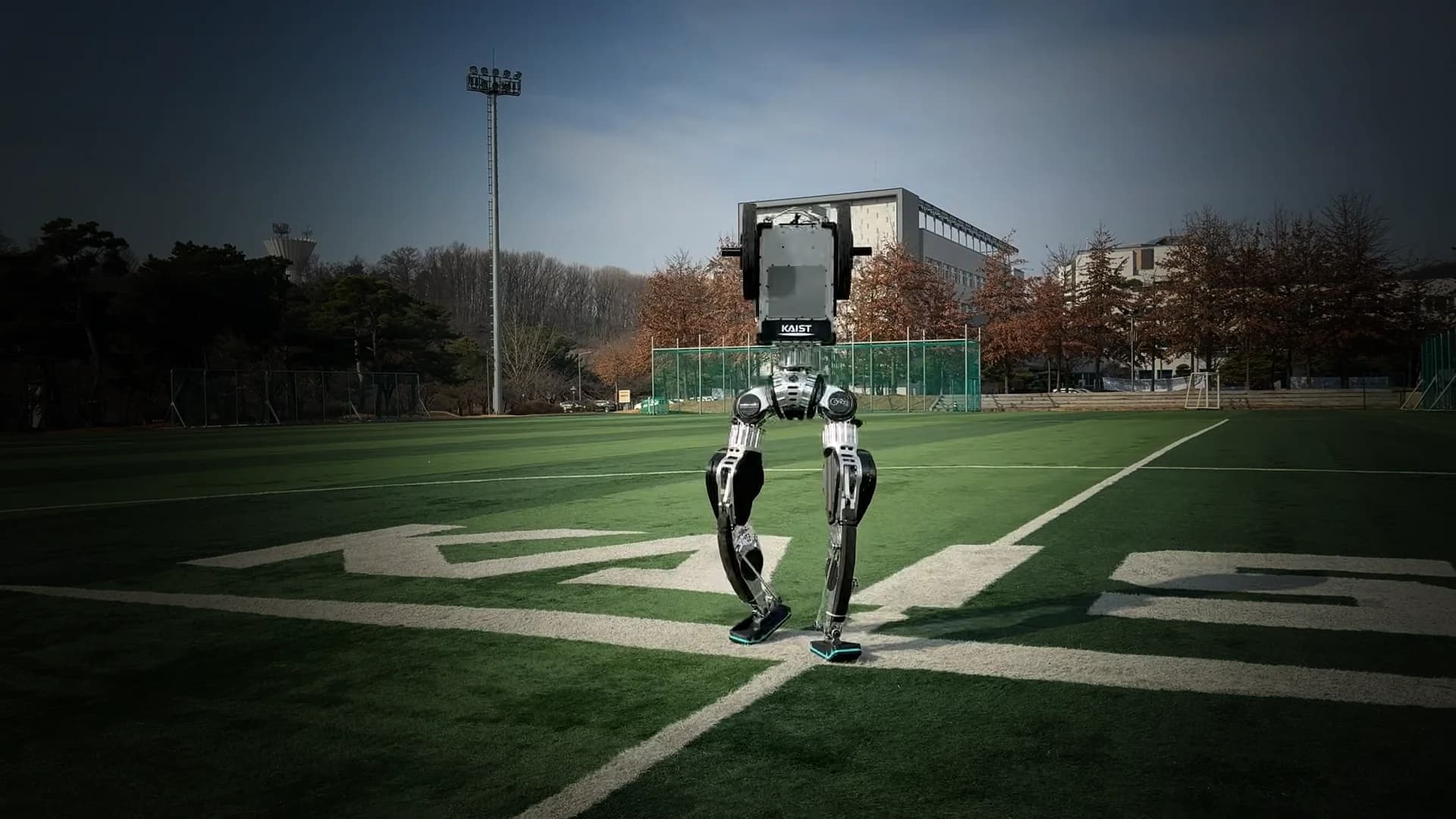
KAIST’s latest humanoid update puts its strength to work: Humanoid v0.9 pushes objects weighing up to 35 kg and lifts objects up to 20 kg, according to a new demonstration released on October 19. The robot uses onboard visual feedback as it handles objects to arrange the letters “KAIST.”
- KAIST Humanoid v0.9 demonstrates pushing objects up to 35 kg and lifting objects up to 20 kg.
- DRCD Lab developed the humanoid in collaboration with RAILAB, which developed its arms.
- The update combines onboard visual feedback with interaction skills developed through deep reinforcement learning and learning from human demonstrations.
From the Moonwalk to moving loads
The new video, titled Whole-Body Locomanipulation with KAIST Humanoid v0.9, shifts attention toward coordinating movement and object handling. KAIST credits its Dynamic Robot Control & Design Laboratory, or DRCD Lab, and arm-development collaborator RAILAB.
It builds on the platform we covered in KAIST Humanoid v0.7: High-Speed Locomotion and the “Moonwalk” of Technical Independence. That update emphasized agile locomotion and the team’s development of core hardware in-house. The lab’s platform page describes the humanoid as a full-size robot for dynamic locomotion with a custom actuator system.
The new demonstration brings manipulation into that picture. Whole-body locomanipulation means coordinating balance, body movement and contact with objects: applying force through the arms also changes the demands on the legs and torso.
The weekly humanoid robotics briefing
One email a week: the launches, funding and research that mattered, with context from Humanoids Daily.
Read recent issuesTwo different measures of strength
The pushing and lifting figures describe different tasks. Moving a 35 kg object along a surface does not require supporting its entire weight, and the resistance depends on the contact conditions. The 20 kg lifting demonstration therefore provides a separate measure of the robot’s handling capability.
KAIST says the interaction skills were developed through deep reinforcement learning and human demonstration-based learning. The video description does not detail how those methods are combined or how tasks are commanded, so onboard visual feedback alone should not be read as evidence of unrestricted autonomy.
For now, the update shows the research platform extending from agile movement into visually guided physical work. It does not establish a commercial payload rating or sustained performance across repeated industrial tasks.
Share this article
Read next
- Published on
- Reading time
- 3 min read
T-Robotics to Lead KRW 4.5 Billion Humanoid Project for Korean Display Factories
- Published on
- Reading time
- 5 min read
KAIST Humanoid v0.7: High-Speed Locomotion and the "Moonwalk" of Technical Independence
- Published on
- Reading time
- 4 min read
Boston Dynamics Says Atlas Takes a Day to Build—and Wants to Cut That to an Hour
- Published on
- Reading time
- 3 min read
South Korea Approves 20-Robot Robros Trial Across Industrial Sites
- Published on
- Reading time
- 2 min read
Boston Dynamics Names Former Amazon AI Leader Rohit Prasad as CEO
- Published on
- Reading time
- 4 min read
Boston Dynamics Gives Atlas Four-Finger Hands Built for Tools and AI Training

The weekly humanoid robotics briefing
One email a week: the launches, funding and research that mattered, with context from Humanoids Daily.
Read recent issues