- Published on
Lumos Says NexCore Can Teach Robots New Skills in Days
One tap, and our reporting appears more often in your Google Top Stories. It makes a real difference to a small newsroom.

Supported by RoboStrategySupport for Humanoids Daily comes from RoboStrategy
Sponsored
Investing involves risk, including possible loss of principal. Read the prospectus before investing.
- Lumos says NexCore can shorten development of new robot skills from weeks to days by combining task definition, training, evaluation and deployment.
- Its MOS 2 wheeled dual-arm robot is the main hardware platform, with production data fed back into further training.
- The company cites Mitsubishi Electric applications and task success rates of up to 99%, but the release provides no detailed test methodology or task-by-task results.
Lumos Robotics says its NexCore platform can cut the time needed to develop a new robot skill from weeks to days, targeting the engineering work that makes each additional factory deployment expensive.
In a press release shared with Humanoids Daily, the company describes a system that brings task definition, data collection, model training, evaluation and deployment into one workflow. The pitch is that adapting a robot to another workpiece or production task should become a repeatable process, with less specialist intervention each time.
NexCore was already part of Lumos’s World Robot Conference showcase in August. The latest release expands on its intended role in turning industrial experience into reusable skills.
From a task description to a deployable skill
According to Lumos, users can describe a task in natural language, bring together real-world, simulation and video data, train candidate skills, evaluate their performance and deploy validated versions. Skills can then be managed and reused across compatible robots and similar tasks.
The weekly humanoid robotics briefing
One email a week: the launches, funding and research that mattered, with context from Humanoids Daily.
Read recent issuesThe company also pitches NexCore to factory users without prior robotics programming or AI development experience. That describes the intended user experience: the underlying process still includes data preparation, model training and validation before a skill reaches a production robot.
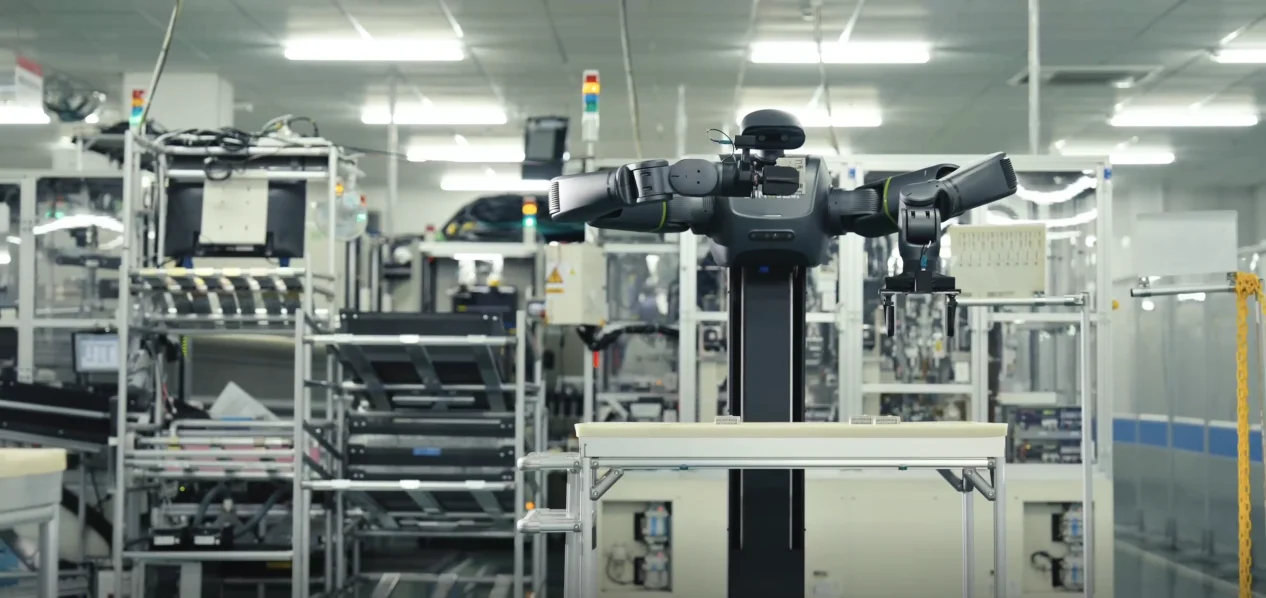
Its primary execution platform is MOS 2, the heavy-duty wheeled dual-arm machine covered in our earlier report on Lumos’s Mitsubishi-backed factory deployments. As robots perform tasks, operational data returns to NexCore for further training, with improved skills subsequently redeployed.
“The key to scaling embodied AI is making the cost of acquiring a new skill low enough,” founder and CEO Yu Chao said in the release. “Our goal is to make robotic skills producible at scale.”
Mitsubishi applications, with limited performance detail
Lumos says NexCore has been validated through its ongoing collaboration with Mitsubishi Electric, spanning inspection, assembly, sorting and material handling. The release describes an expansion from programmable logic controller inspection into tasks including box pushing and screwdriving.
It reports that MOS 2 robots have reached success rates of up to 99% across multiple tasks through continued training on production data. However, it does not identify the result for each task, the number of attempts, the definition of success or how human interventions were counted.
The development-time claim is similarly broad. The release does not provide a worked comparison showing which skill previously took weeks, how many days NexCore required, or what data, compute and engineering support were available. Pricing and a detailed compatibility list are also absent.
Making collected data useful on the factory floor
NexCore addresses the next step in a process explored in our UMI Effect feature: collecting demonstrations is valuable only if those recordings can be turned into reliable robot behavior. Lumos already offers robot-free data collection systems and a data marketplace, putting NexCore alongside a broader effort to supply both training inputs and the tools that use them.
For factory customers, the meaningful test will be how much work remains when a product, tool or workstation changes. Evidence that NexCore can reduce that adaptation effort while maintaining production reliability would give the weeks-to-days claim commercial weight.
Share this article
Read next
- Published on
- Reading time
- 2 min read
Apptronik Launches Elevate Robotics for "Superhuman" Industrial Automation
- Published on
- Reading time
- 5 min read
Lumos Robotics Unveils MOS 2 Mobile Manipulator Backed by Mitsubishi Factory Deployment
- Published on
- Reading time
- 4 min read
Lumos Robotics Launches Project EDGE, Offering 100 Free Humanoids to Developers
- Published on
- Reading time
- 6 min read
Figure’s Helix 2.5 Takes on Chores in 30 Unseen Homes
- Published on
- Reading time
- 3 min read
XPENG’s XPACE Trains IRON With Human Videos and Simulated Mistakes
- Published on
- Reading time
- 4 min read
Don’t Forget the Salt: Physical Intelligence Equips Robots with 15-Minute "Multi-Scale" Memory

The weekly humanoid robotics briefing
One email a week: the launches, funding and research that mattered, with context from Humanoids Daily.
Read recent issues