- Published on
NVIDIA Buys Hugging Face for $12.9B as Open-Source Robotics Scales Up
One tap, and our reporting appears more often in your Google Top Stories. It makes a real difference to a small newsroom.


Your guide
Rich Robinson
Jee Chee Ren · Executive tour
See China’s AI and robotics ecosystem first-hand.
Six days exploring AI, robotics and advanced manufacturing.
With Rich Robinson, Clinical Professor of Entrepreneurship at Peking University
Beijing · Guangzhou · Shenzhen
29 November–4 December 2026
Referral partnership · We earn a commission on referred bookings.
- NVIDIA has announced a definitive agreement to acquire Hugging Face in an all-cash and stock deal valued at $12,930,300,000.
- Hugging Face will remain an open, hardware-agnostic platform, preserving support for multi-cloud environments, open-weight models, and third-party compute accelerators.
- The acquisition tightens NVIDIA’s grip on the open-source physical AI ecosystem, expanding on prior initiatives to integrate Isaac GR00T and Cosmos into LeRobot.
- The deal lands alongside the viral rollout of Microduck, a $399 bipedal learning platform developed by Hugging Face’s in-house team at Pollen Robotics.
- By marrying NVIDIA’s massive compute infrastructure with Hugging Face’s developer community, the transaction shifts the physical AI arms race toward open, reproducible robot learning.
NVIDIA has agreed to acquire Hugging Face for $12.93 billion, marking one of the largest acquisitions in artificial intelligence history. The deal unites the world's dominant AI compute provider with the central watering hole for open-weight models, code, and datasets—a platform hosting over 18 million developers, 3 million models, and 200,000 corporate teams.
Both companies emphasize that Hugging Face will continue to operate as an independent, open platform. Developers will retain the freedom to run models across multi-cloud environments, deploy using non-NVIDIA accelerators, and distribute open weights from any model provider.
"Hugging Face will remain an open platform for the entire AI ecosystem," NVIDIA founder and CEO Jensen Huang said in the announcement. "NVIDIA compute will not be required to build on or deploy through Hugging Face."
Hugging Face CEO Clément Delangue framed the sale as a calculated step to scale open alternatives to proprietary frontier labs. "Open-source AI is at an inflection point," Delangue said. "Thanks to the community, we’ve shown that it can be a complement, and even an alternative, to closed-source APIs. But for it to happen at larger scale, it needs more compute, more support, more collaboration and more visibility."
The weekly humanoid robotics briefing
One email a week: the launches, funding and research that mattered, with context from Humanoids Daily.
Read recent issuesWhile the acquisition commands Wall Street's attention for its language and multimodal implications, its deepest long-term disruption may lie in embodied artificial intelligence. Over the past two years, Hugging Face has quietly transformed itself into a vital proving ground for physical AI—a push that now dovetails directly into NVIDIA’s robotics ambitions.
From LeRobot to Physical Infrastructure
The buyout represents the culmination of a rapidly warming alliance. Only two months ago, NVIDIA and Hugging Face partnered to standardize open-source robotics workflows by embedding Isaac GR00T 1.7, Isaac Teleop, and Isaac Lab simulation environments directly into Hugging Face’s LeRobot library.
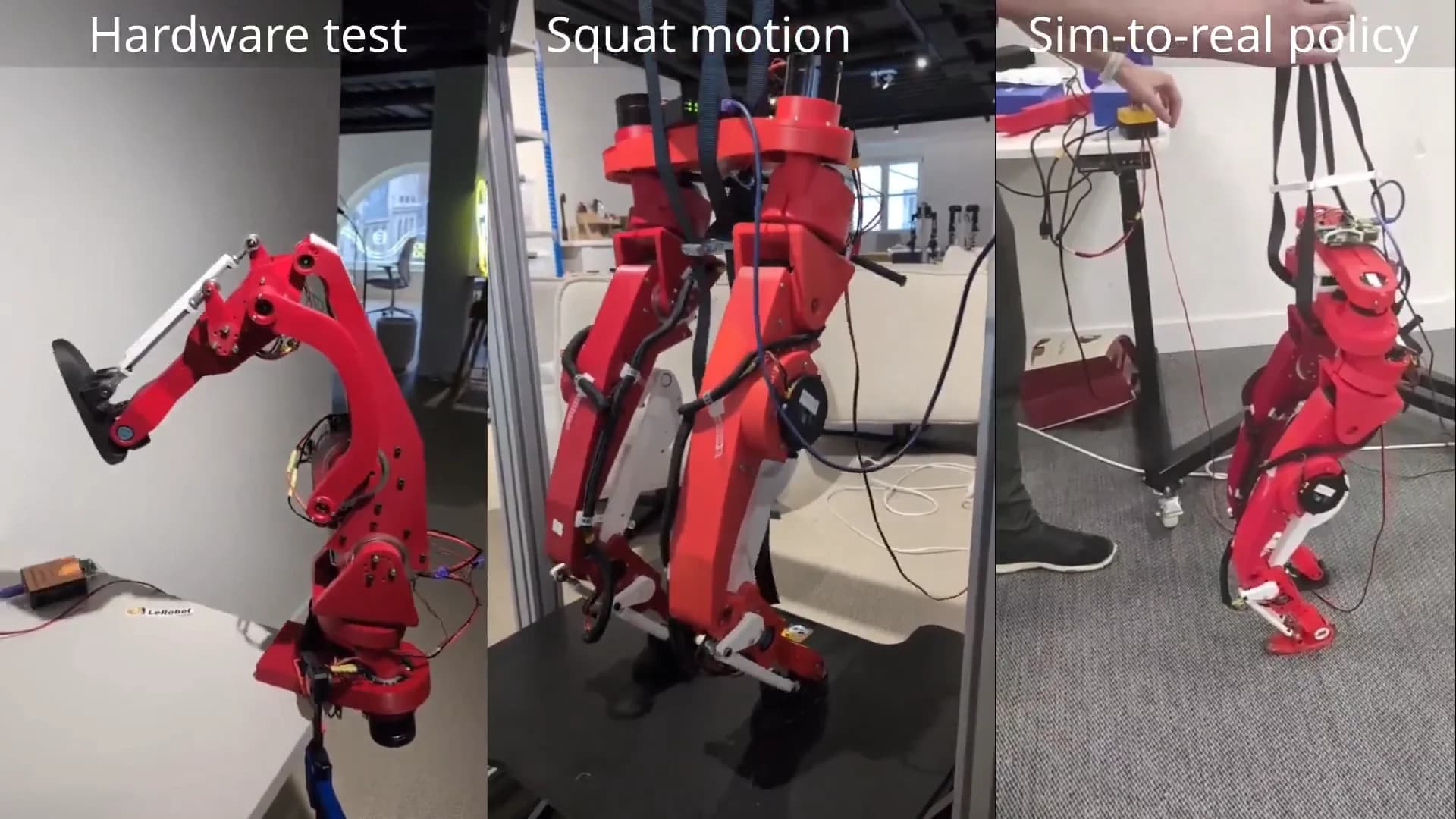
LeRobot has quickly emerged as the de facto open-source operating layer for robotics research, systematically taking on data storage and policy execution. From hosting massive household teleoperation repositories like HIW-500 to prototyping accessible hardware like the $2,500 3D-printed LeRobot Humanoid, the platform has tackled the physical data bottleneck from the grassroots up.
By taking ownership of Hugging Face, NVIDIA secures native distribution across these workflows. Rather than competing with community standards, NVIDIA can now funnel LeRobot datasets, teleoperation logs, and reinforcement learning scripts straight into its Blackwell-driven Jetson Thor systems and Isaac simulation stacks.
Microduck: The $399 Sim-to-Real Sandbox
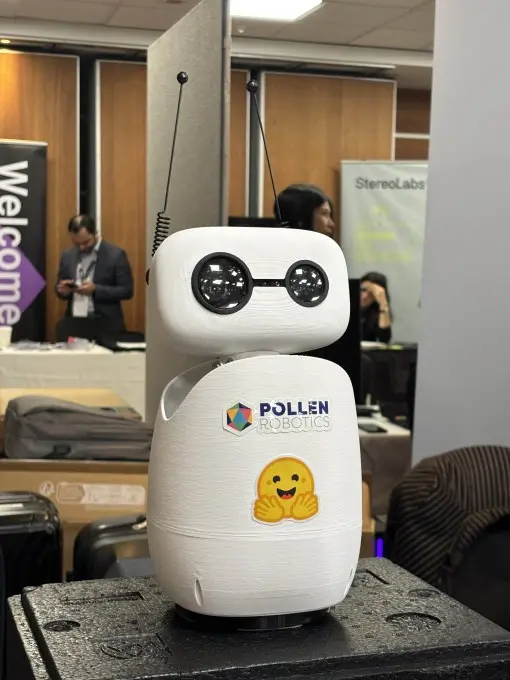
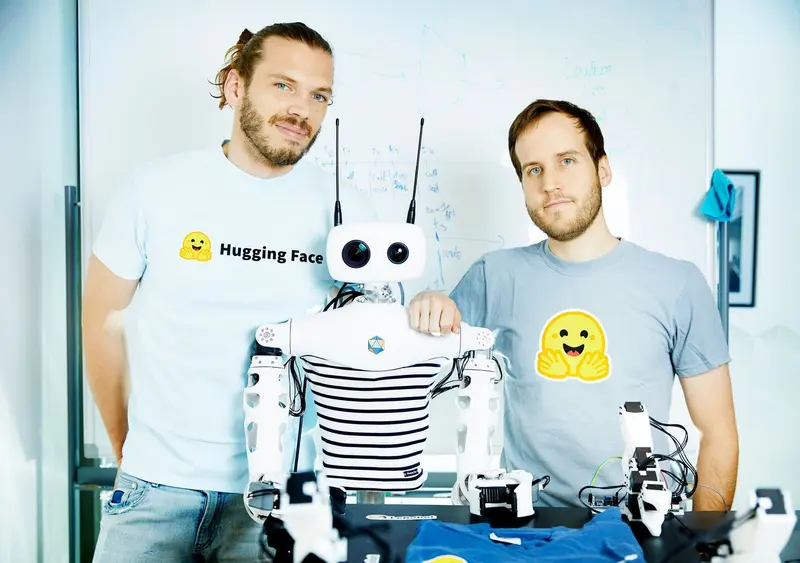
Nowhere is Hugging Face’s embodied ambition clearer than in its hardware ventures. While industrial developers deploy million-dollar clusters to train full-scale humanoids, Hugging Face’s hardware arm—Pollen Robotics, which the company acquired in early 2025—has taken a decidedly different approach to embodied research.
Enter Microduck.
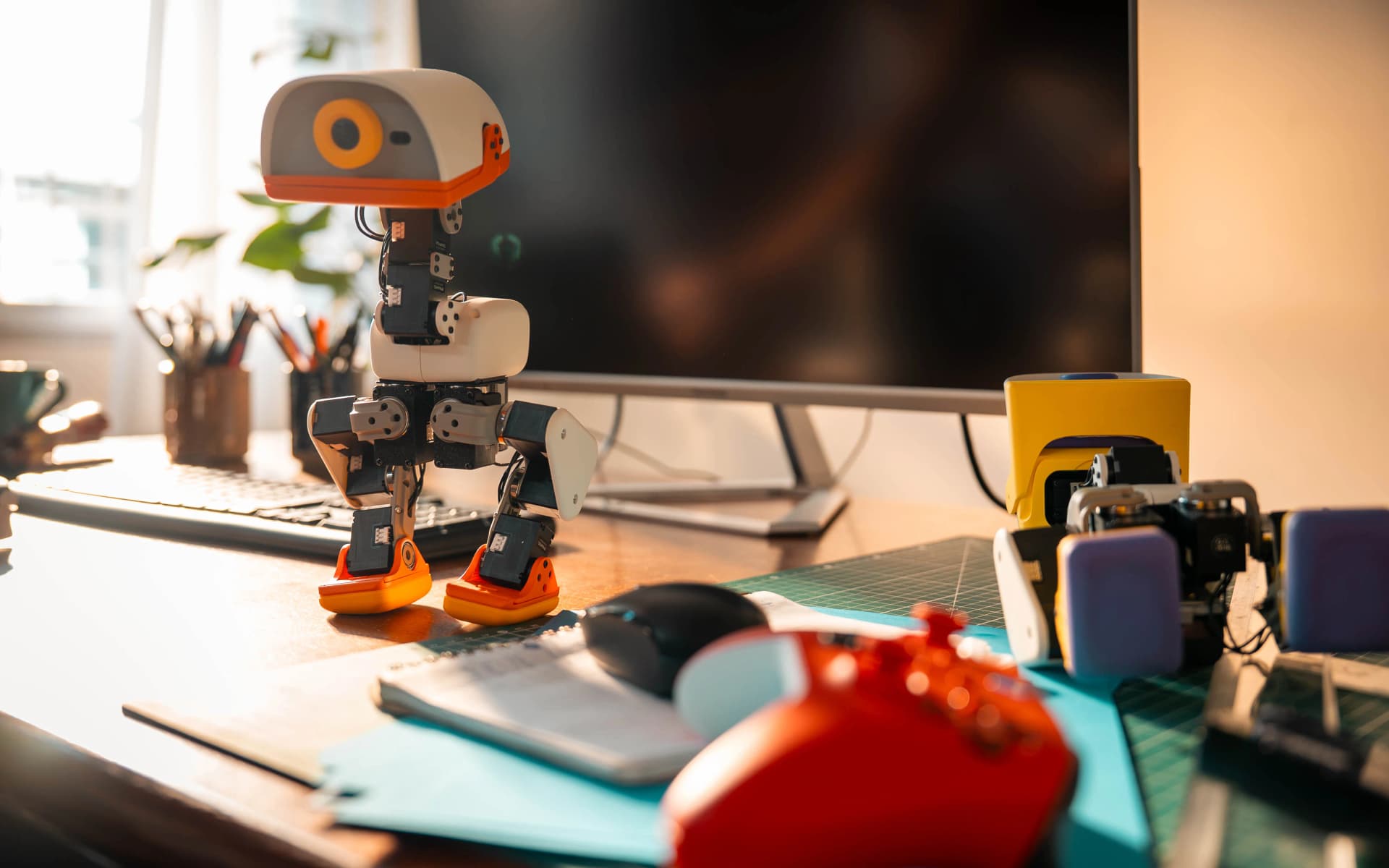
Revealed in late August, the pint-sized biped has captured viral attention across the robotics landscape. Standing just 25 cm tall and weighing under 800 grams, the robot is built around a waddling two-legged gait, an articulated neck, and a functional grasping beak.
Priced at an introductory $399, Microduck is designed to be playable out of the box with a bundled game controller while serving as a full-fledged sim-to-real research testbed.
Despite its toy-like aesthetic and playful colorways (Cream, Graphite, Lavender, and Sky), the internal specifications reflect serious engineering:
- Degrees of Freedom: 15 articulated motors distributed across the legs, head, and neck.
- Onboard Compute: A Rockchip RK3566 system-on-chip with dedicated AI acceleration, 1 GB RAM, and 32 GB internal storage.
- Perception Stack: A front-facing RGB camera (complete with a retro REC indicator light), an 8x8 time-of-flight compact LiDAR sensor, and two IMUs situated in the body and head.
- Physical Interaction: An articulated beak for pick-and-place manipulation, accompanied by dual NFC antennas in the head and beak for object identification.
- Power: Removable NP-F550 camera batteries (2,600 mAh) delivering roughly an hour of continuous runtime.
Crucially, Pollen Robotics is pairing the physical duck with an open-source reinforcement learning pipeline. The robot runs a 50 Hz onboard policy loop and ships with seven pre-trained behaviors, including the ability to waddle, crouch, sit, roller-skate, and independently recover from common falls.
Pollen is releasing the simulation assets, gym environments, and sim-to-real workflows on GitHub ahead of deliveries targeted before Christmas 2026. While the mechanical CAD files remain proprietary—meaning it is not fully open-source hardware—the software stack is entirely open for modification.
Redefining the Robotics Bottleneck
Microduck highlights an increasingly popular thesis within robot learning: you do not need a $50,000 full-scale humanoid to make algorithmic breakthroughs in locomotion and dynamic balance.
Earlier this year, Hugging Face challenged the high cost of physical hardware with projects like HOPEJr and Reachy Mini. Microduck scales down that accessibility even further. By dropping the entry threshold for a dynamic biped to $399, Pollen Robotics allows academic labs, students, and independent developers to train reinforcement learning policies in simulation and test them on physical hardware in their living rooms.
Under NVIDIA’s umbrella, that sim-to-real loop could accelerate dramatically. NVIDIA's simulation engines, such as Isaac Sim, have long specialized in high-throughput physics modeling for locomotion and tactile feedback. Hooking LeRobot’s training gym and accessible hardware directly into NVIDIA’s distributed compute could turn millions of student and hobbyist interactions into a compounding data flywheel.
Open Weights vs. Closed Humanoids
The acquisition also establishes a distinct counterweight to the increasingly vertically integrated, closed-door humanoid labs. Competitors like Figure AI are spending hundreds of millions to build proprietary pipelines—crowdsourcing millions of hours of human labor via platforms like Index to train models like Helix—while Sunday Robotics iterates on in-house data gloves to perfect domestic chores.
NVIDIA is pursuing the opposite route: selling the compute layer to everyone while owning the open commons where the world's roboticists collaborate.
Maintaining community trust will be the central test of the deal. The robotics ecosystem adopted LeRobot precisely because it offered an escape hatch from vendor lock-in and black-box APIs. If NVIDIA honors its pledge to maintain compute-agnostic infrastructure, multi-accelerator support, and permissive model sharing, Hugging Face could solidify its role as the open foundation of physical AI.
Whether training high-dimensional manipulation policies or teaching a tiny plastic duck to waddle across a desk, the future of open robotics now runs directly through Jensen Huang’s balance sheet.
Share this article
Read next
- Published on
- Reading time
- 4 min read
NVIDIA and Hugging Face Standardize Open-Source Robotics Pipeline via LeRobot
- Published on
- Reading time
- 4 min read
Hugging Face Introduces Open-Source Humanoid HOPEJr and Desktop Robot Reachy Mini
- Published on
- Reading time
- 4 min read
Hugging Face Acquires Pollen Robotics, Eyes Open Source Future for Humanoid Hardware
- Published on
- Reading time
- 4 min read
Humanoid Robotics Momentum: London and Shanghai Host Major Industry Summits Concurrently
- Published on
- Reading time
- 4 min read
Hugging Face Drops a $2,500 3D-Printed Humanoid for Open Robot Learning
- Published on
- Reading time
- 4 min read
NEURA Robotics, SAP, and NVIDIA Partner to Bring Business AI to Physical Robots
The weekly humanoid robotics briefing
One email a week: the launches, funding and research that mattered, with context from Humanoids Daily.
Read recent issues