- Published on
ShengShu Technology Unveils Motubrain: A Unified "World Action Model" to Solve the Robotics Scaling Problem
One tap, and our reporting appears more often in your Google Top Stories. It makes a real difference to a small newsroom.


Your guide
Rich Robinson
Jee Chee Ren · Executive tour
See China’s AI and robotics ecosystem first-hand.
Six days exploring AI, robotics and advanced manufacturing.
With Rich Robinson, Clinical Professor of Entrepreneurship at Peking University
Beijing · Guangzhou · Shenzhen
29 November–4 December 2026
Referral partnership · We earn a commission on referred bookings.
- ShengShu Technology has launched Motubrain, a "World Action Model" (WAM) designed to serve as a unified robotic brain for diverse hardware embodiments.
- The model leverages Mixture-of-Transformers architecture to jointly learn video generation, world modeling, and action control, achieving a 13.55x increase in data efficiency over traditional methods.
- Motubrain currently ranks top three on the WorldArena benchmark and RoboTwin 2.0, where it is the only model to exceed a 95% success rate in randomized environments.
- Backed by a $293 million Series B led by Alibaba Cloud, the startup is positioning Motubrain as a hardware-agnostic "intelligence layer" for industrial, commercial, and home robotics.
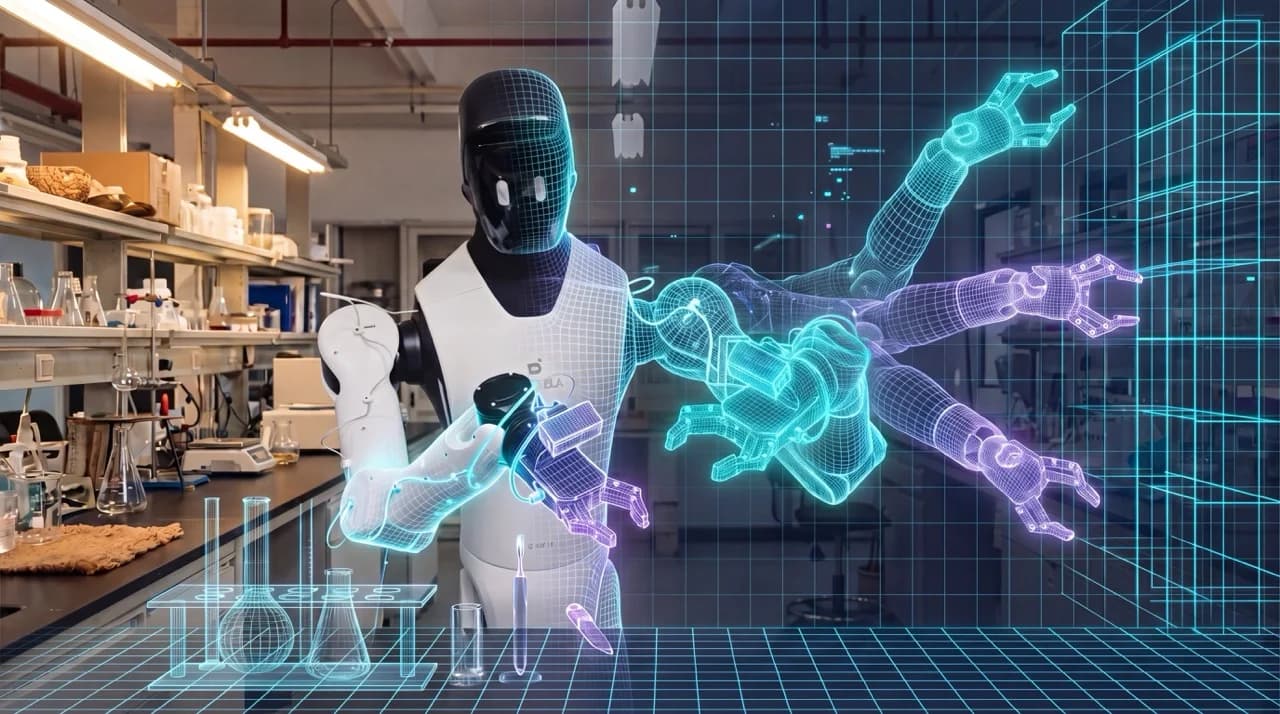
In the rapidly evolving landscape of Physical AI, the industry has long struggled with a "fragmentation tax"—the need to build bespoke models for every new task or robot chassis. Today, Beijing-based ShengShu Technology aims to consolidate that effort with the unveiling of Motubrain, a general-purpose World Action Model (WAM) that unifies "seeing" and "doing" within a single architectural framework.

The announcement follows a significant $293 million (2 billion yuan) Series B funding round led by Alibaba Cloud, with participation from Baidu Ventures and Luminous Ventures. This capital injection, reported earlier this month, is being funneled directly into the development of what ShengShu calls a "Unified Multimodal Model" that can anticipate environmental changes while driving physical action in real-time.
Beyond the "VLA Crutch"
Lately the robotics field has been dominated by Vision-Language-Action (VLA) models. These systems, such as Physical Intelligence's π0.7, often graft an action-output head onto a pre-trained language brain. While effective for semantic reasoning, critics—including Yann LeCun—have argued that these models lack "intuitive physics."
Motubrain represents a shift toward the visual imagination strategy championed by firms like NVIDIA. Built on a three-stream Mixture-of-Transformers (MoT) architecture, Motubrain treats video and action as continuous, linked modalities. By leveraging the same generative foundations as ShengShu’s flagship video platform, Vidu, the model can "dream" a future state and then execute the inverse dynamics required to make that state a reality.
Follow humanoid robotics without following every announcement.
Get the week’s most important launches, funding and research—and why they matter—in one email from Humanoids Daily.
Once a week. Unsubscribe anytime.
Read recent issuesScaling Through Task Complexity
Perhaps the most striking data point from Motubrain’s release is its performance scaling. While VLA models often see performance degradation as task variety increases—a phenomenon known as overfitting—Motubrain displays a positive scaling trend.
In task-scaling evaluations, Motubrain’s average success rate rose to 92% at 50 tasks, outperforming Pi-0.5 by approximately 37%. ShengShu attributes this to the model's ability to ingest heterogeneous data, including unlabeled internet video and human demonstrations, rather than relying solely on scarce, teleoperated robot data. This allows the model to handle long-horizon tasks involving up to 10 "atomic actions".
Hardware Agnosticism and Real-World Deployment
The robotics industry is currently witnessing a convergence of "brain" and "body", but ShengShu is betting on a decoupled, hardware-agnostic future. Motubrain is designed to be a universal intelligence layer, capable of transferring skills across different robot types without full retraining.
The model is already operational in training programs for several robotics firms, including Astribot, SimpleAI, and Anyverse Dynamics. In real-world tests, Motubrain-trained robots have demonstrated emergent "retry" behaviors. For example, a robot attempting to scoop a ladle will automatically recognize if it comes up empty and re-attempt the action, despite never being explicitly trained on failure recovery data.
Benchmarking the "Physical Common Sense"
To validate its claims, ShengShu pointed to top-tier rankings on two critical benchmarks:
- WorldArena: Motubrain is high up on the global rankings with a 63.77 EWM Score, measuring its ability to understand physical prediction and reasoning.
- RoboTwin 2.0: The model achieved an average success rate of 96.0% across 50 tasks. Notably, it is the only model on the leaderboard to maintain a score above 95% in randomized environments, where lighting and object positions are shifted.
While the "reactivity gap"—the latency between imagining a future and acting upon it—remains a hurdle for the wider world model category, Motubrain’s integration of high-speed video priors suggests a path toward real-time, "common sense" robotics.
Share this article
Follow humanoid robotics without following every announcement.
Get the week’s most important launches, funding and research—and why they matter—in one email from Humanoids Daily.
Once a week. Unsubscribe anytime.
Read recent issuesRead next
- Published on
- Reading time
- 6 min read
NVIDIA Keynote: Cosmos 3 Realizes the "World Action Model" End Game
- Published on
- Reading time
- 5 min read
From Representation to Reality: AGIBOT Unveils Genie Envisioner 2.0 as a Scalable “World Simulator”
- Published on
- Reading time
- 5 min read
1X Goes "All In" on World Models, Hires Luma AI’s Samarth Sinha Amid Leadership Reshuffle
- Published on
- Reading time
- 4 min read
Yann LeCun Predicts "Paradigm Shift" in Robotics by 2027, Dismisses LLMs as "Intrinsically Unsafe"
- Published on
- Reading time
- 5 min read
The World Model Taxonomy: Decoding the Ambiguous Engine of Physical AI
- Published on
- Reading time
- 4 min read
NVIDIA Open-Sources DreamDojo: A 44,000-Hour "Dream" to Solve the Robotics Data Gap