- Published on
The Shape of Scale: New Figure Production Data Hints at Exponential Ramp-Up
One tap, and our reporting appears more often in your Google Top Stories. It makes a real difference to a small newsroom.


Your guide
Rich Robinson
Jee Chee Ren · Executive tour
See China’s AI and robotics ecosystem first-hand.
Six days exploring AI, robotics and advanced manufacturing.
With Rich Robinson, Clinical Professor of Entrepreneurship at Peking University
Beijing · Guangzhou · Shenzhen
29 November–4 December 2026
Referral partnership · We earn a commission on referred bookings.
- Figure CEO Brett Adcock shared a production chart showing a massive manufacturing acceleration starting in February 2026 at the BotQ facility.
- While the Y-axis lacks explicit labels, analysts estimate April 2026 production reached approximately 150 units, a sharp increase from single-digit monthly outputs in 2025.
- This ramp-up supports Figure’s goal of achieving 24/7 autonomous operations and total supply chain decoupling by summer 2026.
- The surge coincides with the transition to the Figure 03, which utilizes high-volume tooling like die-casting to reduce costs by 90%.
Figure CEO Brett Adcock has released a new look at the company’s internal momentum, posting a production chart that illustrates a "hockey stick" growth curve for the California-based robotics firm. The graph, captioned "Humanoid robots manufactured at Figure by month," tracks the company's output from June 2023 through April 2026, revealing a dramatic pivot from research-level prototyping to industrial-scale manufacturing.
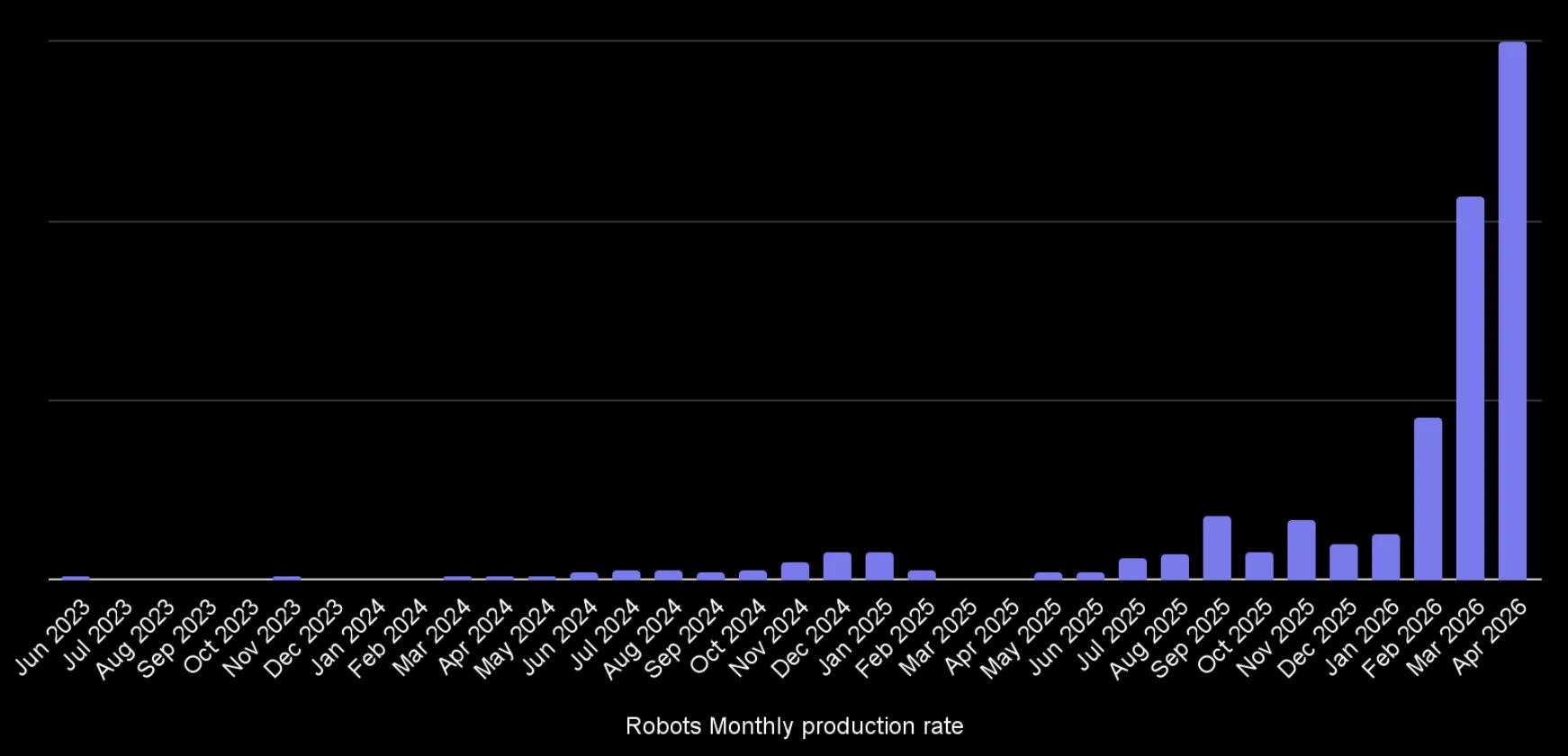
While the chart provides a clear visual of Figure's trajectory, it notably lacks a labeled Y-axis, keeping the exact number of units produced under wraps. This omission has sparked a wave of digital forensics within the robotics community as observers attempt to quantify Figure’s current "run rate."
The "150 Unit" Theory
Despite the missing legend, the community was quick to apply relative scaling to the data. X influencer @CernBasher posted a detailed breakdown of the chart, suggesting that Figure's production hit approximately 150 units in April 2026 alone.
This estimation is based on the relative height of the bars. If the single-digit outputs seen throughout late 2024 represent early Figure 02 prototypes, the vertical surge in February and March 2026 suggests a transition to the Figure 03 assembly line. While Adcock has not verified these specific figures, the scale of the bars suggests that Figure manufactured more robots in the last 60 days than in its entire three-year history combined.
The weekly humanoid robotics briefing
One email a week: the launches, funding and research that mattered, with context from Humanoids Daily.
Read recent issuesHardware Built for the "BotQ" Era
The timing of this acceleration aligns perfectly with Figure’s recent milestones at its BotQ facility. In April 2026, Adcock claimed the plant was already producing a robot every 90 minutes. Unlike previous iterations, the Figure 03 was designed specifically for mass production, replacing expensive CNC-machined parts with die-cast components and injection molding.
This hardware maturation is a prerequisite for Figure’s broader "Software 2.0" ambitions. To train the Helix 02 architecture—which computes torque directly from pixels—the company requires a massive fleet of identical machines to gather real-world data. A sudden influx of 150+ robots per month would provide the necessary "compute-in-the-loop" required to solve room-scale autonomy.
Scaling Toward 50,000 Units
While 150 units a month is a significant milestone for a $39 billion startup, it is only the first step in an aggressive roadmap. Figure has previously stated its intention to reach an initial capacity of 12,000 units per year, with a long-term target of 50,000.
If the current trajectory holds, the challenge for Figure will shift from "how do we build them?" to "how do we maintain them?"One answer is the recently unveiled Vulcan, Figure’s AI balance policy that allows robots to autonomously limp to repair bays. As the fleet expands into the hundreds and eventually thousands, "self-triage" becomes a mathematical necessity to prevent the Sunnyvale facility from becoming a graveyard for broken actuators.
For now, Figure appears to be among the leaders of the "Numbers War" in the domestic humanoid race, even as competitors like Unitree push for lower-cost, high-volume entries from overseas. The next six months will determine if Figure can sustain this vertical climb or if supply chain decoupling hurdles will level out the curve.
Share this article
Read next
- Published on
- Reading time
- 2 min read
Figure’s Humanoid Has Walked 348 Miles on a Treadmill—and It’s Still Going
- Published on
- Reading time
- 6 min read
Figure CEO Brett Adcock Claims Humanoids Are Already Delivering ROI Amid Severe Labor Shortages
- Published on
- Reading time
- 4 min read
Stepping Up: Figure 03 Achieves Autonomous Ladder Climbing, Reigniting the Bipedal Debate
- Published on
- Reading time
- 4 min read
A Golden Milestone: Figure Manufactures Its 1,000th Figure 03 Humanoid
- Published on
- Reading time
- 4 min read
Figure AI Pops Champagne as Autonomous Marathon Crosses 200 Hours Without Hardware Failure
- Published on
- Reading time
- 5 min read
Man vs. Machine: Figure AI Intern Edges Out Humanoid Fleet in 10-Hour Sorting Challenge


The weekly humanoid robotics briefing
One email a week: the launches, funding and research that mattered, with context from Humanoids Daily.
Read recent issues