- Published on
The $1,688 Appliance Bet: Nori Robotics Launches Wheeled Bimanual Manipulator
One tap, and our reporting appears more often in your Google Top Stories. It makes a real difference to a small newsroom.


Your guide
Rich Robinson
Jee Chee Ren · Executive tour
See China’s AI and robotics ecosystem first-hand.
Six days exploring AI, robotics and advanced manufacturing.
With Rich Robinson, Clinical Professor of Entrepreneurship at Peking University
Beijing · Guangzhou · Shenzhen
29 November–4 December 2026
Referral partnership · We earn a commission on referred bookings.
- San Francisco startup Nori Robotics has launched the Nori A3, a 19-DoF wheeled bimanual manipulator priced at $1,688—substantially undercutting existing domestic robotics platforms.
- While marketed as an autonomous household assistant, the company's academic papers and open-source documentation detail an experimental developer platform with early-stage perception and navigation stacks.
- The A3 joins a domestic hardware trend that abandons legs for wheeled bases, placing Nori in direct philosophical contrast with well-funded competitors like Sunday Robotics and Weave Robotics.
- Newly released wire protocol specifications reveal a previously undisclosed predecessor fleet (L2) with permanently frozen firmware, as well as a local-first data recording pipeline built on Hugging Face infrastructure.
- Launching weeks after the FCC expanded its Covered List to restrict foreign advanced robotics, Nori emphasizes domestic assembly while navigating global supply chain dependencies.
In the consumer robotics sector, price tags typically resemble automobile invoices rather than home utility bills. San Francisco-based Nori Robotics is attempting to upend that dynamic with the commercial debut of the Nori A3, a 19-degree-of-freedom (DoF) bimanual mobile manipulator retailing for $1,688.
Emerging from Y Combinator’s Summer 2026 cohort, the five-person startup—founded by Columbia University robotics researcher Antonio Sitong Li—frames the domestic robot challenge strictly as an economic problem rather than an intelligence bottleneck. The company argues that modern lab manipulators are capable enough for basic household utility, but fail to enter homes because they are priced out of reach.
However, a close examination of Nori’s technical papers, newly open-sourced software development kits (SDKs), and wire protocol repositories indicates that the A3 is less of a turn-key household maid and more of a radically low-cost developer platform navigating the severe engineering trade-offs required to reach a four-figure price point.
Defining the Embodiment: Wheels Over Bipeds
While several mainstream outlets have categorized the A3 as a budget "humanoid," the physical system avoids bipedal locomotion entirely. The A3 features a compact 45 × 45 cm wheeled mobile base supporting a three-stage telescoping column that extends from 69 cm to 145 cm. Mounted to this torso are a pan-tilt sensor head and two 55 cm arms providing 7+1 DoF each.
The weekly humanoid robotics briefing
One email a week: the launches, funding and research that mattered, with context from Humanoids Daily.
Read recent issues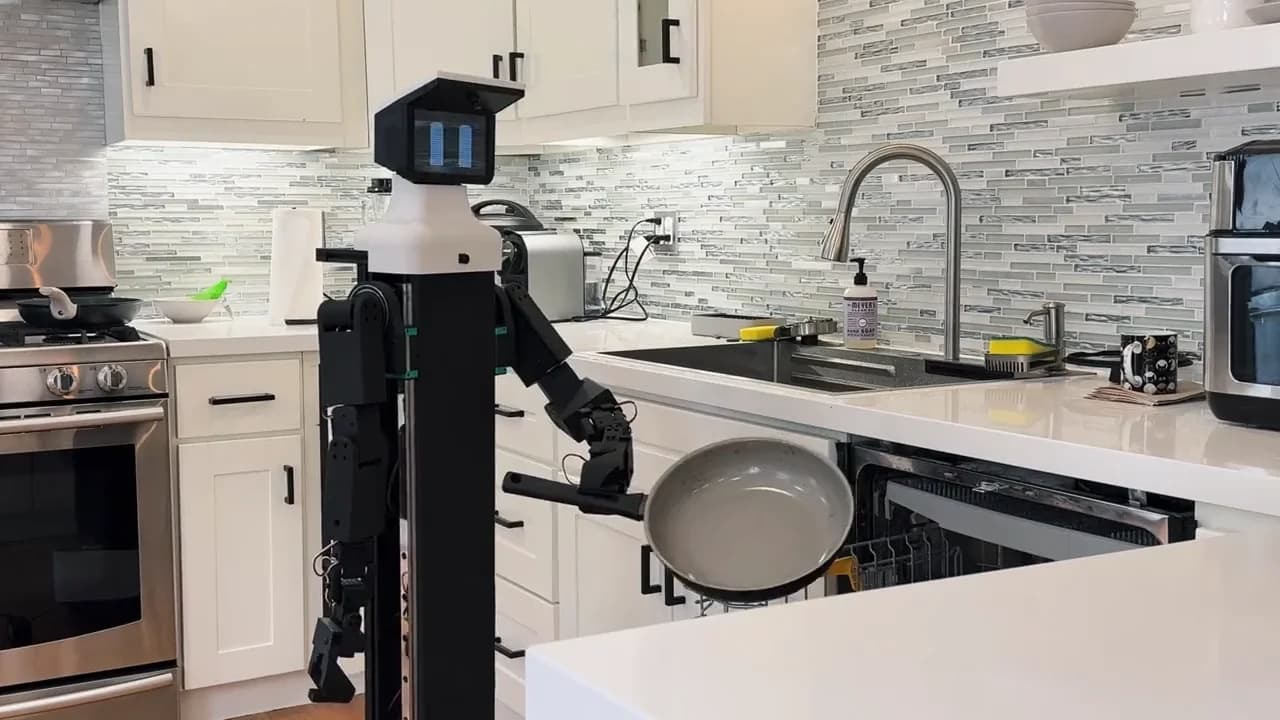
Early coverage of the machine has frequently conflated its mechanical payload specifications. The A3 features a column lift rating of 55 kg (roughly 122 pounds)—a measure of the linear actuator's vertical travel capacity—while the individual arms are rated for a payload of 1.5 kg each.
To keep the bill of materials low and maximize operating life to an advertised 6 to 8 hours, Nori opted for an aggressive thin-client compute architecture. The on-robot controller is a single Raspberry Pi 5 (4 GB RAM), intentionally eschewing heavier system-on-chips like the Nvidia Jetson Orin Nano, which the team noted would have substantially increased hardware costs and halved battery runtime.
To achieve compliance without expensive 6-axis force-torque sensors, the robot utilizes 3D-printed thermoplastic polyurethane (TPU) gripper fingers. By monitoring current registers on its Feetech STS3215 serial-bus servos, the system translates motor draw into a continuous grip-force proxy during manipulation tasks.
Transparent Limits in Early Development
While consumer-facing marketing illustrates broad potential use cases—ranging from kitchen assistance to folding clothes—the engineering documentation and academic papers released by the team take a noticeably transparent, disciplined approach to the robot's current limitations.
In the academic preprints detailing the system's architecture (arXiv:2605.16537), the authors are candid about benchmark maturity. Initial demonstrations of Action Chunking with Transformers (ACT)—the imitation learning method pioneered by Stanford researchers—focused on a baseline skill (picking up a small DC motor) evaluated under controlled lighting and clean backgrounds, explicitly framing full multi-skill autonomy as ongoing work rather than a solved capability.
That engineering realism extends across the company's newly open-sourced codebase and Python SDK, released under the Apache-2.0 license:
- Perception Architecture: While client-side caching and data structures are implemented, the on-robot perception pipeline remains in active development; invoking
perceive()currently returns null on live hardware. - Experimental Navigation: SDK documentation for v1.1.0 clearly delineates between simulated and physical testing, cautioning developers that autonomous waypoint navigation is unproven on live machines and recommending an accessible physical E-stop during bench tests.
- Compute-Bounded Video: Due to the processing constraints of software-based x264 encoding on a Raspberry Pi 5, the live WebRTC stream is engineered as a lightweight operator viewfinder (roughly 320×240 resolution per tile at 15 fps) rather than a heavy, high-res vision pipeline.
Rather than obscuring early-stage software rough edges, the engineering repository adopts a public "xfail" test policy to catalog and address divergences between the wire spec and hardware gateways. For a nascent platform operating at a sub-$1,700 price point, this level of documented constraint gives developers an unvarnished look at where the hardware stands today and what remains to be built in the open.
The L2 Predecessor and Fleet Protocol
The A3 is not the startup's first physical build:
- L2 (Nori Bot): A 12-motor system utilizing 5-DoF arms derived from the open-source XLeRobot and SO-101 arm reference designs mounted to an IKEA rolling cart frame. The protocol documentation describes deployed L2 units as a frozen fleet with static, non-updatable firmware that requires client-side steering compensations.
- L3 (Nori A3): The 16-joint, 19-DoF commercial embodiment currently shipping, featuring 7-DoF arms, Cartesian pose targets, and integrated LiDAR streaming.
Interestingly, transitioning from the L2 to the L3 architecture involved specific capability trade-offs: the newer platform dropped full-duplex audio streaming and absolute leader-arm mapping, focusing instead on Cartesian end-effector control and ROS 2 gateway integration.
Comparing the Hardware Iterations
| Metric | L2 (Nori Bot v1) | L3 (Nori A3 v2) |
|---|---|---|
| Degrees of Freedom | 17 DoF (12 motors) | 19 DoF (16 joints) |
| Arm Configuration | 5-DoF + Gripper | 7-DoF + Gripper |
| Hardware Lineage | XLeRobot / SO-101 | Custom Telescoping Column |
| Base Architecture | Modified Rolling Frame | Integrated Wheeled Base |
| Compute Host | Raspberry Pi 4 | Raspberry Pi 5 (4 GB) |
| Retail Price | ~$947 (BOM cost) | $1,688 (Assembled) |
Domestic Assembly Meets Global Supply Chains
Nori’s commercial launch follows significant regulatory shifts in the United States. On July 28, 2026, the FCC’s Public Safety and Homeland Security Bureau expanded its Covered List to restrict equipment authorizations for foreign-manufactured advanced mobile robotics, citing critical supply chain security.
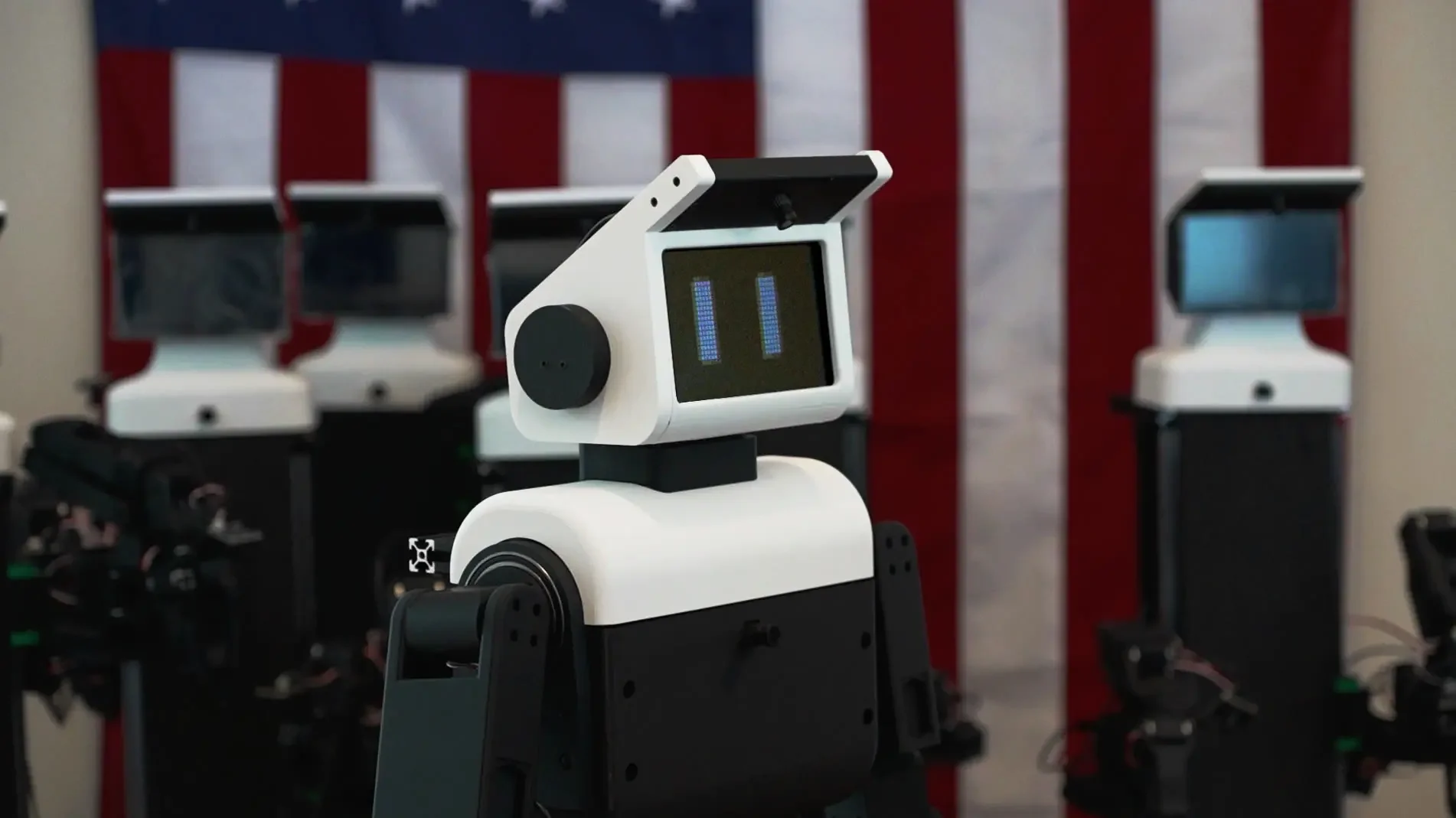
Nori has positioned its San Francisco assembly operations as a central marketing pillar. Nonetheless, maintaining a sub-$1,700 retail price requires reliance on global hardware ecosystems. The A3’s core motion infrastructure utilizes standard imported components, including its serial-bus actuator array and linear drive mechanics.
As regulators define the boundaries between domestic assembly and international component sourcing, Nori's platform provides a functional test case for how accessible, low-margin hardware ventures can scale in an evolving policy climate.
With initial production batches delivered and subsequent shipments scheduled through late 2026, the Nori A3 establishes an intriguing baseline for the robotics industry. Whether thousands of distributed, low-cost manipulators can overcome early-stage perception hurdles remains an open question—but the race to build the personal computer of domestic manipulation is now running on real, shipping hardware.
Share this article
Read next
- Published on
- Reading time
- 3 min read
Nine Minutes to Recharge: Agility Picks Nyobolt for Digit 5’s Long Working Day
- Published on
- Reading time
- 3 min read
Rhoda Blindfolds Its Robot—and Lets Touch Guide the Search
- Published on
- Reading time
- 2 min read
Agility Moves Closer to Nasdaq as Merger Vote Is Set for November 2
- Published on
- Reading time
- 4 min read
Boston Dynamics Says Atlas Takes a Day to Build—and Wants to Cut That to an Hour
- Published on
- Reading time
- 2 min read
Physical Intelligence Opens API Beta for Robot Model Training and Inference
- Published on
- Reading time
- 3 min read
Dynamic Creatures Introduces Hugo, a Furry Character Robot With 43 Actuators
The weekly humanoid robotics briefing
One email a week: the launches, funding and research that mattered, with context from Humanoids Daily.
Read recent issues