- Published on
Aether AI Unveils CRIS-0, a Robot AI System That Checks Its Own Actions
One tap, and our reporting appears more often in your Google Top Stories. It makes a real difference to a small newsroom.

- CRIS-0 combines a causal world model with an agent that selects actions and verifies their outcomes, allowing it to retry or replan when conditions change.
- Aether told Humanoids Daily it used roughly 20,000 hours of pretraining data and only “hours” of robot-specific fine-tuning data.
- The household demonstrations remain controlled tests. The company identifies contact-rich manipulation and generalization to unfamiliar settings as major limitations.
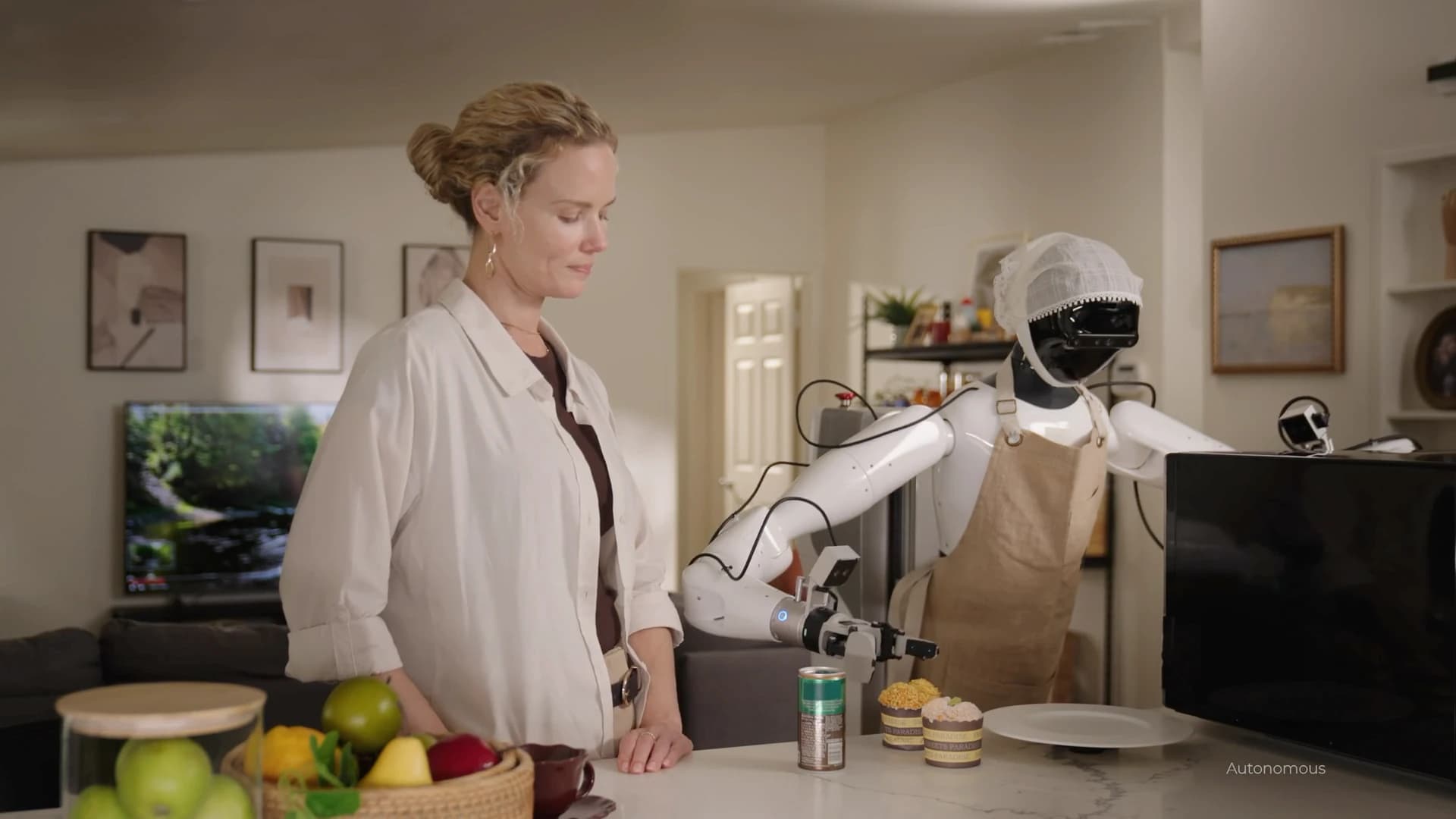
Aether AI has introduced CRIS-0, a robotic intelligence system designed to predict the consequences of its actions, check what actually happened, and change course when reality fails to match the plan. Its first public demonstration brings the company's causal world model and robotic agent together on a robot performing household tasks.
In a written interview with Humanoids Daily, Aether, founded this year by UC San Diego assistant professor Biwei Huang, described the challenge behind that integration: getting a robot to distinguish between completing a movement and achieving the result it intended.
Checking whether an action actually worked
CRIS-0 stands for Causal Robotic Intelligence System. According to Aether, it represents a task through variables describing the environment and relationships describing how those variables change when the robot acts. Its world model predicts possible outcomes, while its agent selects tools and actions. Execution results then feed back into that shared representation.
A technical post Aether published alongside the announcement describes how a new task is set up. CRIS-0 starts from a small set of teleoperated demonstrations and breaks the task into “atomic, verifiable stages,” each checked at runtime by an executable verification script. For each stage, the agent picks a tool: a learned policy for contact-rich manipulation, functions it writes itself using SAM3 segmentation, depth data and inverse kinematics, SLAM-based navigation, or the world model. When a generated function fails, for example because an inverse-kinematics solution violates the robot's joint limits, the system revises it using the error and keeps the corrected version.
The weekly humanoid robotics briefing
One email a week: the launches, funding and research that mattered, with context from Humanoids Daily.
Read recent issuesThe practical purpose is to catch mistakes before they propagate through a longer task. A grasp might appear complete without securely holding an object, for example, or an object might move differently than expected.
“What surprised us most was how different ‘the action completed’ is from ‘the intended outcome actually happened,’” Aether told Humanoids Daily.
“That made verification just as important as prediction,” the company added. If the observed result diverges from the prediction, CRIS-0 can retry, go back or replan.
Aether says its earlier research explored causal prediction and robotic replanning separately. As of September, its causal world model, CausalWM, ranked first on the TriWorldBench world-model leaderboard, by half a point, according to the company. Aether also reports a top score in the robot track of PAI-Bench, though its paper notes that score was measured by the authors rather than taken from the official leaderboard. Its agent framework, RSIAgent, outperforms frontier closed-source models on the OSWorld 2.0 and Agents' Last Exam computer-use benchmarks without additional training, it says. Those results came from simulation and software environments, where a wrong step can be undone. The new demonstration integrates prediction and replanning into a continuous feedback loop on physical hardware.
“Software lets you undo mistakes, but actions in the physical world cannot be reversed,” Huang said in Aether's announcement.
Reacting to an obstruction
In the interview, Aether pointed to a microwave scenario in which a hand entered the path of a closing door. The system interrupted its action within an average of 0.2 seconds of detecting the risk and resumed after the obstruction cleared, according to the company. Aether's press release gave the figure as 0.5 seconds; a spokesperson told Humanoids Daily that 0.2 seconds is correct and comes from internal testing, but said the number of trials is not available for disclosure.
“The task goal had not changed, but the consequences of the next action had,” Aether said.
Aether's announcement also describes a coffee-bean pouring and grinding task with deliberate disruptions, reporting an average replanning time of two seconds. In a personalized pick-and-place task involving ambiguous prompts, the company reports a 90% success rate.
These are company-reported results. Neither the materials supplied to Humanoids Daily nor the technical post gives trial counts or a comparison against another robot system on the same tasks, leaving open how much of this performance comes from the causal architecture, and a single obstruction example does not establish how the system behaves across household use.
Learning broadly, then adapting to a robot
Aether says it draws on web video, egocentric human data and simulation to learn about interactions and the consequences of actions before adapting to a particular robot.
“For CRIS-0, we used roughly 20,000 hours of high-quality data for pretraining, while adaptation to the robot required only hours of high-quality fine-tuning data,” the company told Humanoids Daily.
It did not provide an exact fine-tuning duration or a breakdown of the pretraining dataset. Real robot demonstrations remain essential for control specific to the hardware, contact-rich interactions and checking whether learned behaviors transfer, it said.
“We don't think scaling Physical AI should require scaling robot demonstrations at the same rate,” the company said.
Beyond the controlled demonstration
Aether identifies interactions involving friction, material properties and changing object states as a current weakness. Its ability to replan depends on correctly estimating those intermediate physical states.
“The bigger challenge, though, is generalization,” the company said, describing the need to handle new environments, objects, tasks and eventually different robots without extensive retraining for each.

Aether says it has raised approximately $20 million and employs around 20 people. Huang has worked on causal discovery for twelve years, according to the company. Robotics is Aether's first application area, with forecasting and scientific discovery also in its plans.
For CRIS-0, the next test is whether the prediction-and-verification loop can remain useful across less controlled tasks and unfamiliar settings—the step Aether itself identifies as necessary before the system becomes broadly useful.
Share this article
Read next
- Published on
- Reading time
- 6 min read
From X to San Francisco: Devang Adhyaru Brings Humanoid Hub Together
- Published on
- Reading time
- 4 min read
Tesla Patent Application Details Flexible Touch Sensors for Robot Hands
- Published on
- Reading time
- 2 min read
UBTECH and FAW-Volkswagen Expand Humanoid Robot Partnership Into Factory Logistics
- Published on
- Reading time
- 2 min read
REK Adds Swords to Humanoid Robot Fights With “Deathmatch”
- Published on
- Reading time
- 4 min read
Faraday Future’s “Built in USA” Robot Plan Starts With Assembly—and Sourced Hardware
- Published on
- Reading time
- 3 min read
Mecka Raises $60M Series B to Expand Robot Training Data and Deployment


The weekly humanoid robotics briefing
One email a week: the launches, funding and research that mattered, with context from Humanoids Daily.
Read recent issues