- Published on
Reward AI Exits Stealth with OM-1, Pitching Zero-Shot Human-to-Robot Manipulation
One tap, and our reporting appears more often in your Google Top Stories. It makes a real difference to a small newsroom.

Supported by RoboStrategySupport for Humanoids Daily comes from RoboStrategy
Sponsored
Investing involves risk, including possible loss of principal. Read the prospectus before investing.
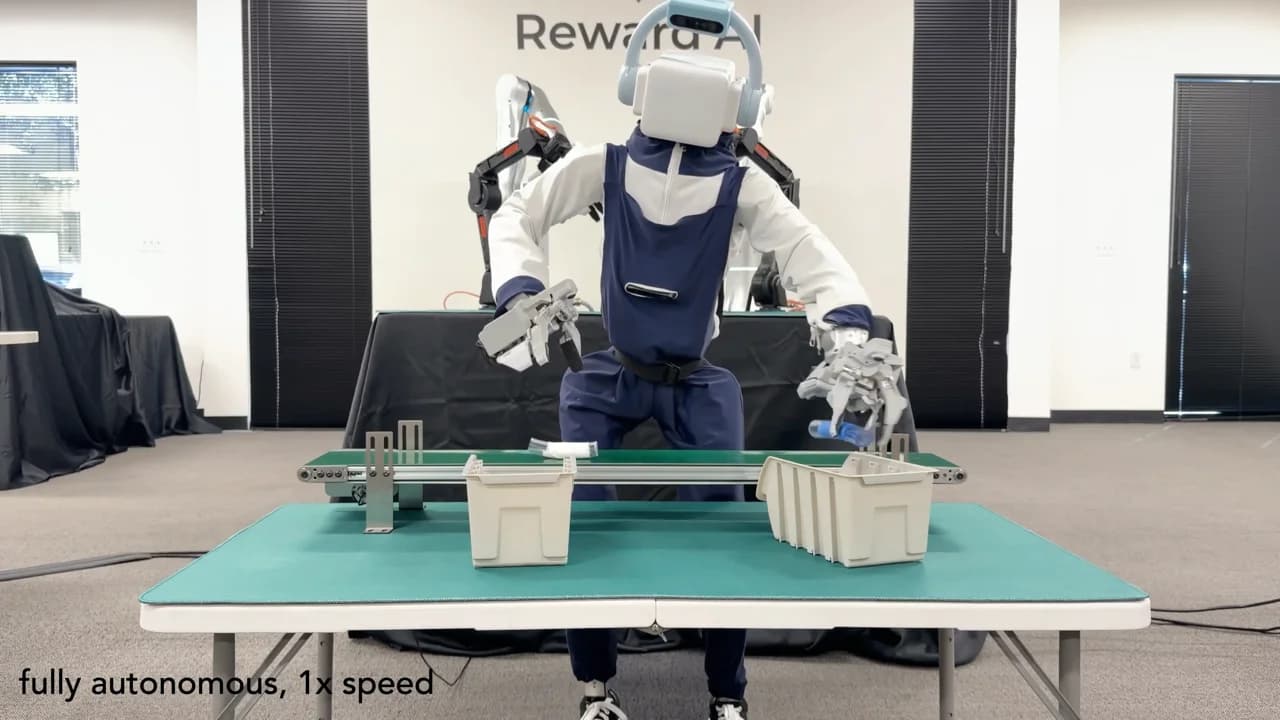
- Stealth startup Reward AI has debuted OM-1, a foundational robot policy trained entirely on direct human manipulation data without teleoperation or on-robot experience.
- The system relies on the Omnibody Hand—a wearable 7-DoF motion capture device derived from Stanford’s DexCap research—combining tactile feedback, proximity sensors, global-shutter in-hand cameras, and electromagnetic tracking.
- The company claims OM-1 generalizes zero-shot across tabletop arms, heavy industrial manipulators, and humanoids, learning novel long-horizon skills in less than 30 minutes of demonstration data.
- Underneath the policy, a decoupled reinforcement learning control layer resolves system dynamics and external disturbances at high frequency without being constrained by policy inference clock times.
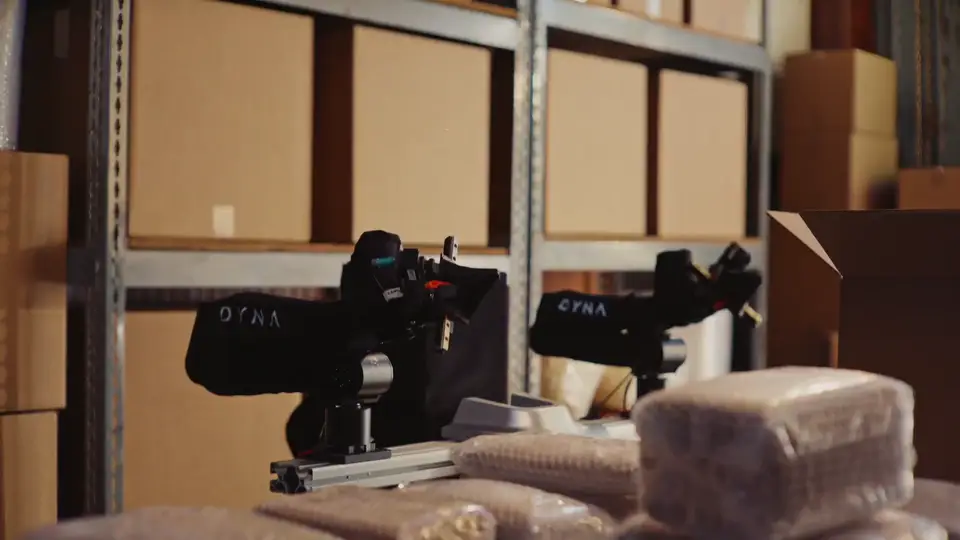
- The announcement intensifies the debate over the data bottleneck in physical AI, challenging video-only pretraining models like Dyna-2 and in-context visual learners like Skild AI's S1.
The physical AI landscape is increasingly divided over a fundamental question: what kind of data should actually teach a robot how to use its hands?
While web-scale video models ingest internet footage and enterprise robotics teams lean on fleet teleoperation, stealth newcomer Reward AI is taking an uncompromising third path. Emerging from stealth today with the debut of its foundation model OM-1, the startup argues that robots can bypass both teleoperation and on-robot post-training entirely by learning motor intelligence firsthand from human demonstrations.
Building on the team's academic lineage with DexCap—the portable motion-capture system developed at Stanford University by researchers including Chen Wang, Karen Liu, and Li Fei-Fei—Reward AI has synthesized hardware, multimodal data capture, and low-level control into what it terms the "Omnibody" stack. The ambition: train one model on natural human movement, and run it across any physical embodiment.
Functional Dexterity Over Skeletal Duplication
At the center of Reward AI’s thesis is the assertion that teleoperation rigs and parallel-jaw grippers systematically corrupt training data. Traditional teleoperation forces operators into unnatural, sluggish movements, filtering out the subconscious reflexes, tactile nudges, and continuous slip corrections that humans use to manipulate objects.
The weekly humanoid robotics briefing
One email a week: the launches, funding and research that mattered, with context from Humanoids Daily.
Read recent issuesTo capture those nuances without imposing robotic constraints, the startup engineered the Omnibody Hand, a wearable data-collection glove. Rather than trying to mirror every biological joint with a fragile 20-plus degree-of-freedom copy, the device focuses on a compact 7-DoF functional architecture:
- Precision and Power Grasping: Independent thumb and index finger flexion enable precise pinching and in-hand reorientation, while the middle, ring, and little fingers move together at the metacarpophalangeal (MCP) joints to wrap around objects for power grasps.
- Ergonomic Invariance: An integrated distal flexion mechanism accommodates varying finger lengths and hand anatomies without demanding per-user link adjustments.
- Sub-Millimeter Tracking: Because rapid direction changes cause pure visual-inertial tracking to slip or overshoot, Reward AI augmented the system with electromagnetic tracking. In benchmark tests across eight speeds, the hybrid sensing reduced mean trajectory overshoot by 60% at peak velocity, dropping error from 24.9 mm to 9.5 mm.
The device lands amid an escalating hardware race in robot-free data collection. While Sunday Robotics centered its data engine on the Skill Capture Glove—using a simpler parallel-jaw pincer to master domestic chores like laundry folding—Reward AI contends that 2-DoF grippers artificially constrain approach angles and contact points. Conversely, Shenzhen-based X Square Robot recently introduced TwinDEX, a 9-DoF exoskeleton designed to solve the embodiment gap through strict physical isomorphism with a matching three-finger robotic hand. Reward AI is attempting to carve out a functional middle ground: an interface expressive enough to preserve human dexterity, yet decoupled enough to map actions onto any downstream embodiment without requiring 1:1 kinematic symmetry.
The glove’s "One Data Interface" synchronizes high-frequency tactile arrays, optical proximity sensors, and global-shutter palm cameras at their native sampling rates. By recording contact forces alongside spatial trajectories, an operator performing ordinary household or workshop tasks passively creates robot-ready training signals without staged lab environments.
One Model, Zero Teleoperation
The resulting policy, OM-1, discards conventional pipelines that rely on massive imitation learning from robot teleoperation. Reward AI claims OM-1 uses no teleoperation and zero on-robot physical data in its pretraining corpus.
Instead, the model consumes the synchronized multimodal streams—visual context, proximity, tactile contact, and force trajectories—and directly predicts continuous motion directions, speeds, contact forces, and grasp timing. The company reports that OM-1 can master an unseen, long-horizon task with challenging physical dynamics from less than 30 minutes of raw human demonstration data.
Because the data interface remains identical regardless of who wore the glove, Reward AI maintains there is no distinction between pretraining and post-training stages. The same unified policy trains on the earliest recordings alongside the latest batches, with the goal of generalizing zero-shot across radically different downstream morphologies—ranging from lightweight desktop arms and industrial manipulators to bipedal humanoids.
In real-time demonstrations, Reward AI showcased OM-1 executing complex coordination tasks at full human speed:
- High-Precision Latching: Unplugging an RJ-45 Ethernet cable, a deceptively difficult manipulation challenge requiring continuous tactile feedback to depress a locking tab before applying pulling force.
- Rapid Household Workflows: Bimanual laundry folding, bartending, and packaging consumer electronics within sub-30-second task cycles.
- Adversarial Error Recovery: Adapting in real time when objects are perturbed or pulled away, exhibiting multi-arm coordination where one limb autonomously compensates if the other slips.
Decoupling the High-Frequency Control Clock
Even the most capable high-level policies frequently stumble when transferred to real hardware due to latency spikes and the "embodiment gap"—the physical mismatch between human dynamics and rigid robot joints.
To bridge this, OM-1 decouples cognitive planning from motor actuation. While the transformer-based policy evaluates visual and tactile histories to predict action chunks, an underlying control layer runs on an independent high-frequency clock.
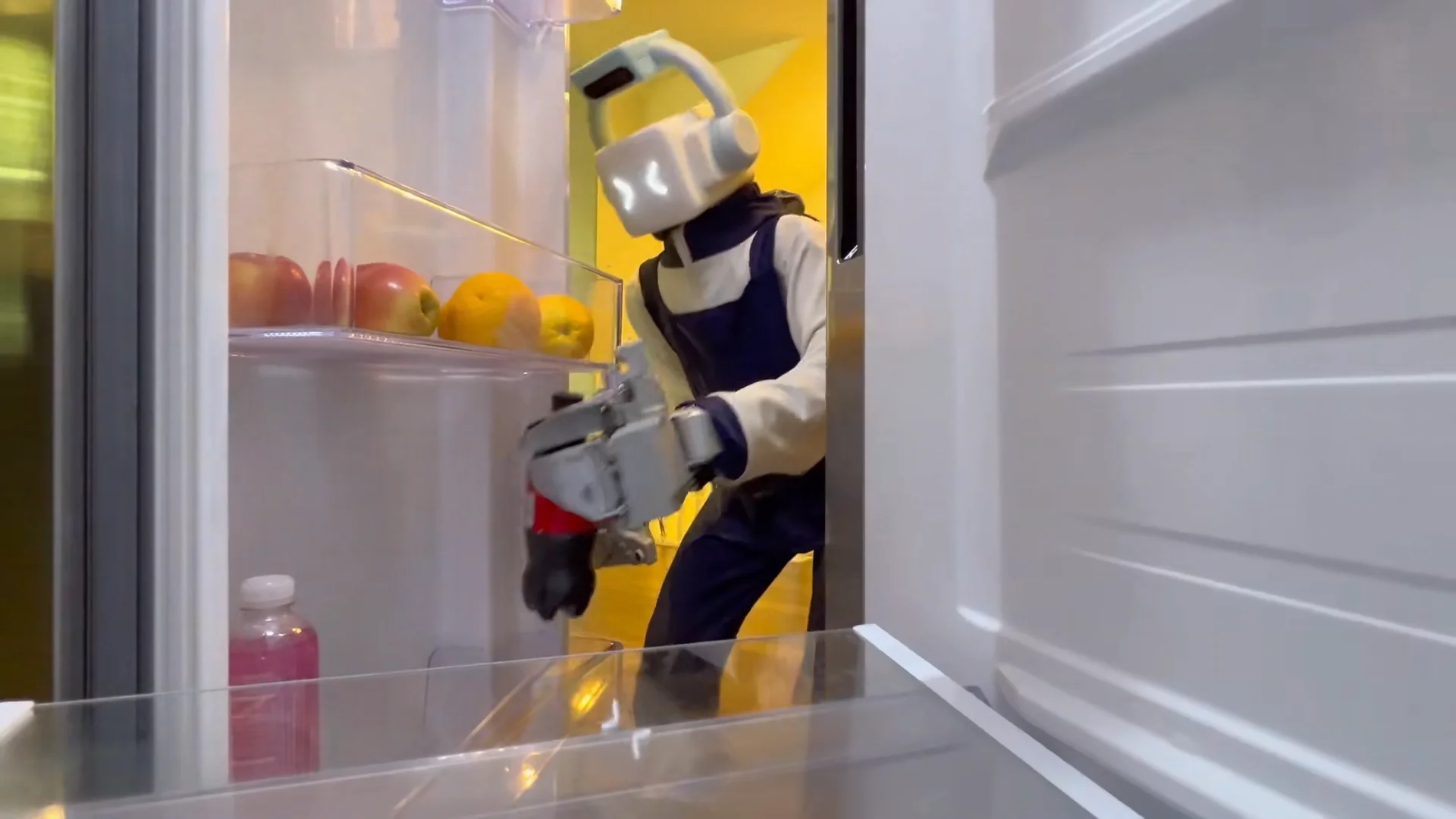
Trained via reinforcement learning in simulation, this controller learns to absorb system delays, unmodeled motor backlash, and sudden physical loads. When a robot pulls open a tightly sealed refrigerator door or lifts an unweighted shipping container, the control layer manages the dynamic resistance without waiting for the next inference frame from the main model. To eliminate the jerky stutter common in chunked action generation, the controller continuously optimizes transitions between successive model predictions online.
Navigating the Physical AI Battleground
Reward AI’s entrance sharpens the technical debate over foundation model architectures in embodied intelligence.
The startup’s wear-and-demonstrate approach positions it directly against the video-only camp led by Rhoda AI and Dyna Robotics' Dyna-2, which argues that passive internet video is sufficient to seed physical commonsense. It also offers a distinct alternative to the in-context prompting strategies pioneered by Skild AI's S1 and Generalist AI's GEN-1.5, which use video demonstrations or handheld grippers to guide manipulation without retraining model weights.
Yet as enterprise players like Skild AI mount an assault on "demo culture" by arguing that factory floors demand rigid cycle-time reliability over laboratory showstoppers, Reward AI will face the same trial by fire that confronts every nascent foundation model: proving that dexterous laboratory benchmarks translate into sustained 99.9% uptime when deployed across customer fleets.
If OM-1's zero-shot hardware claims hold outside the lab, Reward AI may have discovered an efficient bypass around the industry's most punishing data bottleneck.
Share this article
Read next
- Published on
- Reading time
- 2 min read
Brett Adcock’s vehicle clip echoes Figure 03’s delivery demo
- Published on
- Reading time
- 5 min read
Maven Robotics Breaks Stealth With $100M to Tackle Industrial Mixed Palletizing
- Published on
- Reading time
- 8 min read
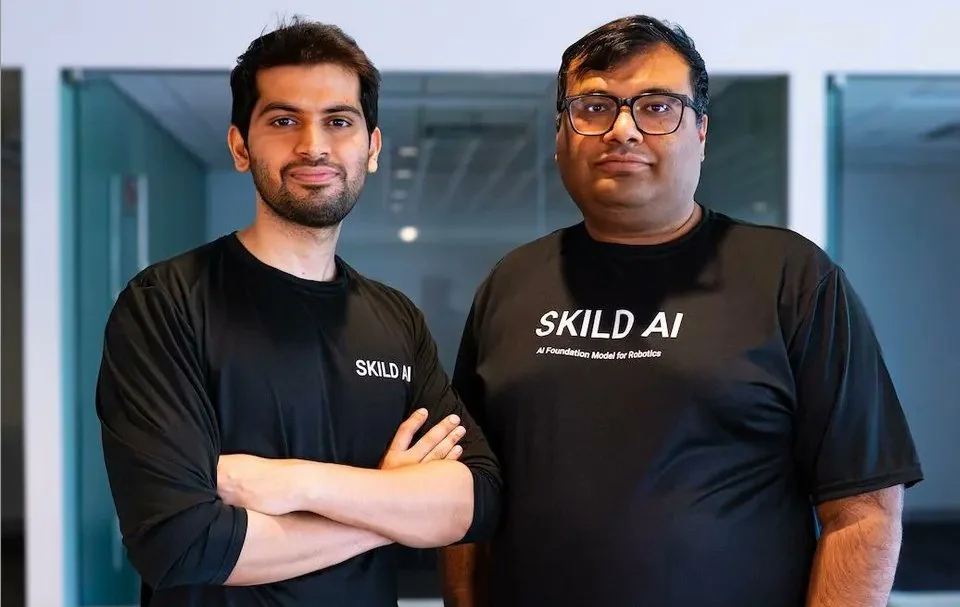
Skild AI Crosses $100M ARR in 10 Months, Mounting an Enterprise Assault on Robotics "Demo Culture"
- Published on
- Reading time
- 4 min read
Figure AI Reports Rapid Growth for Index, Surpassing 69,000 Weekly Active Users
- Published on
- Reading time
- 5 min read
Dynamic Creatures Emerges From Stealth With Boston Dynamics Backing to Build Expressive Guest-Facing Robots
- Published on
- Reading time
- 6 min read
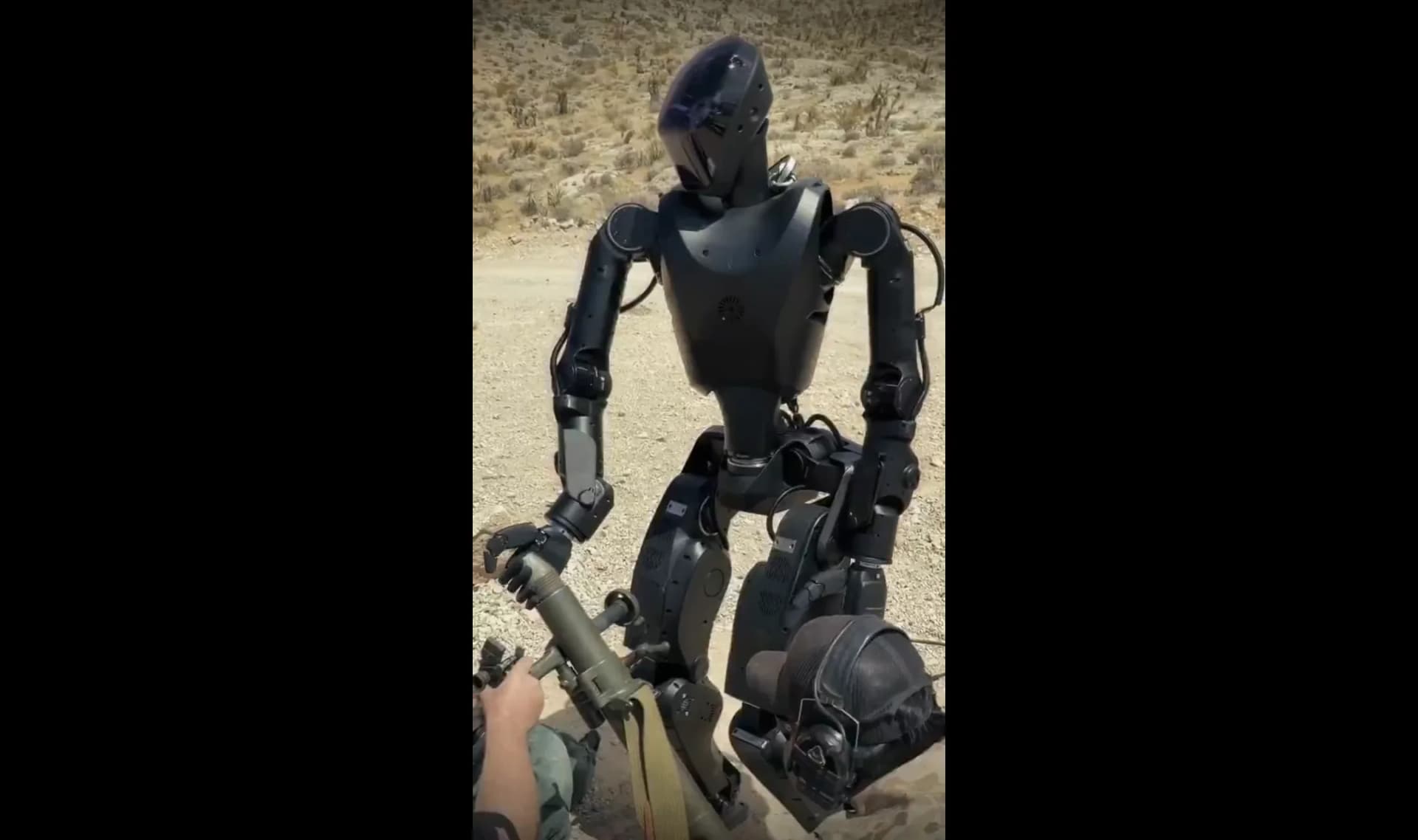
From Stadiums to the Front Line: How China and the US Are Preparing Humanoids for Combat




The weekly humanoid robotics briefing
One email a week: the launches, funding and research that mattered, with context from Humanoids Daily.
Read recent issues