- Published on
Giving the Robot Fingerprints: XELA Robotics Shrinks Sensors for Tesollo Hand Integration

One of the longest-standing "holy grails" in humanoid robotics is the ability to give machines a human-like sense of touch. While companies like Sharpa Robotics have recently begun shipping hands with integrated high-density pressure arrays, the market remains fragmented between high-end, sensor-laden manipulators and robust, "numb" industrial grippers.
XELA Robotics, a Tokyo-based specialist in tactile sensing, is betting that the industry doesn't need a new hand—it just needs better skin.
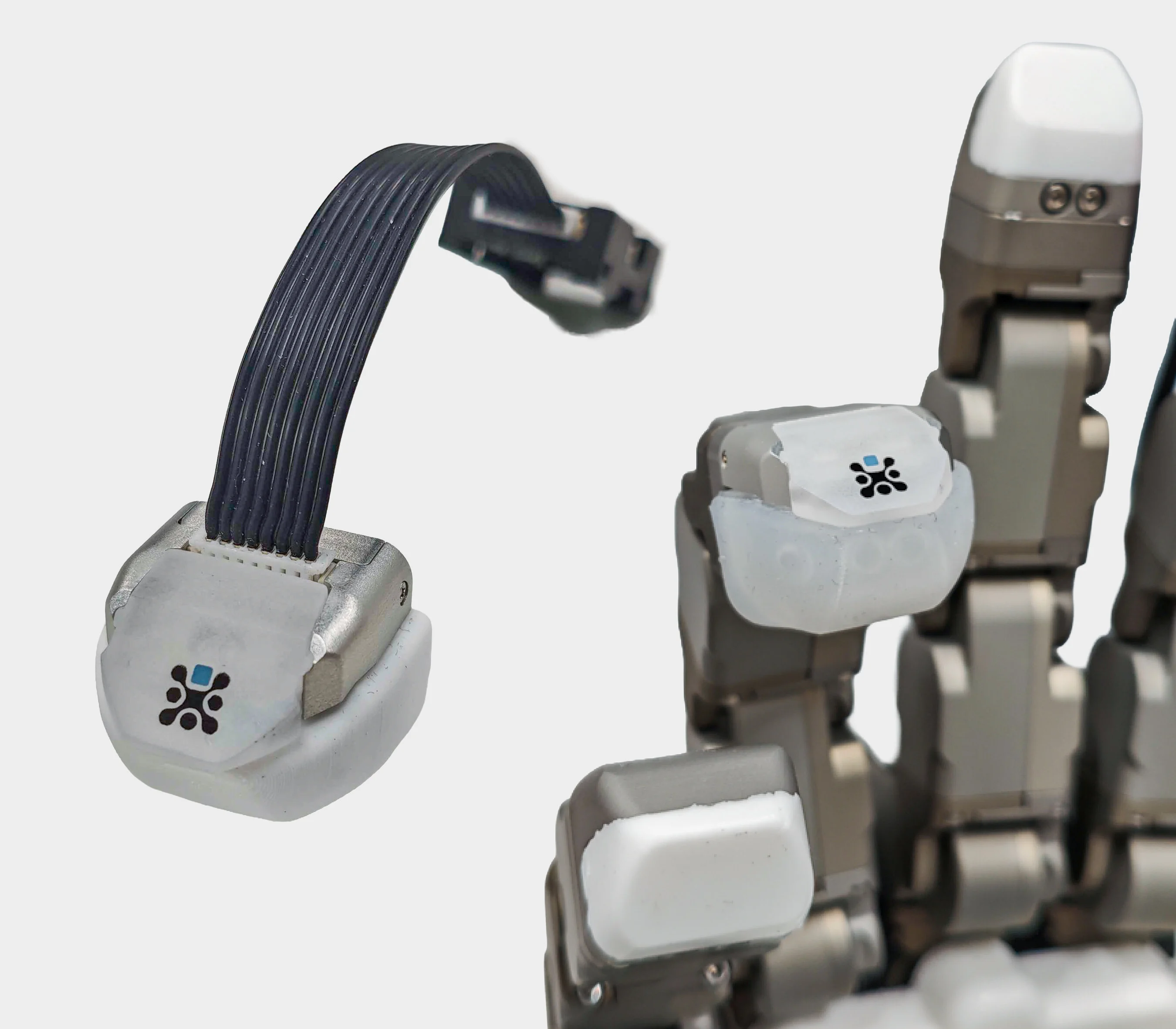
The company announced this week that it has successfully integrated its uSkin® 3D tactile sensors into the Tesollo DG-5F, a five-fingered anthropomorphic hand known for its independent joint control. Simultaneously, XELA revealed an aggressive 2026 technology roadmap that includes shrinking its sensing points by nearly 40% to achieve higher spatial density, a move designed to give robots the ability to feel texture and slip with "unprecedented precision."
The "All-Japan" Lineage
XELA Robotics is a spin-out from Waseda University, an institution that is increasingly becoming the gravitational center of Japan's humanoid resurgence. Waseda’s Humanoid Robotics Institute is already providing the theoretical backbone for the recently formed KyoHA alliance, a consortium of industrial giants attempting to counter US and Chinese dominance in the sector.
While XELA operates independently of that specific alliance, its Waseda lineage places it firmly within the country's "hardware-first" philosophy. The integration with the Tesollo DG-5F—a human-sized robotic hand—involves equipping the fingertips, phalanges, and palm with soft, porous sensors.
According to the company, the current integration features 12 sensing points per fingertip within a compact footprint (roughly 21mm x 26mm). These sensors are capable of detecting 3-axis forces (normal force and shear force), which is critical for manipulation. While simple pressure sensors can tell a robot if it is holding an object, 3-axis sensors can tell the robot if the object is slipping or rotating within the grasp.
The 2026 Roadmap: Shrinking the Skin
The more significant news for the broader industry may be XELA's roadmap for miniaturization. The company plans to reduce the size of its individual sensing points from the current 4mm x 4mm down to 2.5mm x 2.5mm by the second quarter of 2026.
This reduction allows for a significantly higher density of sensors on a fingertip. In the world of manipulation, density equals data. A denser array allows a robot to recognize the orientation of small objects (like a nut or bolt) without needing to look at them with a camera—a capability that industry experts like Scott Walter have identified as a major hurdle for real-world utility.
XELA claims its sensors can detect forces as light as 0.1 gram-force (approximately 1 mN). For context, the recently announced SharpaWave hand claims a sensitivity of roughly 5 mN (0.005 N). While specs on paper often differ from real-world performance, XELA’s claim suggests a sensitivity that could rival human fingertips in detecting initial contact.
The Integration Battle: Built-in vs. Add-on
XELA’s business model represents a distinct "horizontal" approach to the robotics supply chain. Rather than building the entire hand, they provide a "skin" that can be applied to grippers from various manufacturers, including Weiss Robotics, Robotiq, and now Tesollo.
Alexander Schmitz, CEO of XELA Robotics, argues that the lack of sensitivity is what keeps automation from scaling. "Currently, many activities cannot be fully automated because robots cannot handle objects as carefully and efficiently as humans do," Schmitz said in a statement.
By offering a skin that can be retrofitted or integrated into third-party hands, XELA is positioning itself as a solution for hardware makers who have solved the "muscle" problem (actuation) but are still struggling with the "nerves" (sensing).
The company will be demonstrating the Tesollo integration and its sensor technology at CES 2026 in Las Vegas this coming January. Commercial orders for the Tesollo integration are expected to open in late Q1 2026.
Comments
No comments yet. Be the first to share your thoughts!
Share this article
Stay Ahead in Humanoid Robotics
Get the latest developments, breakthroughs, and insights in humanoid robotics — delivered straight to your inbox.