- Published on
Xiaomi CEO: Humanoids Will Working at "Large Scale" in Our Factories Within 5 Years

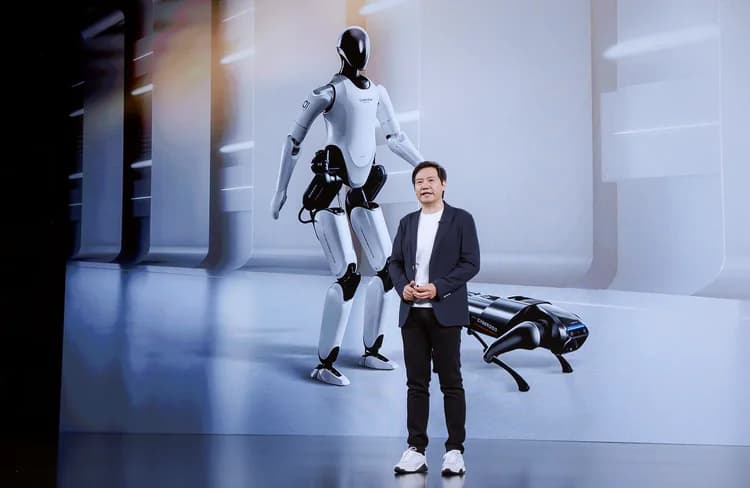
Xiaomi is betting that the factory floor is the necessary training ground for the robotic home assistant.
In a wide-ranging interview with the Beijing Daily released this week, Xiaomi founder and CEO Lei Jun offered one of his most specific timelines yet for the deployment of humanoid labor, predicting that his company’s factories will employ humanoid robots on a "large scale" within the next five years.
The comments mark a significant recommitment to the form factor for the consumer electronics and EV giant, coming just days after the company released a new open-source AI model designed to bridge the gap between autonomous driving and robotic manipulation.
The "Factory First" Strategy
Speaking on the rapid industrial upgrades in Beijing’s manufacturing sector, Lei argued that the complexity of the consumer home requires a technological maturity that doesn't exist yet. The controlled environment of a factory, however, offers an immediate proving ground.
"This is just the first step," Lei told the Beijing Daily, describing the factory deployment. "The demand for humanoid robots in the home is larger, the requirements are higher, and the market is bigger."
This "factory-first" approach mirrors the strategy currently being pursued by competitors like Figure, who has been using automotive assembly lines to refine bipedal locomotion and manipulation before attempting to sell general-purpose bots to consumers. Lei’s timeline—placing mass deployment roughly around 2030—aligns with recent analysis from Goldman Sachs, which suggests that while "dedicated purpose" robots will dominate the near term, general-purpose viability remains a longer-term play.
"Redoing" Industry with AI
Lei’s pivot to robotics is part of a broader internal philosophy that "all industries are worth doing again with AI".
He cited Xiaomi's massive EV factory in Yizhuang, Beijing—which recently produced its 500,000th vehicle—as a case study in this transition. The facility currently utilizes AI visual models and X-ray machines to inspect large die-cast parts, a task Lei claims is now completed in two seconds with ten times the efficiency and five times the precision of human inspectors.
The goal is to integrate humanoid form factors into these existing "smart manufacturing" clusters. Lei noted that Xiaomi is leveraging Beijing's dense industrial supply chain—which includes national innovation centers for smart vehicles and battery technology—to support this automation push.
The Software "Brain"
While Xiaomi’s hardware ambitions were signaled back in 2022 with the debut of the CyberOne humanoid, the project has been relatively quiet compared to the frenetic pace of rivals like Unitree, UBTECH or AgiBot. However, recent software moves suggest the company has been focusing on the "cerebrum" rather than just the chassis.
On Friday, Xiaomi open-sourced MiMo-Embodied, a new vision-language foundation model. According to the South China Morning Post, the model is designed to excel at "spatial understanding" and "affordance prediction"—essentially helping robots understand not just what an object is, but how it can be used.
Significantly, the project is being led by Luo Fuli, a prominent researcher recently hired from the AI startup DeepSeek. This recruitment drive indicates Xiaomi is attempting to solve the "Moravec’s paradox" stalling the industry: the fact that high-level reasoning is computationally easier than low-level sensorimotor skills.
A Crowded Local Field
Xiaomi's re-entry into the humanoid conversation adds weight to an already overheating domestic market. As we reported recently, Beijing regulators have warned of "bubbles" in the sector, urging companies to avoid "low-level redundancy."
By tethering its robotic development to its successful EV production lines—which generated a profit of $1.5 billion (11.3 billion yuan) in Q3 combined with its AI and new business units —Xiaomi may have the distinct advantage of a captive customer: itself.
While startups struggle to find pilot programs, Lei Jun has millions of square feet of factory floor waiting for workers. If his five-year prediction holds, many of those workers will soon be running on batteries.
Comments
No comments yet. Be the first to share your thoughts!
Share this article
Stay Ahead in Humanoid Robotics
Get the latest developments, breakthroughs, and insights in humanoid robotics — delivered straight to your inbox.