- Published on
UMA Exits Stealth: The European Robotics ''Supergroup'' Arrives in Paris
One tap, and our reporting appears more often in your Google Top Stories. It makes a real difference to a small newsroom.


Your guide
Rich Robinson
Jee Chee Ren · Executive tour
See China’s AI and robotics ecosystem first-hand.
Six days exploring AI, robotics and advanced manufacturing.
With Rich Robinson, Clinical Professor of Entrepreneurship at Peking University
Beijing · Guangzhou · Shenzhen
29 November–4 December 2026
Referral partnership · We earn a commission on referred bookings.
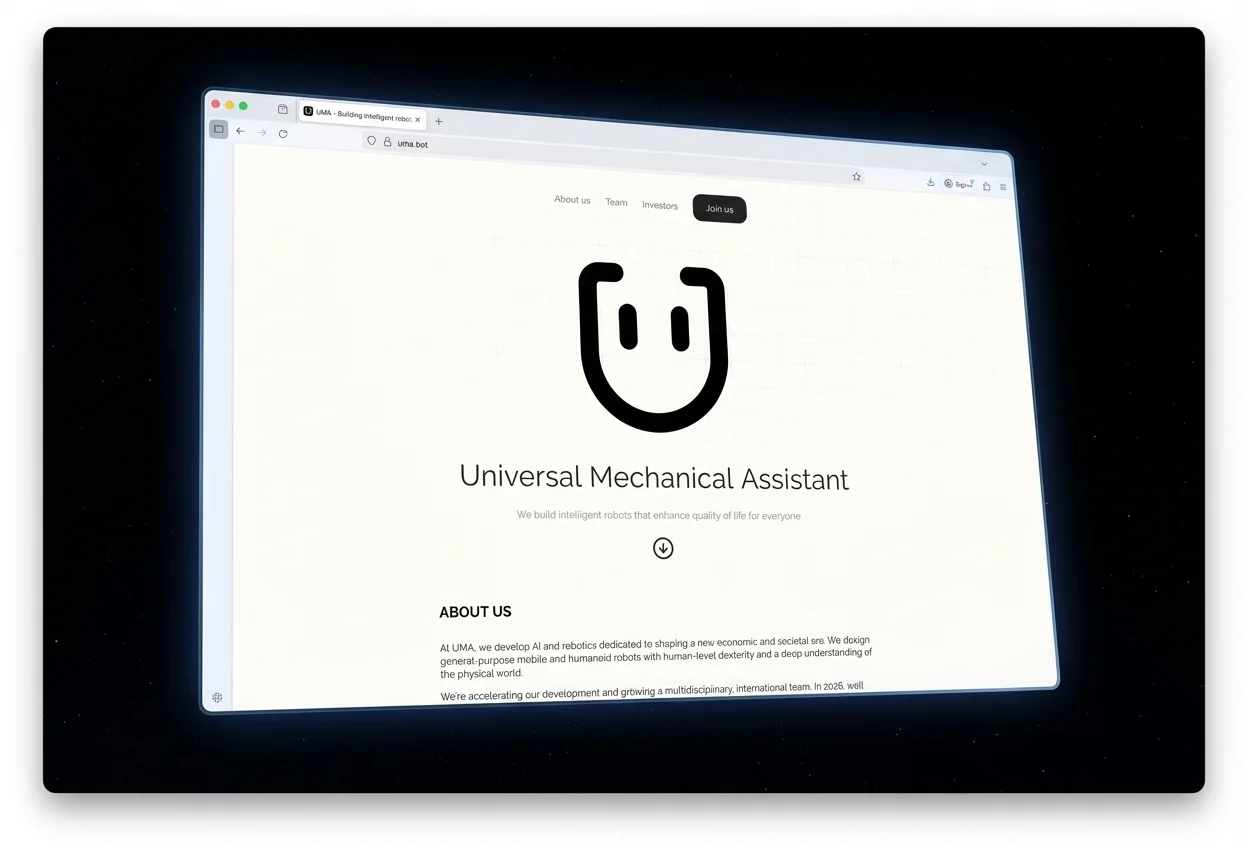
Paris, France — The mystery surrounding the stealth startup UMA has officially lifted. In a coordinated series of announcements on social media today, founder Rémi Cadene unveiled the company’s full identity—Universal Mechanical Assistant—alongside a high-profile leadership team and a formidable roster of investors, confirming that the European robotics race has a serious new contender.
Cadene, formerly a research scientist at Tesla (working on Autopilot and Optimus) and most recently a principal researcher at Hugging Face, described the launch as a "turning point."
"I am launching UMA to build general-purpose mobile and humanoid robots from Europe," Cadene announced on X (formerly Twitter). "Proud to start with people I admired for years."
A "Supergroup" of Embodied AI
When Humanoids Daily first analyzed UMA's job listings in November, the focus on "sim-to-real" and "stylized walks" hinted at a sophisticated technical approach. The newly revealed founding team confirms that UMA is aggregating some of the most specific talent in the sector, effectively creating a European robotics "supergroup."
The weekly humanoid robotics briefing
One email a week: the launches, funding and research that mattered, with context from Humanoids Daily.
Read recent issuesJoining Cadene (CEO) are:
- Robert Knight (Chief Robot Officer): A veteran with over 25 years in the field. Knight is the founder of The Robot Studio and the designer behind the open-source SO-100 arm and the recently announced HOPEJr humanoid. His presence suggests UMA will leverage high-performance, cost-effective hardware design principles.
- Pierre Sermanet (Chief Science Officer): A heavyweight in computer vision and robotics learning, Sermanet brings experience from Google Brain and DeepMind, where he was a founding member of the robotics team.
- Simon Alibert (Chief Technology Officer): A co-founder of the LeRobot project at Hugging Face. Alibert was instrumental in building the infrastructure that made LeRobot a critical tool for the open-source community.
The company has also secured a roster of advisors that lends immediate institutional credibility, arguably the most notable being Yann LeCun, Meta’s Chief AI Scientist and a Turing Award winner often referred to as a "Godfather of Deep Learning." Other advisors include Hugging Face co-founder Thomas Wolf and Sorbonne Professor Matthieu Cord.
Beyond Humanoids: A Pragmatic Approach?
While the company’s name and previous job listings hinted strongly at bipedal robots, the official messaging takes a broader stance. UMA’s new website states the company designs "general-purpose mobile and humanoid robots," a distinction that suggests a pragmatic approach to form factors.
Mustafa Shukor, an AI researcher at UMA focusing on multimodal large-scale training, reinforced this flexibility on X: "We have a simple plan: a straight shot toward general-purpose robots. Whatever their form factor, humanoid or otherwise."
According to the company's "About" page, the timeline is aggressive but concrete. UMA aims to launch "several pilot programs in logistics and manufacturing" by 2026.
The LeRobot Lineage
The DNA of Hugging Face runs deep in UMA. Both Cadene and Alibert were central to LeRobot, the open-source toolbox that democratized access to robotics training data.
In his announcement, CTO Simon Alibert acknowledged the transition from building tools to building products. "Our goal [with LeRobot] was to build a simple toolbox to get started with AI for robotics," Alibert wrote. "With UMA, we want to address the needs and challenges of society today and tomorrow by pushing automation in the physical space to the absolute max."
Alibert confirmed that while he is moving on, LeRobot will "continue to grow and thrive," suggesting an amicable split from the open-source hub to pursue this proprietary venture.
Backing and The Road Ahead
The updated website also reveals a significant list of investors backing UMA's "strong first round." The syndicate includes Greycroft, Relentless, Unity Growth Fund, Red River West, Factorial, Drysdale, Kima Ventures, and ALM Ventures.
This influx of capital will be necessary. As noted in our previous coverage of the European landscape, UMA is entering a crowded arena.
However, UMA's strategy appears to be vertical integration—combining Knight's hardware innovation with Sermanet and Cadene's "AI-first" brains. If they can meet their 2026 pilot deadline, UMA may well prove that the next generation of general-purpose robots will speak French.
Share this article
Read next
- Published on
- Reading time
- 25 min read
The Humanoids of Europe: Built by Their Customers
- Published on
- Reading time
- 4 min read
In Paris, a New Stealth Startup Named UMA Enters the Humanoid Race
- Published on
- Reading time
- 4 min read
The World Model Rebellion: Yann LeCun Launches AMI Labs to Challenge the 'LLM-Pilled' Consensus
- Published on
- Reading time
- 3 min read
Humanoid Expands NVIDIA Collaboration, Replacing Two Robot Computers With One
- Published on
- Reading time
- 4 min read
Generative Bionics Plans Major Humanoid Training Hub in Italy With AMD
- Published on
- Reading time
- 3 min read
Schaeffler Puts Humanoids to Work Building Parts for Other Humanoids



The weekly humanoid robotics briefing
One email a week: the launches, funding and research that mattered, with context from Humanoids Daily.
Read recent issues