- Published on
NJIT's PHD-Hand Uses Linkages, Not Tendons, in a Humanoid Hand You Can Print for Under $650
One tap, and our reporting appears more often in your Google Top Stories. It makes a real difference to a small newsroom.

Supported by RoboStrategySupport for Humanoids Daily comes from RoboStrategy
Sponsored
Investing involves risk, including possible loss of principal. Read the prospectus before investing.
Researchers at the New Jersey Institute of Technology have built PHD-Hand, a five-fingered humanoid hand whose fingers are driven entirely by rigid linkages and can be printed on a budget 3D printer. The paper, PHD-Hand: A Printable Humanoid Dexterous Hand with Linkage-Driven 3-DOA Digits, has been accepted at the IEEE-RAS International Conference on Humanoid Robots (Humanoids 2026), taking place December 6–9 in Santa Clara.
The hand was designed by Neel Adwani, a PhD candidate in electrical and computer engineering at NJIT, together with co-authors Muhaiminul Islam Akash, Saffia Ouali and Ethan Liu, under Adwani's advisor, NJIT professor Cong Wang. Adwani told Humanoids Daily that a complete hand costs less than $650 in parts, including the servos, controller, filament and steel rods, and that the team plans to release the design files and control software as open source in about a month.
- PHD-Hand has 15 actuated joints, three per digit, all driven by rods and linkages instead of tendons.
- Each finger is moved by three HobbyPark HD1223MG servos mounted below the digit, and one Pololu Mini Maestro 18 board controls all 15.
- The 200 mm, 570 g hand is printed in TPU and PETG on a budget FFF printer, and Adwani puts the full parts cost below $650.
- The team demonstrated all 33 grasp types in a standard human grasp taxonomy, plus in-hand tasks such as turning a screwdriver and re-orienting a cube.
- The hardware will be released under the CERN-OHL-P v2 license and the software under MIT. The prototype has no touch sensors, and grip force has not been measured yet.
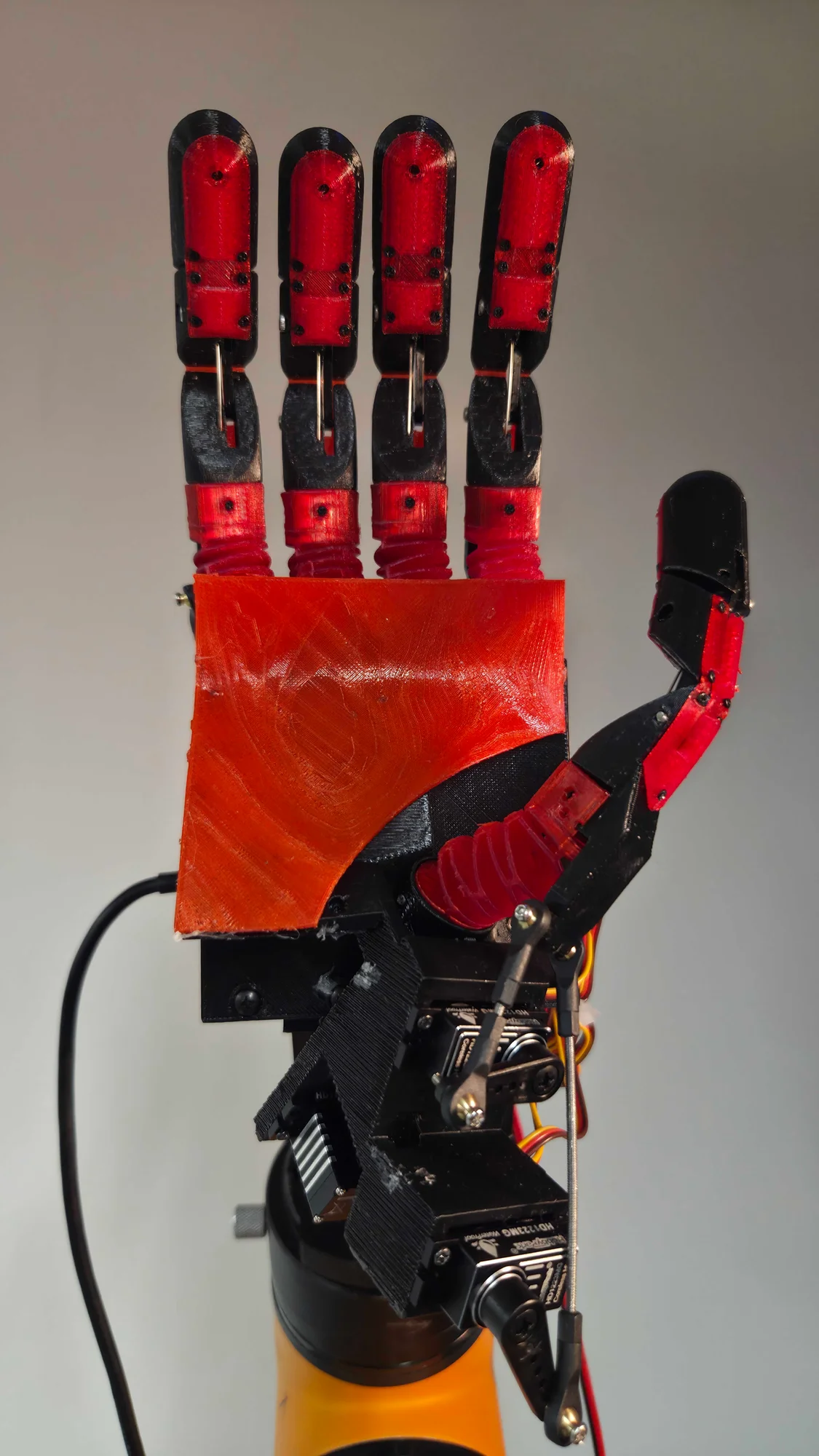
Why linkages instead of tendons
Most low-cost dexterous hands move their fingers with cables. A tendon-driven design keeps the motors out of the fingers, but the cables need regular maintenance. The trade-offs between tendon and direct-driven approaches are the same ones splitting commercial hand makers, as we covered in our look at tendon versus direct-drive hands.
"Tendons are what make most affordable robot hands hard to keep running: they stretch, slip and need constant re-tensioning," Adwani said. "I wanted to see whether rigid linkages could give a hand human-like dexterity without that upkeep, and so far they can."
Follow humanoid robotics without following every announcement.
Get the week’s most important launches, funding and research—and why they matter—in one email from Humanoids Daily.
Once a week. Unsubscribe anytime.
Read recent issuesIn PHD-Hand, each digit has three degrees of freedom that are actively driven. The paper calls them "degrees of actuation" because two of the joints are coupled. The knuckle is a two-axis flexure hinge printed in TPU, which lets the finger both curl and spread sideways. Two servos move it through rigid rods and four ball joints.
The third servo drives the two upper joints together. A 0.6 mm stainless spring-steel rod runs through the knuckle to a crossed four-bar linkage, which bends the top two joints at a fixed ratio of 0.77. The authors cite a range of 0.75 to 0.8 for the same coupling in human fingers. With five digits, that comes to 15 servos for the hand.
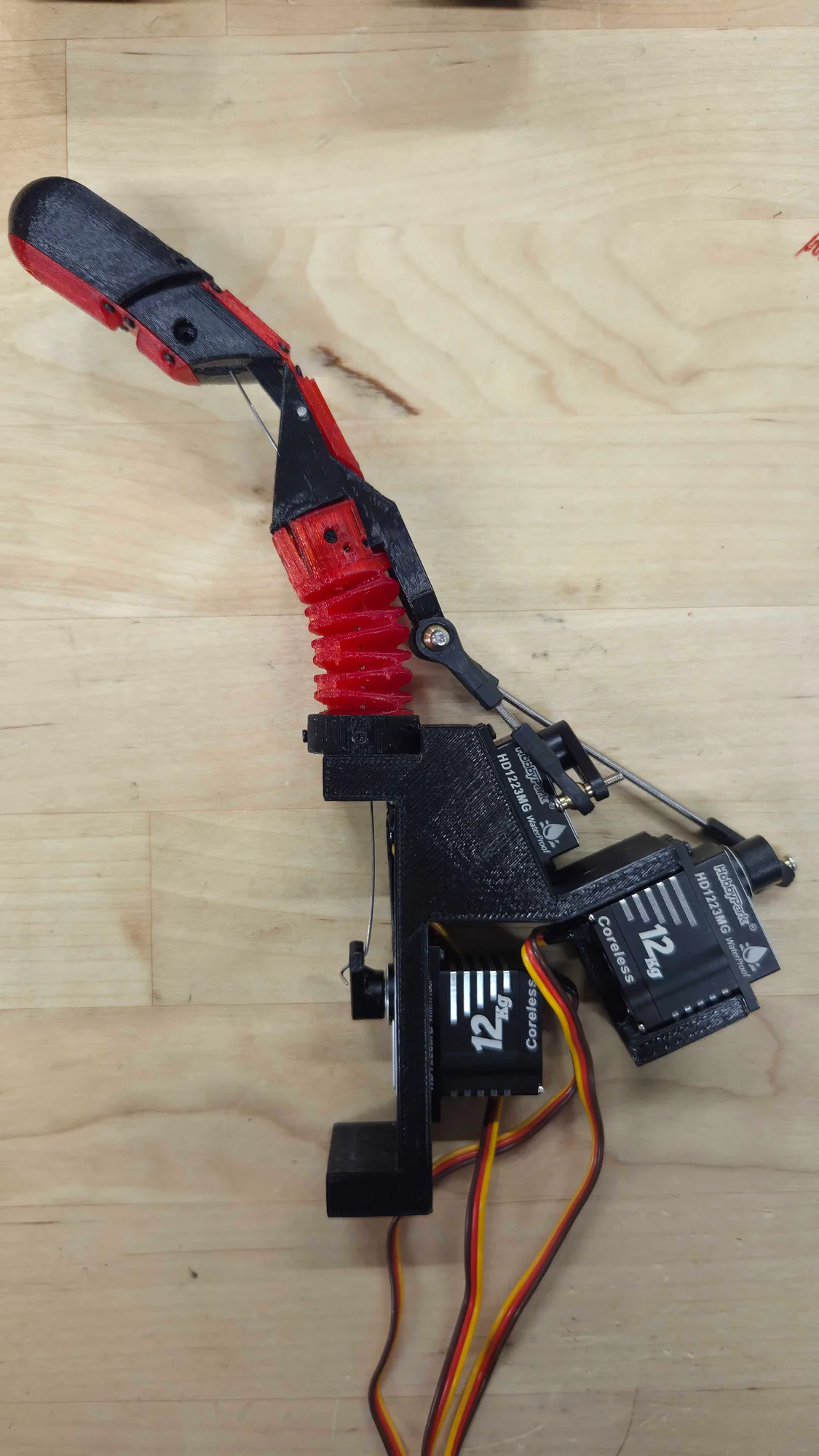
Printing and parts
The phalanges of the fingers are printed in PETG or TPU and the flexures in TPU 95A. The print settings are ordinary for a hobby machine: a 0.4 mm nozzle, 0.15 mm layers, 15% infill and no supports. Each digit takes a total of 18 printed and off-the-shelf parts. The authors compare that with more than 27 parts per digit in an earlier linkage-driven hand from Kim et al., published in Nature Communications in 2021, which needed industrial machining.
The servos are HobbyPark HD1223MG coreless hobby servos rated at 12 kg·cm, and a single Pololu Mini Maestro 18 controller drives all 15 of them. The complete hand weighs 570 g. At 200 mm from wrist to fingertip, it is roughly the size of an adult male hand and slightly smaller than the roughly 225 mm Linkerbot L20, the commercial hand the authors list for comparison. Adwani told us that the team has not yet measured fingertip force or grip payload and plans to report them in a follow-up paper.
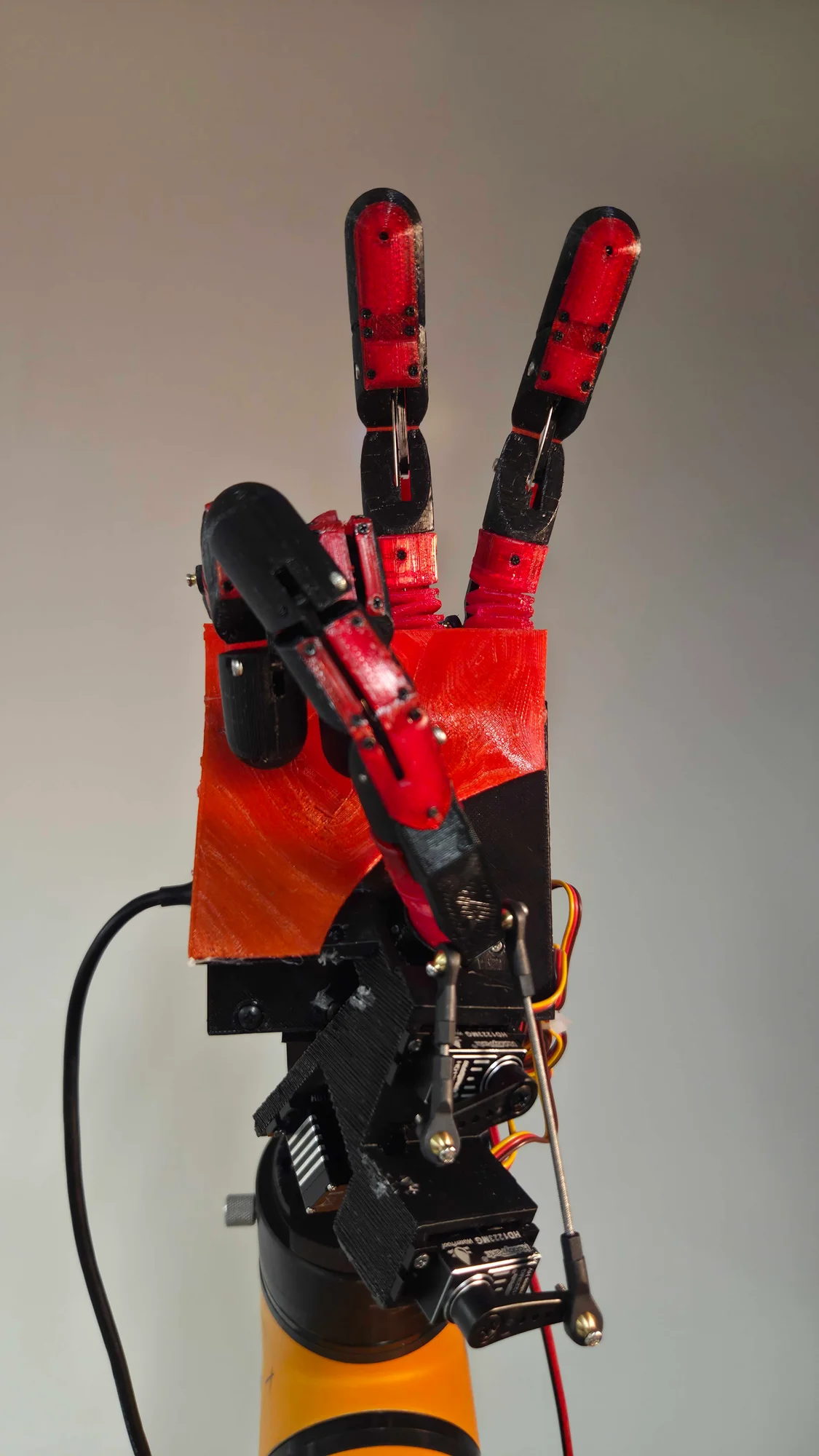
What it can do
The team tested PHD-Hand against the Feix grasp taxonomy, a standard set of 33 human grasp types, and showed it holding objects in each one, along with items such as a mug and a power drill. The authors note that a few grasps, including holding a stick or using chopsticks, were imperfect because the fingers cannot flex as far as human ones and the hand lacks the web of skin (thenar web) between thumb and index finger.
The in-hand demonstrations include flipping the lid off a jar, turning a precision screwdriver, rolling the worm screw of an adjustable wrench to close its jaws, and rotating a 55 mm cube.
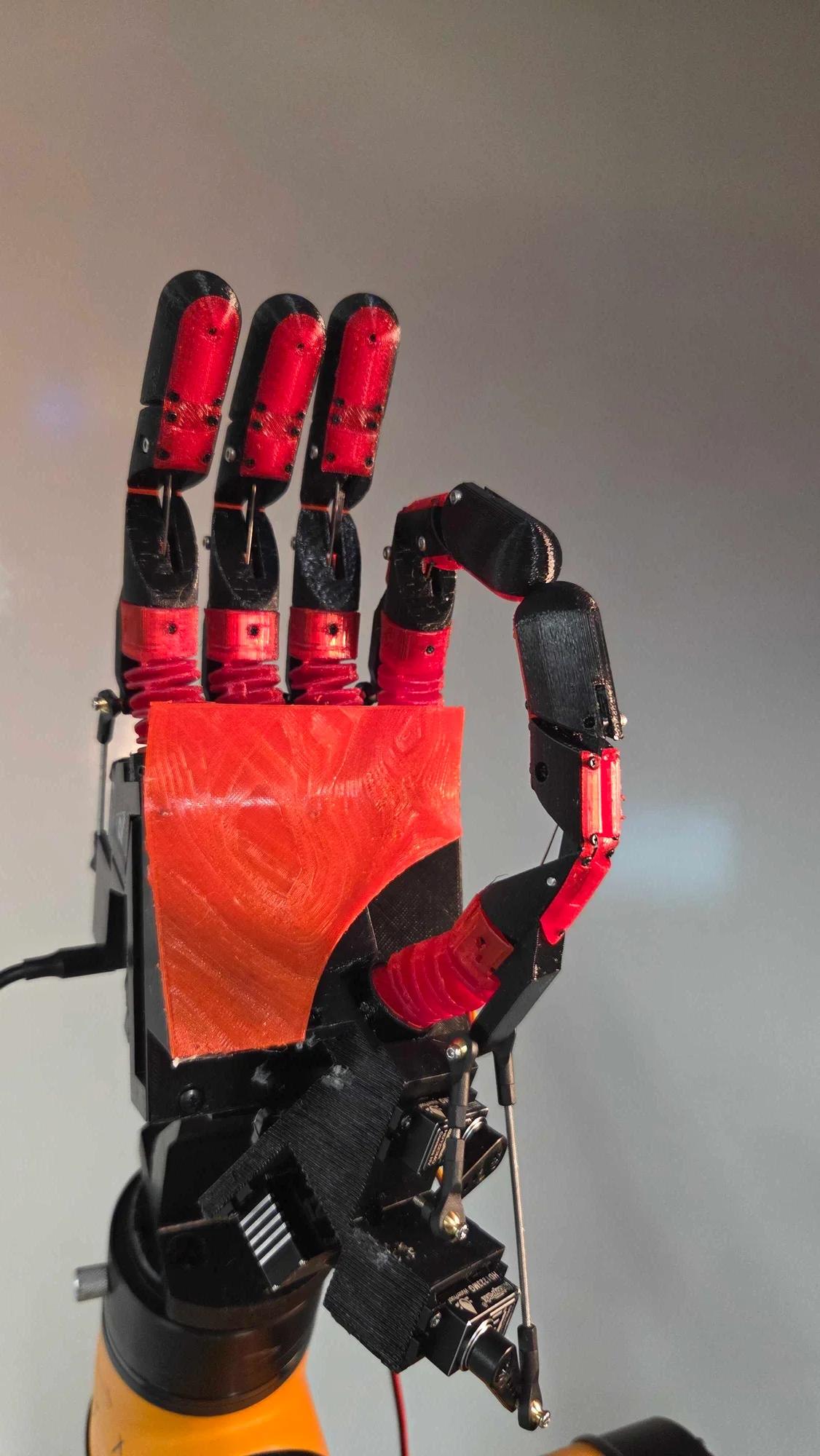
The trajectories were not learned through data capture gloves or reinforcement learning. The team used Anthropic's Claude Sonnet 4.6 to write a browser-based control interface from a text specification and to generate motion sequences, which a user then refined. The first 40-frame cube-rotation sequence the model produced failed. The revised version, in the paper's words, was "surprisingly successful."
Durability and what comes next
The authors report about 200 hours of testing on a single prototype. Two failures occurred in that time, both breaks in the spring-steel coupling rod, and the paper says a proper fatigue study has not been done yet.
The listed next steps are moving the coupling rod through the middle phalanx, redesigning the thumb's base joint, adding the missing thumb web, and printing each digit in one piece, which the team cannot yet do reliably. The hand has no tactile sensors. The authors want to estimate contact from the servos' own readings instead of adding touch sensors.
When the design is released, the hardware files will carry the permissive CERN-OHL-P v2 open hardware license and the control software the MIT license, with the repository linked from the project page. "Robot hands shouldn't be a luxury only a few well-funded labs can afford," Adwani said. "By making PHD-Hand open source and printable, we're lowering the barrier to entry, so anyone, from students and hobbyists to startups and research labs, can build one and push dexterous manipulation forward."
An earlier version of the design, with flexure joints, appeared at the 2026 Modeling, Estimation and Control Conference. The PHD-Hand paper is on arXiv, and the project page has the demonstration video.
Share this article
Follow humanoid robotics without following every announcement.
Get the week’s most important launches, funding and research—and why they matter—in one email from Humanoids Daily.
Once a week. Unsubscribe anytime.
Read recent issuesRead next
- Published on
- Reading time
- 12 min read
How Frontier Language Models Are Speeding Up Robotics Research
- Published on
- Reading time
- 8 min read
NYU's MABEL Puts a 56-DOF Mobile Bimanual Robot on an $8,056 Open-Source Parts List
- Published on
- Reading time
- 4 min read
The Human Scale: NVIDIA’s EgoScale Unlocks High-Dexterity Robotics via 20,000 Hours of Human Video
- Published on
- Reading time
- 3 min read
NVIDIA "Supersizes" Humanoid Control: SONIC Open-Sources Whole-Body Tracking at Scale
- Published on
- Reading time
- 7 min read
After SuperMimic, Open-Source Humanoid Motion Trackers Now Train in Minutes on One GPU
- Published on
- Reading time
- 6 min read
OpenAI’s GPT-6 Astra Hits 95% on Physical Manipulation Benchmark, But Precision Tasks Expose Familiar Bottlenecks