- Published on
CJ Logistics Puts ROBOTIS Dual-Arm "AI Worker" on Live Olive Young Fulfillment Lines
One tap, and our reporting appears more often in your Google Top Stories. It makes a real difference to a small newsroom.


Your guide
Rich Robinson
Jee Chee Ren · Executive tour
See China’s AI and robotics ecosystem first-hand.
Six days exploring AI, robotics and advanced manufacturing.
With Rich Robinson, Clinical Professor of Entrepreneurship at Peking University
Beijing · Guangzhou · Shenzhen
29 November–4 December 2026
Referral partnership · We earn a commission on referred bookings.
- CJ Logistics has deployed two dual-arm humanoid robots into active packaging operations at the Olive Young logistics hub in Yangji, South Korea.
- The deployment utilizes the ROBOTIS AI Worker, an open-source semi-humanoid platform featuring 7-DOF dual arms, dexterous manipulators, and a swerve-drive mobile base.
- Operating on live order streams, the robots stuff protective void-fill paper into parcels before human coworkers complete packing for customer delivery.
- Operational telematics from the line will continuously fine-tune CJ Logistics' Robot Foundation Model (RFM), built in strategic partnership with Physical AI startup RLWRLD and sensor specialist Aidin Robotics.
- The shift demonstrates an industry pivot toward pragmatic, wheeled semi-humanoids over bipedal platforms to bypass mechanical complexity in brownfield warehouse environments.
The global push to deploy embodied AI onto active industrial floors has reached South Korea's supply chain core. Supply chain and contract logistics giant CJ Logistics announced today that it has deployed two dual-arm humanoid robots into active fulfillment lines at the Olive Young distribution center in Yangji, Gyeonggi Province.
Unlike isolated staging areas or scripted lab tests, the machines are directly embedded in live customer order fulfillment. Operating along conveyor lines, the robots grasp and insert crumpled paper cushioning into shipping cartons. Once the void-fill is placed, human coworkers pack retail cosmetics and goods directly into the boxes before dispatch to consumers.
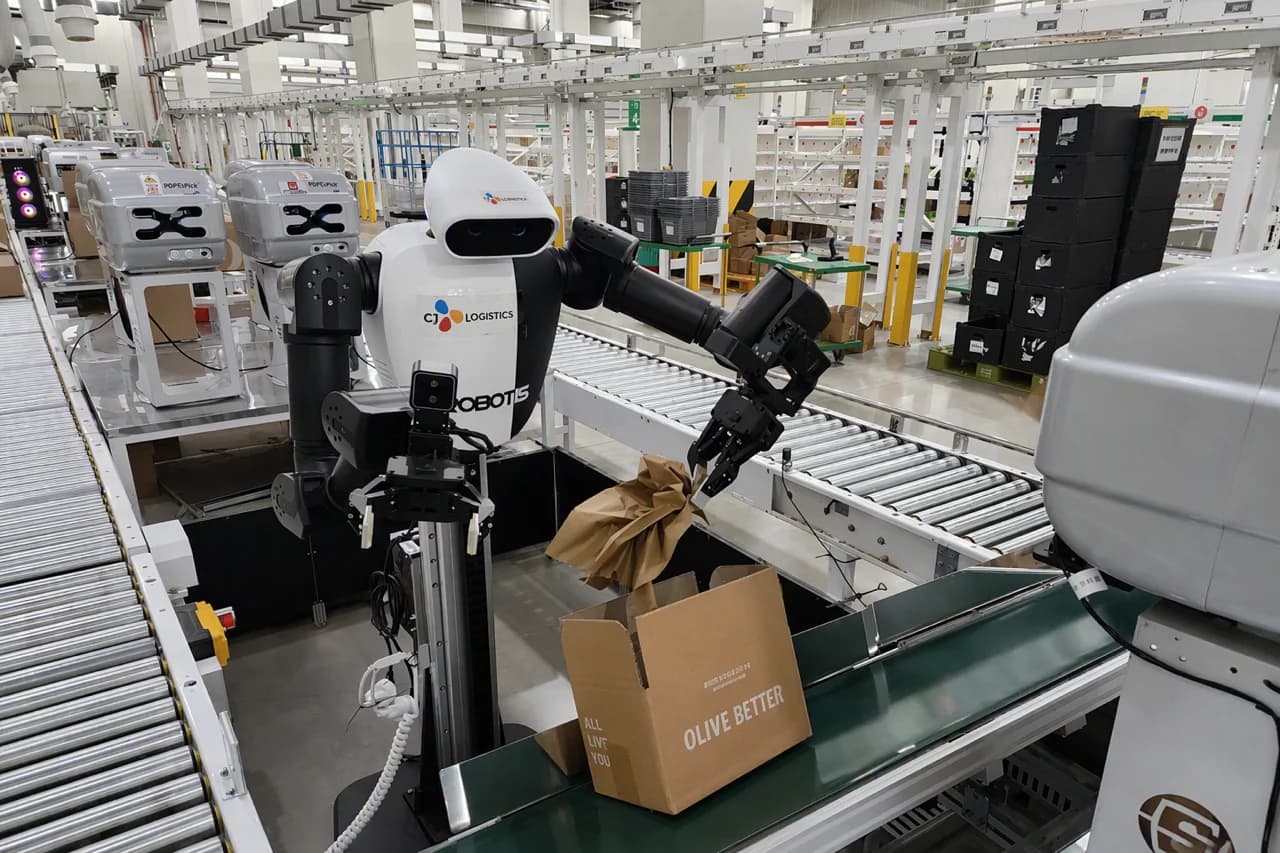
Pragmatic Anatomy: The ROBOTIS "AI Worker"
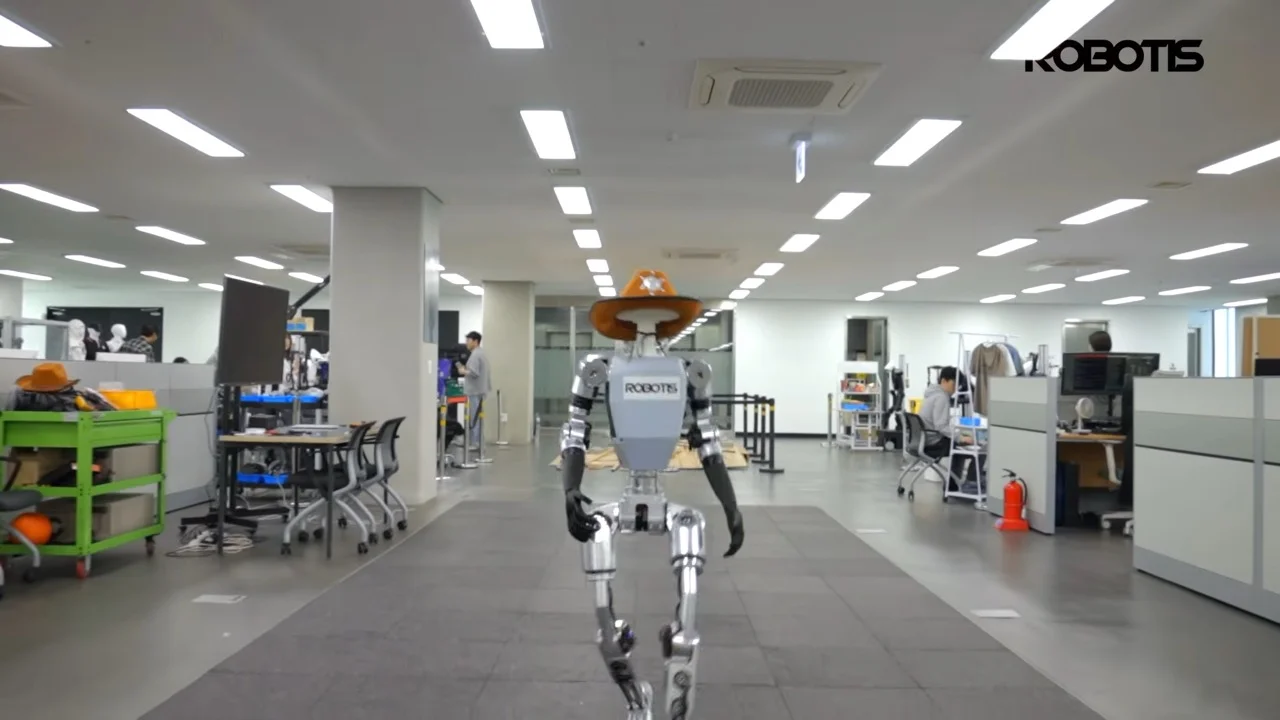
The hardware powering the Yangji packaging cell is the AI Worker, developed by Seoul-based robotics pioneer ROBOTIS. While the company recently demonstrated bipedal research baselines, its commercial warehouse machine takes a distinctly pragmatic approach: a semi-humanoid architecture.
Instead of navigating on legs, the AI Worker pairs an upper humanoid torso with a high-maneuverability swerve-drive mobile base. This mechanical compromise provides omnidirectional movement across smooth warehouse concrete while bypassing the balance, tipping risks, and battery overhead typical of bipedal platforms.
The weekly humanoid robotics briefing
One email a week: the launches, funding and research that mattered, with context from Humanoids Daily.
Read recent issuesThe upper chassis features:
- 7-DOF Dual Arms: Symmetrical manipulators engineered for human-equivalent workspace reach over standard packaging conveyors.
- Dexterous End-Effectors: Multimodal hands targeting 16 to 20 degrees of freedom (DoF) for compliant grasping of non-rigid, deformable goods.
- Integrated Imitation Pipeline: On-board systems designed to capture human teleoperation demonstrations and translate them into autonomous motor policies via reinforcement learning.
Aligning with ROBOTIS' broader commercial ethos, the platform is anchored in open-source access, offering simulation models and datasets to help developers eliminate the integration tax that typically delays industrial robotic deployments.
Escaping the Pilot Trap
The Yangji rollout marks a critical milestone for CJ Logistics following feasibility trials conducted in late 2025 at its Gunpo fulfillment center. During those early evaluations, CJ tested whether mobile manipulators could handle unstructured logistics tasks without disrupting conventional warehouse architecture.
"This deployment moves beyond technical demonstrations and feasibility verifications; it signifies that humanoids have entered the phase of performing genuine operational roles in live logistics workflows," said Jung-hee Kim, Head of the TES Logistics Technology Research Institute at CJ Logistics. "By combining the vast operational data collected directly from the floor with AI technology, we plan to advance our humanoids to independently judge and execute diverse tasks."
Fulfillment hubs present an automation bottleneck that traditional fixed machinery struggles to address. High-speed conveyor sorters excel at moving rigid containers along static paths, but e-commerce fulfillment requires manipulating tens of thousands of dynamic stock-keeping units (SKUs) spanning arbitrary geometries and textures.
Deploying fixed robotic cells often requires re-engineering entire facilities at multi-million-dollar price points. Conversely, semi-humanoids like the AI Worker slide into existing, human-proportioned workstations without requiring facility retrofits—a structural strategy also demonstrated by stationary dual-arm manipulators like Ultra Robotics' OP1 deployment in Brooklyn.
Feeding the Physical AI Data Engine
Handling crinkled kraft paper may appear mundane compared to gymnastics demos, but manipulation of deformable materials is one of the hardest problems in modern robotics. To solve it, CJ Logistics is deploying a proprietary Robot Foundation Model (RFM) designed to perceive surroundings via camera feeds and sensors, infer situational context, and generate real-time motor torque commands.
The Yangji line serves as an active data collection engine. As the AI Worker encounters varied box dimensions, conveyor speeds, and deformable packing materials, operational edge cases are captured and fed back into CJ’s training pipeline. To accelerate policy convergence, the team mixes this live operational telematics with synthetic training generated in physics simulations.
This real-time feedback loop mirrors the high-stakes endurance strategies dominating the embodied AI sector. Whether looking at Figure AI's 200-hour continuous marathon or X Square Robot’s livestreamed parcel-sorting run, the industry has shifted its focus from edited demo reels to verifiable operating hours on active production lines.
Expanding the "Physical AI Alliance"
Rather than building an end-to-end stack from scratch, CJ Logistics is acting as the systems integrator for a broader domestic robotics alliance.
While ROBOTIS provides the mechatronic chassis and actuators, sensor specialist Aidin Robotics collaborates on tactile robotic hands capable of handling delicate cosmetic bottles. On the intelligence layer, CJ Logistics is working with RLWRLD, the Physical AI startup it backed in late 2025 to co-develop hardware-agnostic cognitive models. The company is also coordinating its logistics initiatives with South Korean government development programs aimed at securing sovereign humanoid capabilities.
Cushioning insertion is only step one. CJ Logistics plans to use the dataset gathered at Yangji to graduate its semi-humanoids to complex, fine-motor tasks across the fulfillment chain—including tote picking, automated item inspection, parcel sorting, and boxing. As these models generalize, the long-term vision is a universal logistics humanoid capable of fluidly pivoting across dynamic warehouse roles on demand.
Share this article
Read next
- Published on
- Reading time
- 4 min read
ROBOTIS Enters the Open-Source Humanoid Arena with "AI Sapiens" K0 Platform
- Published on
- Reading time
- 4 min read
CJ Logistics Doubles Down on “Physical AI,” Backs Startup RLWRLD to Build Robot Brains
- Published on
- Reading time
- 4 min read
Boston Dynamics Says Atlas Takes a Day to Build—and Wants to Cut That to an Hour
- Published on
- Reading time
- 3 min read
South Korea Approves 20-Robot Robros Trial Across Industrial Sites
- Published on
- Reading time
- 2 min read
Boston Dynamics Names Former Amazon AI Leader Rohit Prasad as CEO
- Published on
- Reading time
- 4 min read
Boston Dynamics Gives Atlas Four-Finger Hands Built for Tools and AI Training


The weekly humanoid robotics briefing
One email a week: the launches, funding and research that mattered, with context from Humanoids Daily.
Read recent issues