- Published on
Figure AI Reports Rapid Growth for Index, Surpassing 69,000 Weekly Active Users
One tap, and our reporting appears more often in your Google Top Stories. It makes a real difference to a small newsroom.


Your guide
Rich Robinson
Jee Chee Ren · Executive tour
See China’s AI and robotics ecosystem first-hand.
Six days exploring AI, robotics and advanced manufacturing.
With Rich Robinson, Clinical Professor of Entrepreneurship at Peking University
Beijing · Guangzhou · Shenzhen
29 November–4 December 2026
Referral partnership · We earn a commission on referred bookings.
- Figure AI has grown its Index crowdsourcing platform to 69,943 weekly active users as of early September 2026, up from roughly 44,000 at launch.
- The platform’s ingestion rate has accelerated to 35 minutes of physical video uploaded every second, up from 30 minutes per second reported in August.
- The consumer data pipeline directly feeds Figure's proprietary Helix foundation model, aimed at solving zero-shot general-purpose manipulation.
- The surge in crowdsourced data follows Figure's multi-billion-dollar compute pact with Nscale, underscoring the company’s bet on data scale over mechanical iteration.
Two weeks after formally unveiling Index, Figure AI founder and CEO Brett Adcock posted updated adoption metrics, signaling rapid user growth for the company's video data collection initiative.
According to data shared by Adcock, Index recorded 69,943 weekly active users for the week ending September 4, 2026. Along with the increase in active participants, data ingestion expanded: contributors are now uploading 35 minutes of video every second across the globe, an increase from the 30 minutes per second cited during the platform's public debut in late August.
Scaling Up the Ingestion Funnel
Index, which operated quietly under the internal moniker Project Go-Big for four months prior to its public launch, incentivizes smartphone owners to record first-person footage of everyday physical manipulation tasks. The crowdsourced library spans domestic chores like making beds and folding laundry to commercial activities in retail and logistics.
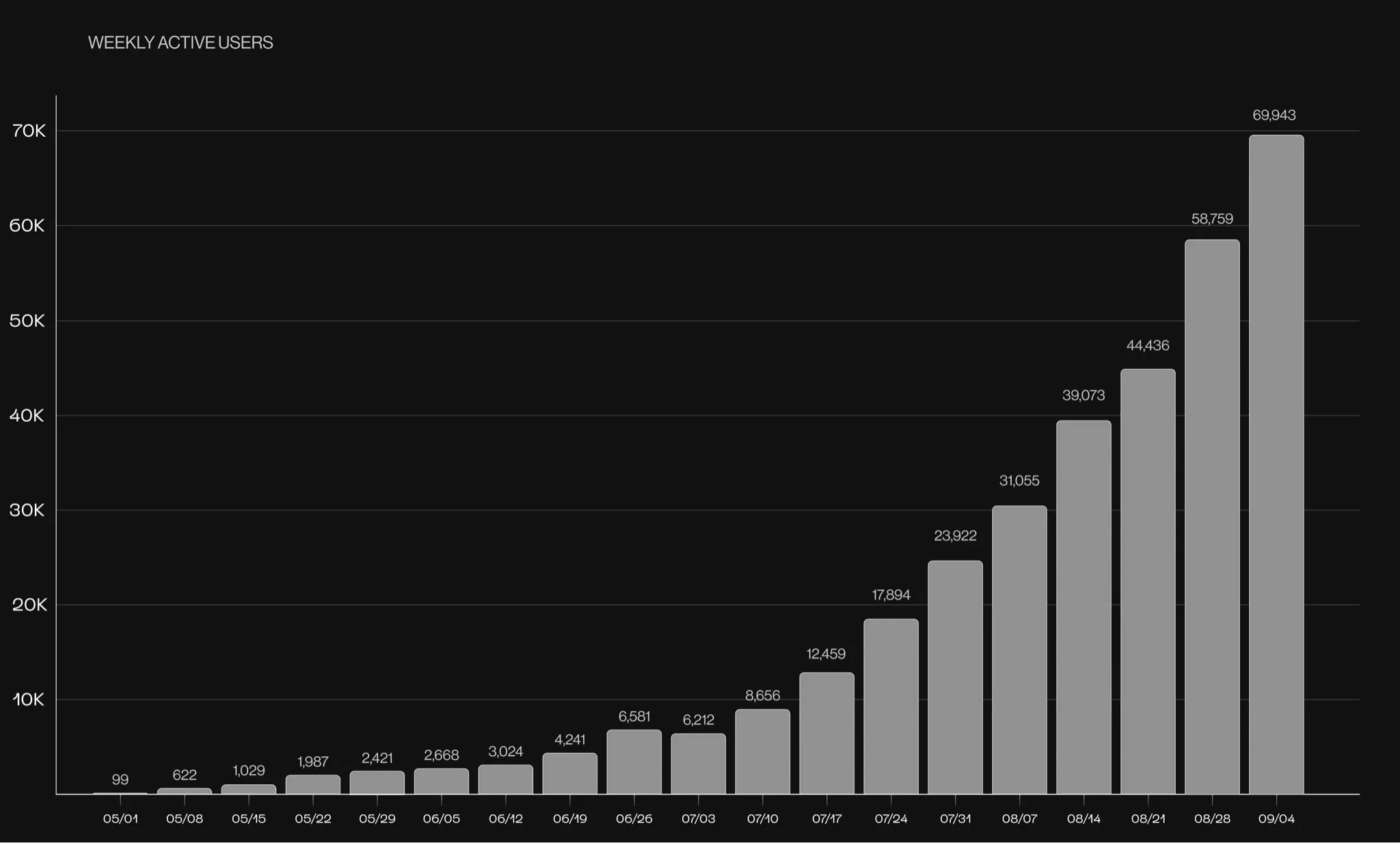
A weekly active user chart published by Adcock highlights the platform’s ramp-up curve:
The weekly humanoid robotics briefing
One email a week: the launches, funding and research that mattered, with context from Humanoids Daily.
Read recent issues- May 1, 2026: 99 weekly active users
- June 5, 2026: 2,668 weekly active users
- July 10, 2026: 8,656 weekly active users
- August 7, 2026: 31,055 weekly active users
- August 21, 2026: 44,436 weekly active users
- September 4, 2026: 69,943 weekly active users
At a velocity of 35 minutes of footage uploaded per second, the pipeline is processing roughly 5.7 years of physical human activity every 24 hours.
Fueling the Helix Pipeline
Figure positions this continuous stream of human demonstration as the cornerstone of its Helix foundation model architecture. While traditional robotics approaches lean heavily on teleoperation or synthetic physics engines, Figure is attempting to replicate the scaling laws of large language models by feeding raw real-world visual interactions into high-capacity multimodal models.
Raw uploads pass through an automated five-stage ingestion pipeline consisting of technical filtering, fraud screening, embedding-based deduplication, task rebalancing, and hierarchical text annotation. The resulting structured dataset is designed to help Figure’s humanoids achieve zero-shot generalization across novel objects and unstructured environments.
The acceleration in data intake also puts Figure's massive infrastructure plans into context. Just last week, the company announced a multi-billion-dollar compute agreement with Nscale to deploy up to 100,000 next-generation NVIDIA GPUs starting in late 2027.
Capital and Data as the Primary Moats
Adcock has repeatedly argued that hardware manufacturing is no longer the central roadblock for the industry. Having built more than 1,000 units of the Figure 03 and deployed machines into enterprise pilots with BMW and Catalyst Brands, leadership maintains that onboard intelligence remains the defining constraint.
With $15 million already disbursed to contributors and over $1 billion committed toward data acquisition and compute over the next year, Figure is treating real-world data collection as a capital-intensive scale problem.
Open questions remain regarding whether monocular smartphone video can provide the fine-grained force dynamics and tactile feedback required for intricate physical assembly. Nonetheless, the early growth trajectory of Index indicates that finding willing human contributors is not the bottleneck in Figure’s equation.
Share this article
Read next
- Published on
- Reading time
- 4 min read
Figure AI Unveils Index: Crowdsourcing Real-World Human Video to Train Helix
- Published on
- Reading time
- 6 min read
Figure’s Helix 2.5 Takes on Chores in 30 Unseen Homes
- Published on
- Reading time
- 4 min read
Generalist AI Unveils GEN-0, Claims Scaling Laws for Robotics Backed by 270,000 Hours of Real-World Data
- Published on
- Reading time
- 5 min read
The Physical AI Bottleneck: Comparing the Data Strategies of 1X, Figure, Tesla, and Neura
- Published on
- Reading time
- 4 min read
Physical Intelligence Finds 'Emergent' Bridge Between Human Video and Robot Action
- Published on
- Reading time
- 3 min read
Tesla Looks to Berlin Factory Workers to Help Train Optimus



The weekly humanoid robotics briefing
One email a week: the launches, funding and research that mattered, with context from Humanoids Daily.
Read recent issues