- Published on
Tokyo Now Has a Dedicated 911 Service—for Busted Humanoid Robots
One tap, and our reporting appears more often in your Google Top Stories. It makes a real difference to a small newsroom.


Your guide
Rich Robinson
Jee Chee Ren · Executive tour
See China’s AI and robotics ecosystem first-hand.
Six days exploring AI, robotics and advanced manufacturing.
With Rich Robinson, Clinical Professor of Entrepreneurship at Peking University
Beijing · Guangzhou · Shenzhen
29 November–4 December 2026
Referral partnership · We earn a commission on referred bookings.

- GMO AI & Robotics unveiled Japan's first Humanoid Ambulance, a specialized rapid-response van designed to repair broken bipedal machines on-site.
- The van is fully equipped with spare parts, diagnostic gear, and an onboard robot engineer who performs emergency field surgery.
- Alongside the ambulance, GMO rolled out GMO LOOP for Physical AI to train robots via real-time field data and added dedicated cybersecurity monitoring to stop unauthorized access.
- As humanoids tackle real-world jobs like baggage handling at Haneda Airport, rapid roadside assistance solves the looming bottleneck: costly, lingering downtime.
Imagine this: It’s rush hour at Haneda Airport. A fleet of sleek humanoid robots is briskly hauling heavy luggage, clearing baggage jams, and generally doing the backbreaking jobs humans are increasingly scarce to fill. Suddenly, one of them blows an actuator, stumbles into a wall, and freezes mid-stride.
Do you drag a 150-pound pile of metal and titanium across the terminal? Throw it in a taxi?
Tokyo has a much better—and wildly cinematic—solution. Say hello to the GMO Humanoid Ambulance, a legit emergency medical service for malfunctioning robots.
Code Red: Blown Actuator on Aisle 4
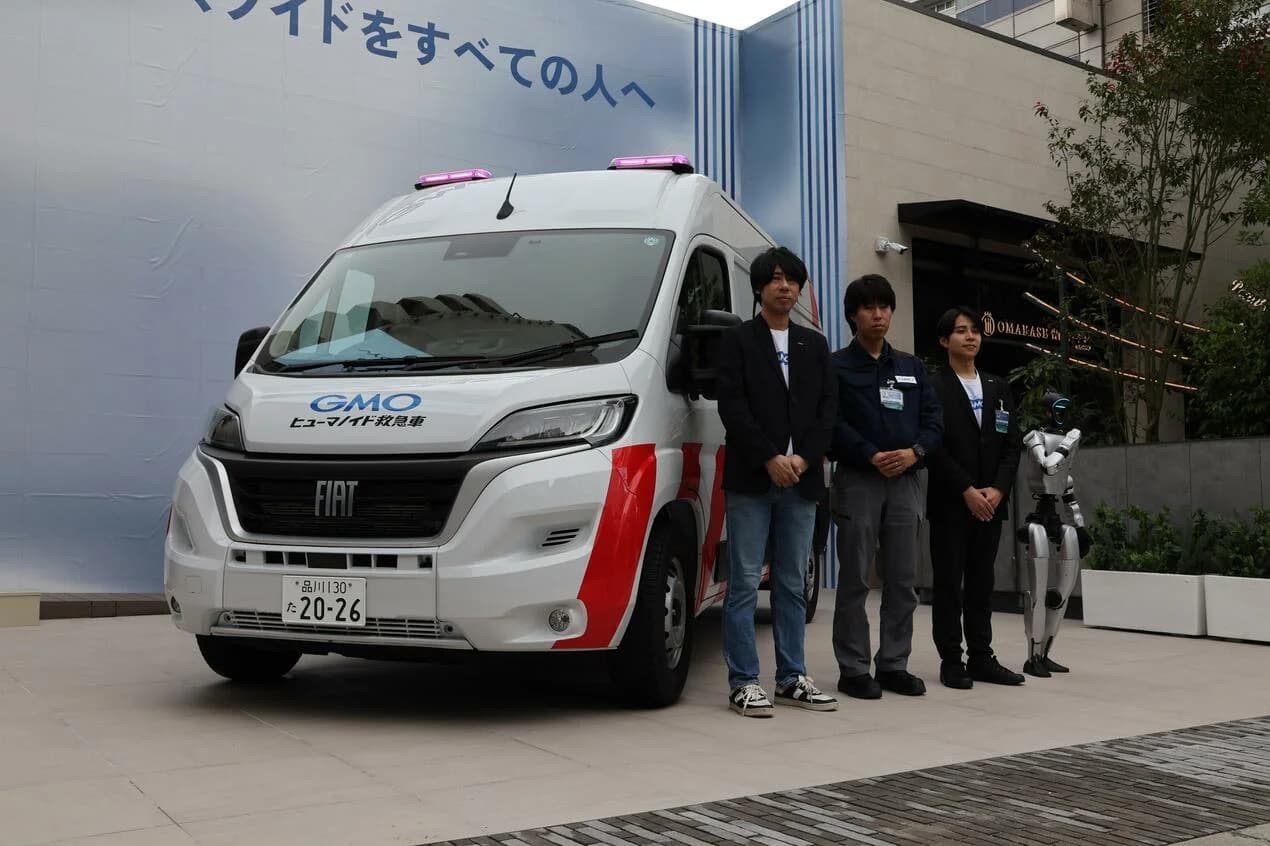
Unveiled this week by GMO AI & Robotics Corp., the Humanoid Ambulance looks remarkably like the real deal: a converted Fiat van rocking red emergency stripes, flashing rooftop lights, and the Japanese words for "Humanoid Ambulance" stamped cleanly on the front bumper.
The weekly humanoid robotics briefing
One email a week: the launches, funding and research that mattered, with context from Humanoids Daily.
Read recent issuesPeep into the back, though, and you won’t find heart defibrillators or oxygen masks. Instead, you'll see heavy-duty wrench sets, specialized diagnostics boards, replacement joints, and an actual medical-style stretcher with harness straps to wheel injured bipedal machines straight into the onboard operating bay.
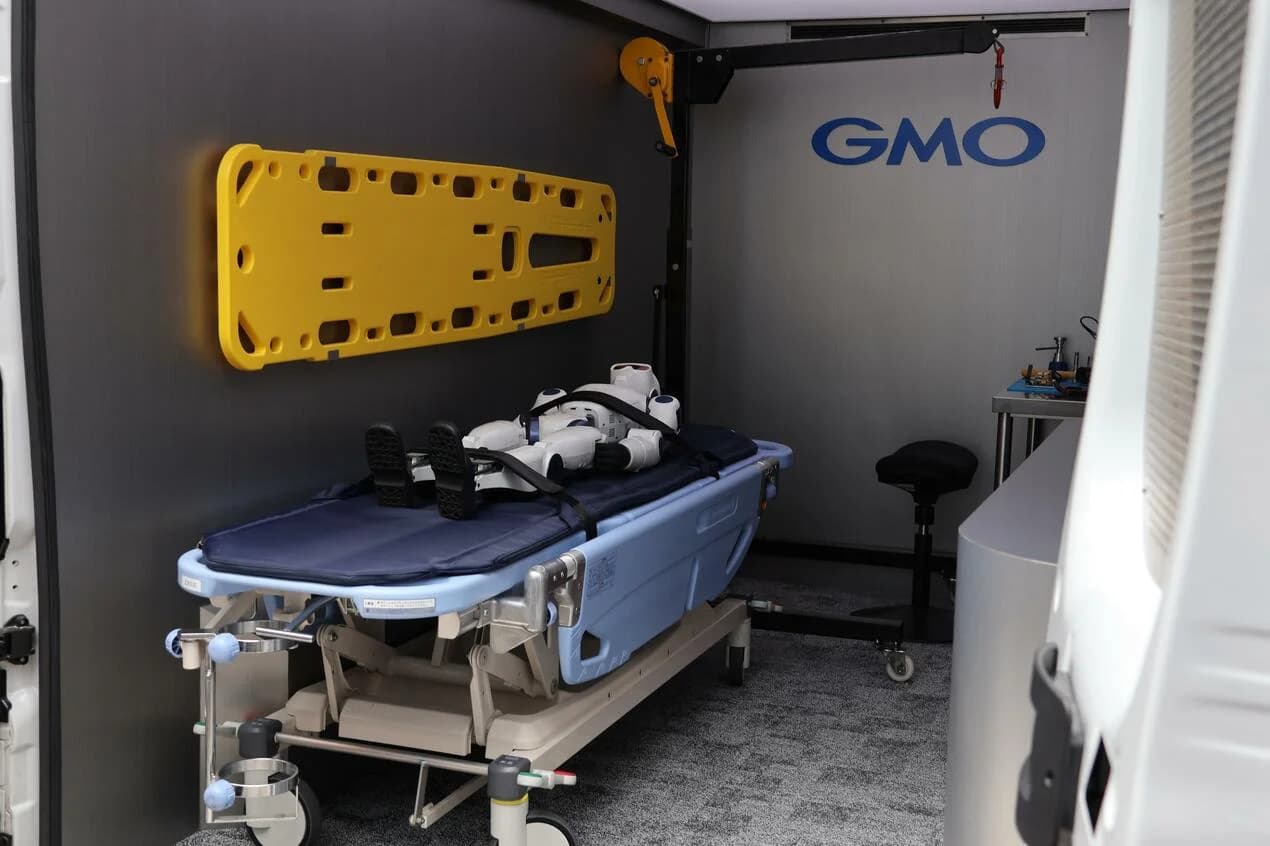
Each van rolls out with a dedicated robotics engineer riding shotgun, ready to perform emergency field repairs the second a robot crashes, bricks, or suffers a mechanical breakdown. According to GMO AIR President Tomohiro Uchida, the goal is straightforward: build the missing frontline infrastructure required before millions of humanoids actually hit the wild.
Building the 911 of Physical AI
Putting humanoids into factories and service stations is easy in carefully staged PR videos. Doing it in crowded public spaces is an entirely different beast.
When robots break down—and they will break down—a business can't afford to box up a machine and ship it across the country for a two-week RMA process. A broken robot idling in the corner is dead capital. Rapid roadside assistance turns a catastrophic shift failure into a 30-minute pit stop.
GMO’s roadside triage isn't just about spinning wrenches, either. The ambulance is part of a larger, full-stack service push:
- GMO LOOP for Physical AI: An optimization pipeline that takes live telemetry and failure data gathered on-site to continuously tweak and improve robot movement algorithms.
- Network Defense Patrol: Continuous security monitoring designed to spot rogue network traffic and prevent hackers from hijacking robotic fleets over the air.
The Robot Society Is Arriving Fast
If this all feels a little premature, look closer at what’s quietly unfolding across Japan.
Facing an aggressive demographic squeeze and massive labor shortages, the nation is moving fast to integrate physical AI into everyday commerce. GMO Internet Group and Japan Airlines already kicked off trials back in May using bipedal robots for ramp-side baggage handling at Tokyo’s Haneda airport. Meanwhile, telecom giant KDDI launched a pilot deployment at railway stations in Osaka to test humanoid concierges and customer service bots.
The Japanese government is simultaneously doubling down on domestic robotics and sovereign AI, determined to lead in security and practical physical automation.
Sure, seeing a tiny humanoid strapped tightly onto a foam gurney inside a van looks a bit adorable—if not slightly surreal. But as thousands of bipedal helpers clock into warehouses, airports, and train stations, don't be surprised if seeing a robot ambulance siren flashing in your rearview mirror becomes just another normal Tuesday.
Share this article
Read next
- Published on
- Reading time
- 3 min read
Donut Robotics Secures ¥300 Million Charm Care Alliance for Eldercare Humanoids
- Published on
- Reading time
- 3 min read
Kawasaki Plans Noetra-Powered Kaleido Rollout Around 2030, With Autonomy Expanding in Stages
- Published on
- Reading time
- 2 min read
Panasonic Targets Humanoid Robot Production by 2029, Citing Battery Safety
- Published on
- Reading time
- 6 min read
O-ID Raises $1.2M to Build Humanoids With Swappable Parts
- Published on
- Reading time
- 6 min read
SoftBank in Talks for Majority Stake in 1X at $6 Billion — Below the $10 Billion It Sought Last Year
- Published on
- Reading time
- 4 min read
Mitsubishi Electric and Chiba Tech Forge 3-Year Pact to Build "Homegrown" Physical AI



The weekly humanoid robotics briefing
One email a week: the launches, funding and research that mattered, with context from Humanoids Daily.
Read recent issues