- Published on
Kawasaki Plans Noetra-Powered Kaleido Rollout Around 2030, With Autonomy Expanding in Stages
One tap, and our reporting appears more often in your Google Top Stories. It makes a real difference to a small newsroom.


Kawasaki Heavy Industries plans to use Noetra’s Japanese physical AI platform in its Kaleido humanoid, with a rollout targeted as soon as 2030, according to Nikkei Asia. The report identifies Kaleido as the first planned adopter of Noetra’s physical AI.
The path to full autonomy will be gradual: initial operation will combine remote human control and AI, with autonomous capabilities expanding as Noetra’s platform develops.
- Kaleido is the first planned adopter of Noetra’s physical AI, according to Nikkei, with deployment targeted around 2030.
- Initial tasks include factory and warehouse patrols and parts transport; assembly is a later ambition.
- Kawasaki is already pitching the robot to automotive and semiconductor customers, while planning a staged transition toward full autonomy.
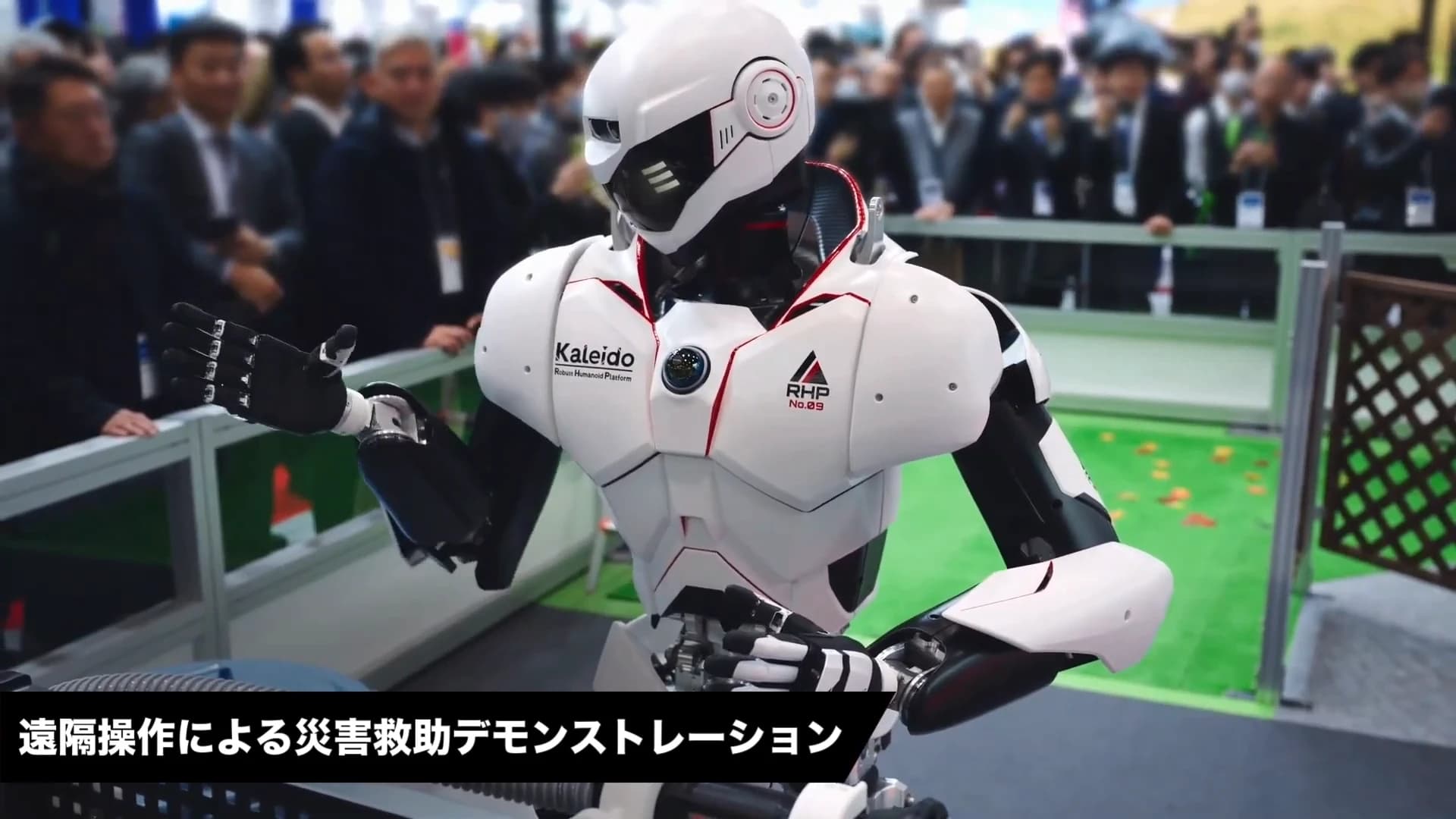
Kaleido has been in development since 2015. Its initial industrial role will focus on relatively simple work, including patrolling facilities and moving parts. Updates would enable more demanding tasks such as product assembly, Nikkei reports.
That makes the deployment sequence important. Although Nikkei’s headline emphasizes a fully autonomous humanoid by 2030, the article describes a combination of remote operation and AI at the outset, followed by expanding autonomy. Full autonomy is the eventual goal; the report does not establish that every intended task will be autonomous at launch.
The weekly humanoid robotics briefing
One email a week: the launches, funding and research that mattered, with context from Humanoids Daily.
Read recent issuesKawasaki’s own March 2026 overview of Kaleido 9 provides a useful baseline. It describes demonstrated autonomous walking with obstacle avoidance, supported by LiDAR-based localization, alongside remote-operated disaster-rescue demonstrations. Its roadmap places remote-assisted work in controlled environments around 2030 and autonomous operation in unstructured environments around 2040. Those are different deployment scopes, so the newer Noetra report does not by itself establish that the entire roadmap has been brought forward.
Noetra’s timetable is closely tied to that progression. Its July announcement sets out plans for an omni-modal foundation model by fiscal 2028 and real-world AI capable of understanding physical properties by fiscal 2030. Sony, SoftBank, NEC and Honda are core members, and Kawasaki is among its investors.
Kawasaki also intends to combine Noetra’s technology with work from its physical AI collaboration with NVIDIA, announced in May, to advance more complex and precise autonomous movements, according to Nikkei. The two relationships put Kaleido within a wider effort to connect Japan’s manufacturing expertise with developing AI capabilities.
Kawasaki’s longer-term scale target extends beyond humanoids. Nikkei reports an ambition for tens of thousands of robots in operation by 2040, encompassing wheeled machines, quadrupeds and hospital transport robots as well as Kaleido.
Share this article
Read next
- Published on
- Reading time
- 2 min read
Panasonic Targets Humanoid Robot Production by 2029, Citing Battery Safety
- Published on
- Reading time
- 6 min read
O-ID Raises $1.2M to Build Humanoids With Swappable Parts
- Published on
- Reading time
- 4 min read
Tokyo Now Has a Dedicated 911 Service—for Busted Humanoid Robots
- Published on
- Reading time
- 6 min read
SoftBank in Talks for Majority Stake in 1X at $6 Billion — Below the $10 Billion It Sought Last Year
- Published on
- Reading time
- 4 min read
Mitsubishi Electric and Chiba Tech Forge 3-Year Pact to Build "Homegrown" Physical AI
- Published on
- Reading time
- 4 min read
Tokyo Robotics Steps Into the Bipedal Arena with RL-Driven Humanoid

The weekly humanoid robotics briefing
One email a week: the launches, funding and research that mattered, with context from Humanoids Daily.
Read recent issues