- Published on
Watch: Foundation Puts Phantom Through a Gauntlet of Marbles and Banana Peels
One tap, and our reporting appears more often in your Google Top Stories. It makes a real difference to a small newsroom.


Your guide
Rich Robinson
Jee Chee Ren · Executive tour
See China’s AI and robotics ecosystem first-hand.
Six days exploring AI, robotics and advanced manufacturing.
With Rich Robinson, Clinical Professor of Entrepreneurship at Peking University
Beijing · Guangzhou · Shenzhen
29 November–4 December 2026
Referral partnership · We earn a commission on referred bookings.
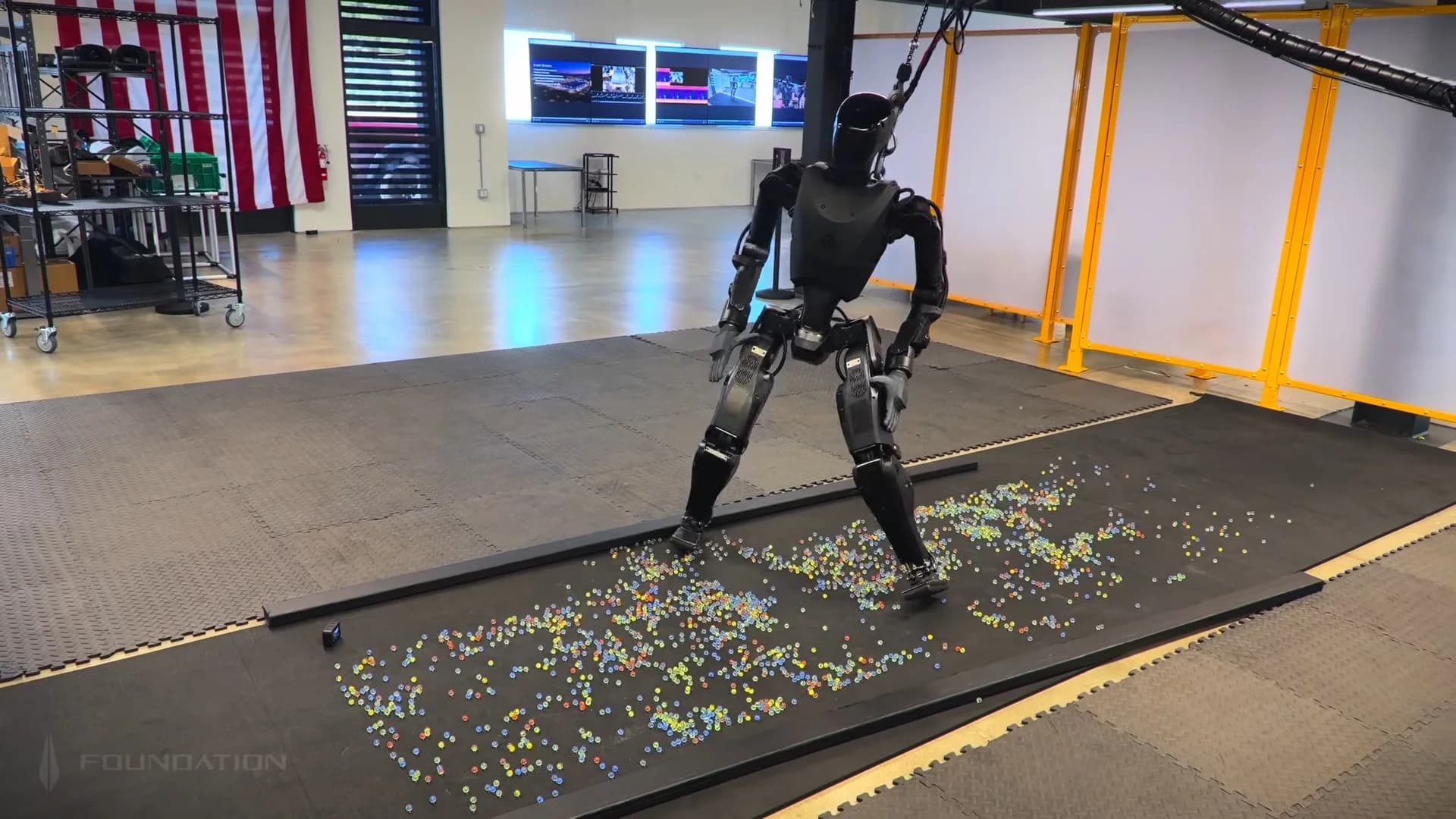
Foundation Robotics has released a new video titled "The Walking Test," trading its usual militant rhetoric for a more experimental—and occasionally comedic—look at the Phantom MK1’s physical resilience. The footage shows the humanoid navigating a series of household hazards, ranging from Lego bricks and packing peanuts to the "age-old question" of banana peels.
While the presentation is lighthearted, the engineering goal is serious: discovering the "edges of its abilities" to refine the robot's fundamental mobility.
The "Spinal Cord" vs. The Brain
The demonstration highlights a specific subset of the Phantom’s architecture: the "whole-body controller." Described by Foundation as the robot's "spinal cord," this system translates coarse movement commands into fine-tuned adjustments for the six motors in each leg.
Notably, this specific test was conducted "blind." Unlike the six-camera array housed in the Phantom's head assembly, the balance policy used in this video ignores visual data. Instead, it relies on:
The weekly humanoid robotics briefing
One email a week: the launches, funding and research that mattered, with context from Humanoids Daily.
Read recent issues- Foot Torque Sensors: Determining if and how the robot is making contact with the ground.
- IMU Sensors: A suite of Inertial Measurement Units located in the legs, pelvis, arms, and head to track the "gravity vector" and the robot's center of mass.
By ignoring vision, Foundation is testing the robot's ability to react to physical perturbations—like slipping on a marble—solely through proprioception and haptic feedback. This contrasts with the company’s higher-level Deep Variational Bayes Filters (DVBF), which are designed to help the robot "infer" or predict the physics of its environment before it makes contact.
Sim-to-Real and Manual Control
The video clarifies that this specific balance policy was developed using reinforcement learning (RL). The system is trained in a simulation environment through millions of trials of "success and failure" before being transferred to the physical hardware.
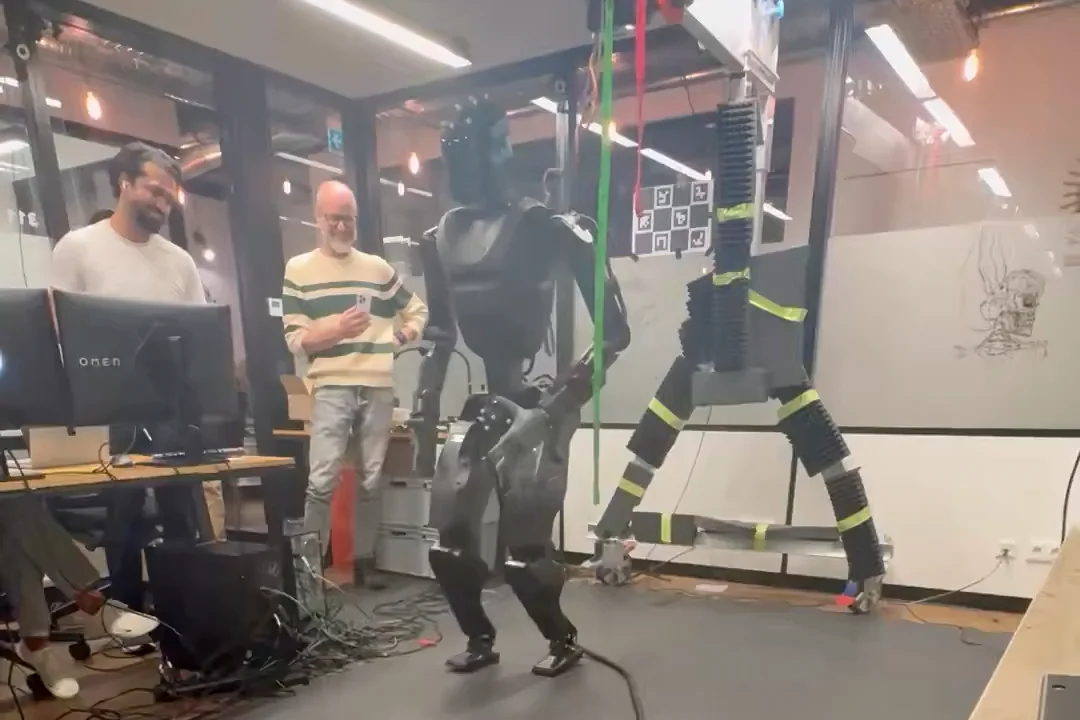
During the "Walking Test," a technician used a standard PlayStation controller to direct the robot's gait. While the balance remains autonomous, the direction and rotation are handled by a human operator—a setup Foundation views as essential for defense applications where a "human in the loop" must make high-level tactical decisions.
The Banana Peel Factor
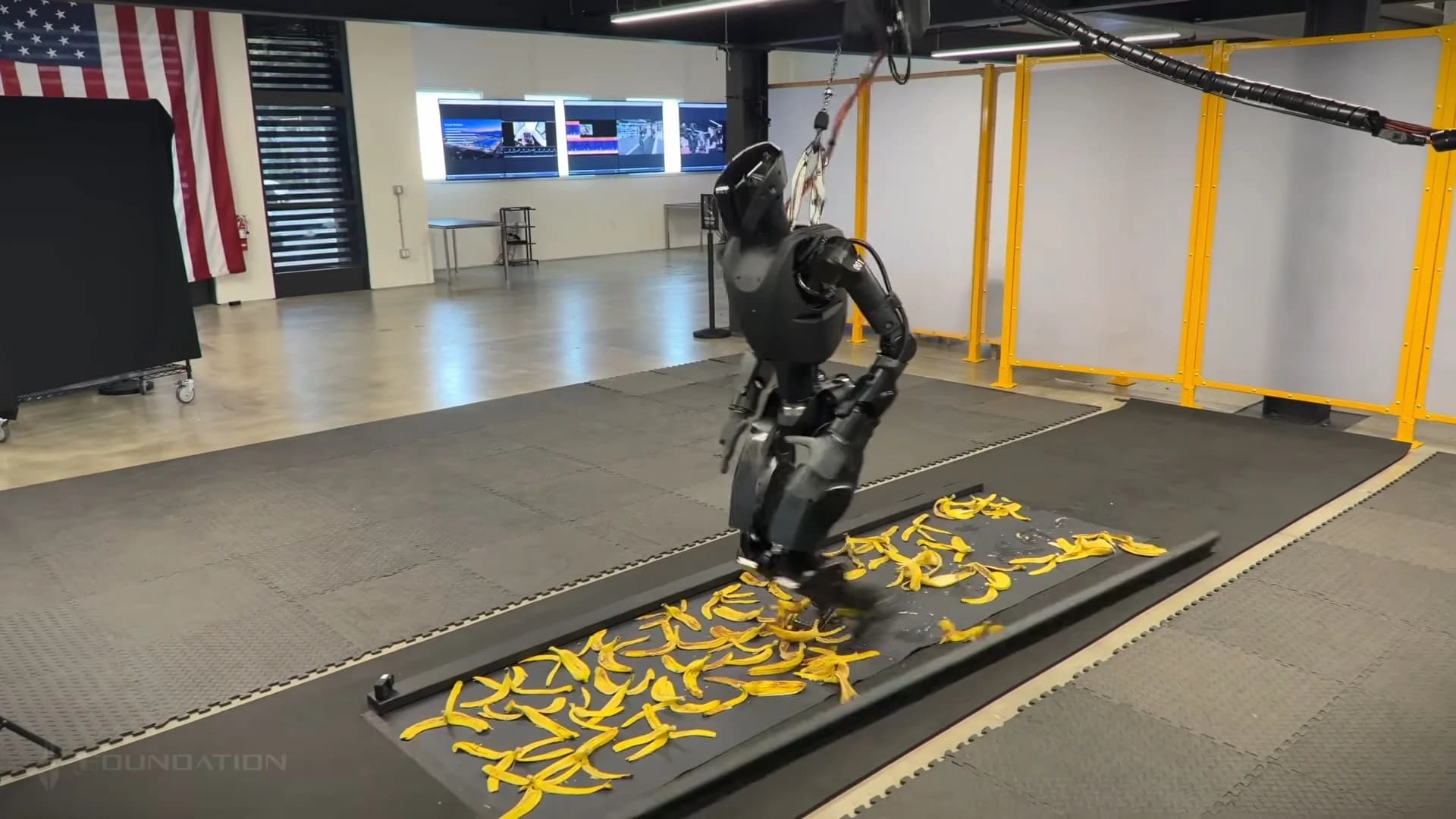
The results of the gauntlet were mixed, highlighting the "sim-to-real gap" that remains a hurdle for the industry. While the Phantom successfully navigated a field of mouse traps and waded through marbles, the banana peel proved to be its undoing. The robot suffered a significant slip and was only saved from a "trip to the Robot Hospital" by its safety gantry.
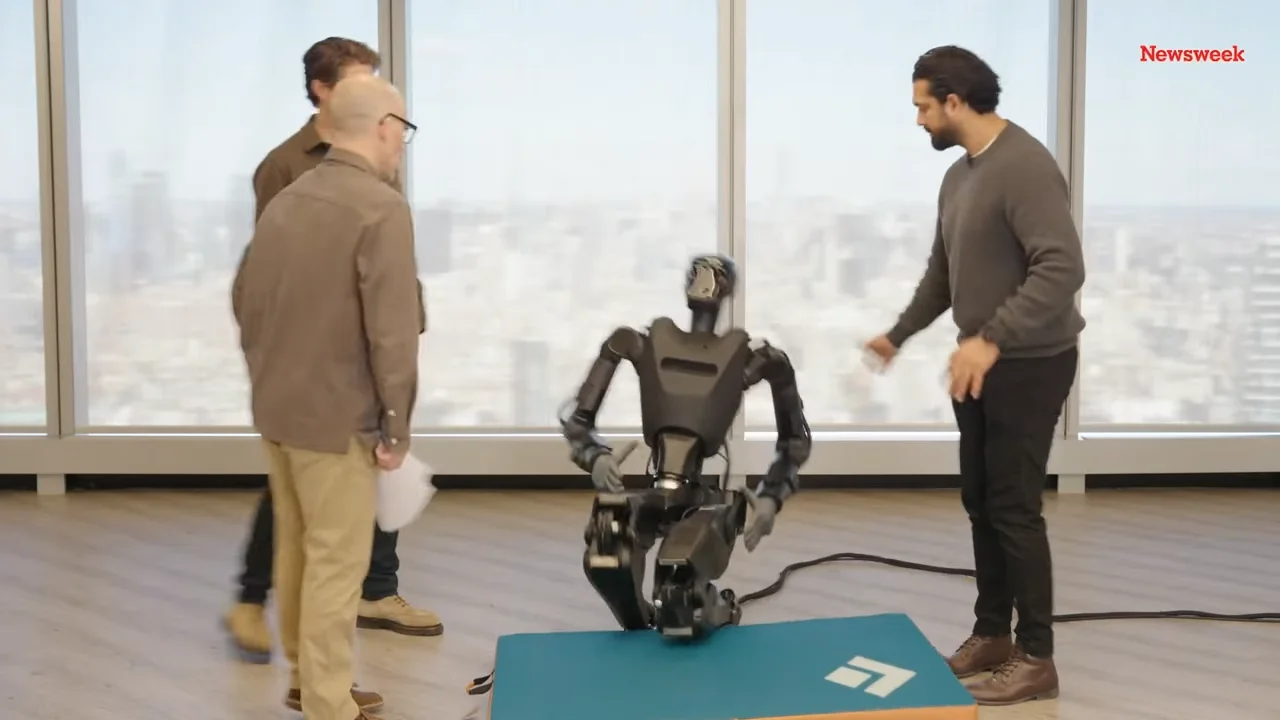
This reliance on a tether serves as a reminder of the hardware's current fragility. Foundation has previously struggled with public hardware failures, including a high-profile crash at Newsweek’s headquarters. The use of a gantry in this video suggests that while the "spinal cord" is maturing, the Phantom is not yet ready to navigate unstructured, slippery environments without a literal safety net.
Scaling for "Dangerous Tasks"
Foundation frames these experiments as a necessary step toward its goal of a general-purpose humanoid. CEO Sankaet Pathak argues that mastering these "basic" mobility challenges is what will eventually allow the Phantom to perform tasks that are "too dangerous or repetitive for humans"—ranging from automotive manufacturing to setting up mouse traps or navigating battlefields in War.
The company continues to pursue an aggressive roadmap, aiming to scale production to thousands of units in 2026. Whether the Phantom can move from the controlled environment of the "Walking Test" to the unpredictable reality of a commercial or military deployment—without its tether—remains the central question for the San Francisco startup.
Watch the full demonstration below:
Share this article
Read next
- Published on
- Reading time
- 5 min read
Foundation Robotics CEO Details Ukraine Pilot, "Super-Heavy" Phantom 2, and Rejection of Companion Bots
- Published on
- Reading time
- 4 min read
Decoupling the Brain: Inside Foundation’s Phantom Head Assembly
- Published on
- Reading time
- 4 min read
"Peace Through Strength": Foundation CEO Showcases Phantom Robot on Fox Business
- Published on
- Reading time
- 5 min read
Watch: Inside Foundation’s Humanoid Factory and the Anatomy of a "War Machine"
- Published on
- Reading time
- 5 min read
Foundation Robotics Leans Into the "Killer App" — Literally
- Published on
- Reading time
- 3 min read
Foundation’s 20-Minute Uncut Walking Video Is Deliberately Unimpressive

The weekly humanoid robotics briefing
One email a week: the launches, funding and research that mattered, with context from Humanoids Daily.
Read recent issues