- Published on
Unitree Enters H1 in Beijing Marathon, Distances Itself from Independent Teams
One tap, and our reporting appears more often in your Google Top Stories. It makes a real difference to a small newsroom.


Your guide
Rich Robinson
Jee Chee Ren · Executive tour
See China’s AI and robotics ecosystem first-hand.
Six days exploring AI, robotics and advanced manufacturing.
With Rich Robinson, Clinical Professor of Entrepreneurship at Peking University
Beijing · Guangzhou · Shenzhen
29 November–4 December 2026
Referral partnership · We earn a commission on referred bookings.
The world’s most prolific humanoid manufacturer is no longer sitting on the sidelines. Unitree Robotics has officially confirmed it will participate in the second annual Beijing Humanoid Robot Half-Marathon on April 19, 2026.
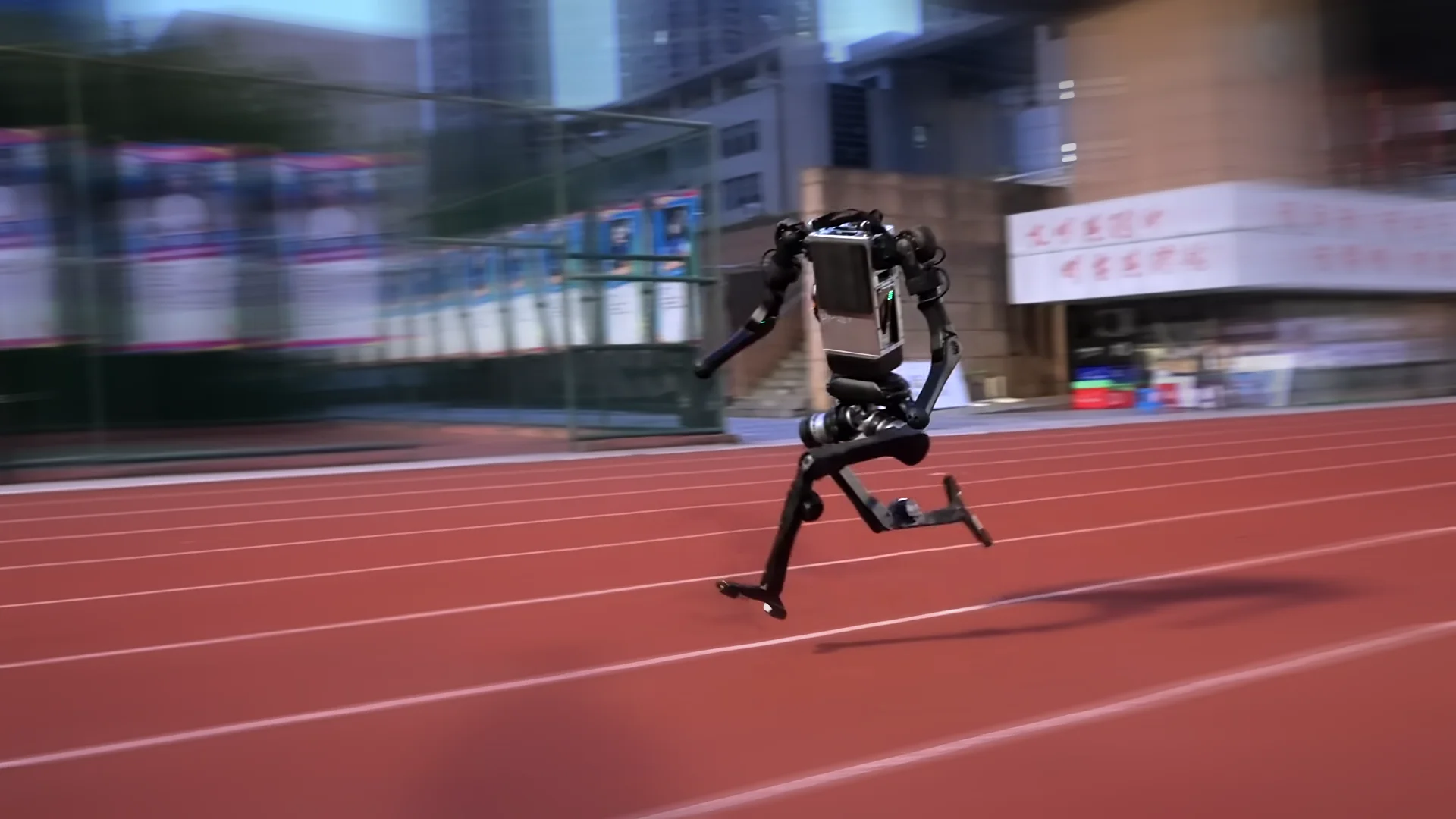
The announcement, shared via social media, marks a significant shift in strategy for the Hangzhou-based company. According to Unitree, they will officially enter a "fine-tuned" version of their H1 model for the 21.0975-kilometer (13-mile) race. Internal testing data released by the company suggests the H1 is capable of completing a half-marathon in roughly 50 to 60 minutes, a pace that would easily eclipse the 2 hour and 40 minute winning time set by the "Tiangong Ultra" last year.
Official Entry vs. Independent Teams
Unitree’s decision to enter officially comes with a clear caveat: the company is only supporting the H1. While other Unitree platforms—most notably the mass-market G1—have been spotted in training footage on Beijing tracks, the company clarified that these are being fielded by "multiple independent teams" using self-developed systems.
This distinction is likely a defensive maneuver to protect the brand's reputation. During the inaugural 2025 race, Unitree did not officially participate. However, several third-party teams used Unitree hardware, leading to high-profile failures that were widely ridiculed on social media. At the time, Unitree was forced to issue a statement clarifying that they "had never planned to participate" and that a robot's performance depends heavily on the "operator's proficiency" and custom software.
The weekly humanoid robotics briefing
One email a week: the launches, funding and research that mattered, with context from Humanoids Daily.
Read recent issuesBy entering the H1 officially this year, CEO Wang Xingxing is putting the company’s internal engineering to the test, ensuring that if a Unitree robot fails or succeeds, it does so under the company's direct control.
Training for 10 m/s
The "fine-tuned" H1 entered in the marathon is the same platform that recently reclaimed the world speed record with a peak velocity of 10 meters per second (m/s). Unitree’s "Training Journey" roadmap shows a rapid acceleration in performance leading up to the race:
- Late February 2026: 5+ m/s
- March 2026: 8+ m/s
- April 2026: 10 m/s
While a 10 m/s sprint is a feat of raw power, a half-marathon is a test of thermal management and battery endurance. Unitree’s internal best of a sub-60-minute half-marathon suggests they have solved the efficiency hurdles that plagued last year's competitors.
Scaling Toward the IPO
This official appearance in Beijing serves as a high-stakes demonstration of "standardized high performance" just as Unitree moves toward its $580 million IPO on the Shanghai Stock Exchange. With plans to ship 20,000 units in 2026, a dominant showing in Beijing would provide the "utility validation" investors are looking for.
As the race moves toward a more autonomous navigation format, all eyes will be on whether Unitree’s official H1 can maintain its record-breaking speed over 13 miles without the stumbles that defined the 2025 event.
Share this article
Read next
- Published on
- Reading time
- 4 min read
Unitree H1 Reclaims Speed Record with Blistering 10 m/s Sprint
- Published on
- Reading time
- 5 min read
Robot Combat Enters the Ring: REK and UFB Launch Competing US Fighting Leagues
- Published on
- Reading time
- 3 min read
Confirmed: Unitree H2 Specs Reveal a 31-DOF Humanoid with a Major Hardware Overhaul
- Published on
- Reading time
- 4 min read
Unitree Unveils H2, a Full-Sized Humanoid Successor to the H1
- Published on
- Reading time
- 3 min read
Unitree CEO Predicts R1 Will Be a Bestseller, Teases Larger 1.8-Meter Humanoid
- Published on
- Reading time
- 6 min read
Reborn and Unitree Team Up to Accelerate Humanoid AI with Open-Source Roboverse
The weekly humanoid robotics briefing
One email a week: the launches, funding and research that mattered, with context from Humanoids Daily.
Read recent issues