- Published on
XPENG Highlights GroundingPI, a Vision Model for More Data-Efficient Robot Learning
One tap, and our reporting appears more often in your Google Top Stories. It makes a real difference to a small newsroom.

- GroundingPI specializes in visual grounding: identifying where an object or a particular part is located in an image.
- In the simulated RoboCasa-GR1 benchmark, policies using GroundingPI with 50% of the demonstrations outperformed comparison models using 75%.
- Code and model weights are available, but the reported robot results do not establish readiness for real-world deployment.
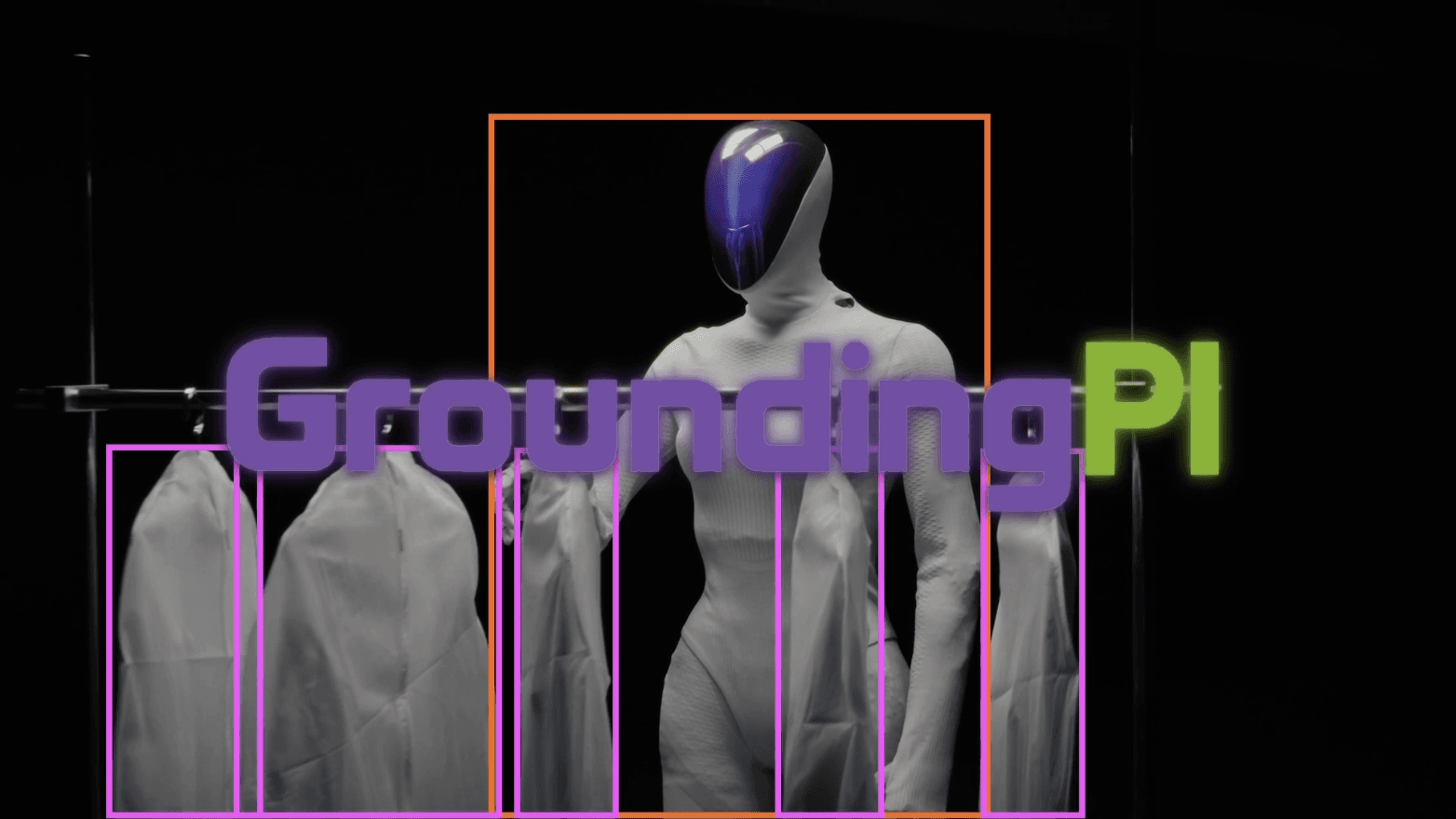
XPENG has highlighted GroundingPI, a roughly four-billion-parameter visual perception model designed to help AI systems locate objects and their parts more precisely. Developed by researchers affiliated with XPENG and academic partners, the model showed promising results when used as the visual foundation for robot policies, including simulated humanoid manipulation with fewer training demonstrations.
The company’s November 4 announcement describes an open research effort involving Peking University, the University of Hong Kong and other institutions. It does not announce deployment in XPENG’s IRON humanoid or another commercial product.
A more precise visual foundation
GroundingPI represents locations using points and bounding boxes. That allows a request such as finding the handle of a particular cup to produce a location that a downstream system can act on, rather than only a description of the scene.
According to the project website, the model uses a shared coordinate vocabulary across tasks ranging from object detection and text recognition to interface understanding and spatial perception. The research paper appeared on September 30, with model weights and code following in early October; XPENG’s announcement brings attention to an already-public project.
Follow humanoid robotics without following every announcement.
Get the week’s most important launches, funding and research—and why they matter—in one email from Humanoids Daily.
Once a week. Unsubscribe anytime.
Read recent issuesAcross 34 benchmarks covering 11 capability categories, the researchers report an aggregate score of 73.68, compared with 71.54 for GPT-6 Astra. That result uses equal weighting across the categories and measures this particular perception suite. It is not a claim that GroundingPI surpasses a frontier model across general intelligence or reasoning.
What the robot experiments show
The more relevant result for humanoid developers concerns how that perception transfers into action learning.
In the paper’s robot experiments, the researchers paired different pretrained visual foundations with the same action-model architecture. Within each benchmark, they held the action-training data, optimization budget and other policy settings fixed to examine the contribution of the visual foundation.
The tests covered fixed-base, two-arm manipulation in RoboTwin 2.0 and humanoid dexterous-hand manipulation in RoboCasa-GR1. In the latter, GroundingPI’s advantage persisted when it received only half the available demonstrations while comparison models received three-quarters. The project also reports improvements across four RoboTwin tests involving conditions outside the training distribution.
GroundingPI’s perception training does not use robot action labels. However, downstream policies still learn from robot demonstrations: these results do not show a robot learning a new physical task without action data.
The authors also identify remaining weaknesses, including some small-object localization and text-recognition tasks. Dynamics, contact and feedback control remain the responsibility of the downstream policy. For humanoid builders, the research therefore offers evidence that better visual grounding can improve learning efficiency in simulation, while leaving the question of reliable physical deployment open.
Share this article
Follow humanoid robotics without following every announcement.
Get the week’s most important launches, funding and research—and why they matter—in one email from Humanoids Daily.
Once a week. Unsubscribe anytime.
Read recent issuesRead next
- Published on
- Reading time
- 3 min read
XPENG Says IRON’s Solid-State Battery Has Entered Small-Batch Production
- Published on
- Reading time
- 2 min read
XPENG Shows IRON Switching Between Handshakes, Fist Bumps and High-Fives
- Published on
- Reading time
- 3 min read
XPENG Targets H2 2027 European Rollout for IRON Humanoid Robot
- Published on
- Reading time
- 4 min read
XPENG Lines Up Humanoid Suppliers Ahead of Year-End Production Target
- Published on
- Reading time
- 4 min read
XPENG’s IRON Remembers Car Buyers in New Interaction Demo
- Published on
- Reading time
- 6 min read
Inside XPENG’s Bet on IRON: He Xiaopeng on Why the Hardest Path in Humanoid Robotics Is Never Crowded