- Published on
Figure Completes $100 Million Employee Tender Offer as Robotics Talent War Intensifies
One tap, and our reporting appears more often in your Google Top Stories. It makes a real difference to a small newsroom.


Your guide
Rich Robinson
Jee Chee Ren · Executive tour
See China’s AI and robotics ecosystem first-hand.
Six days exploring AI, robotics and advanced manufacturing.
With Rich Robinson, Clinical Professor of Entrepreneurship at Peking University
Beijing · Guangzhou · Shenzhen
29 November–4 December 2026
Referral partnership · We earn a commission on referred bookings.
- Figure has finalized a $100 million employee tender offer to provide its technical staff with early liquidity.
- CEO Brett Adcock confirmed that he did not participate in the share sale and has never sold any of his Figure equity.
- The announcement has sparked a significant industry debate regarding the timing of liquidity events before widespread commercialization of hardware.
- High-profile sector figures, including representatives from 1X Technologies and Physical Intelligence, traded opposing views on the ethics and structural importance of early tech compensation.
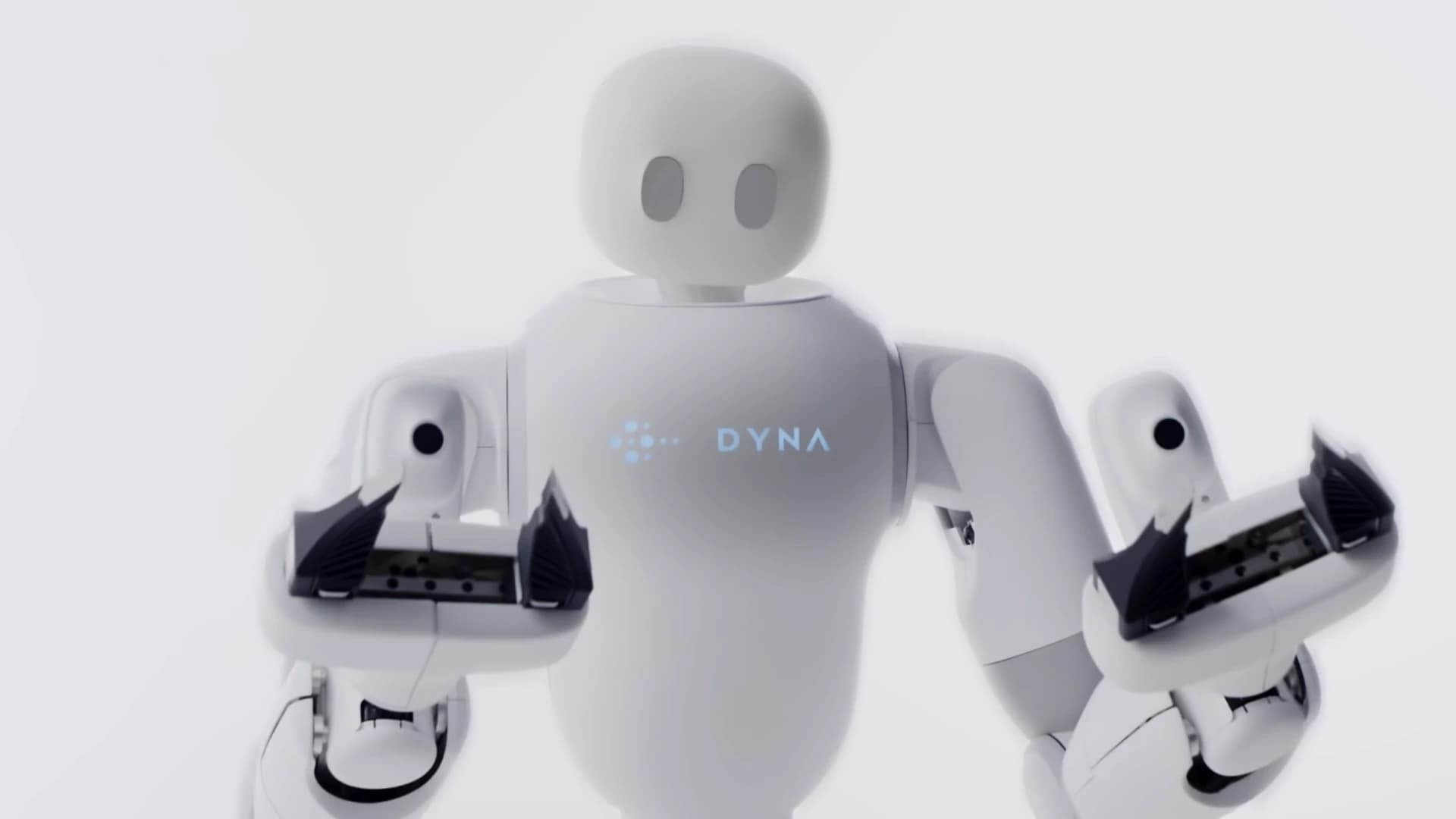
In an industry where the timeline to widespread commercial viability remains measured in years, hardware startups are increasingly turning to financial engineering to retain top-tier engineering talent. Figure CEO Brett Adcock announced that the humanoid robotics firm has completed a $100 million employee tender offer, allowing early staff to convert a portion of their equity into cash.
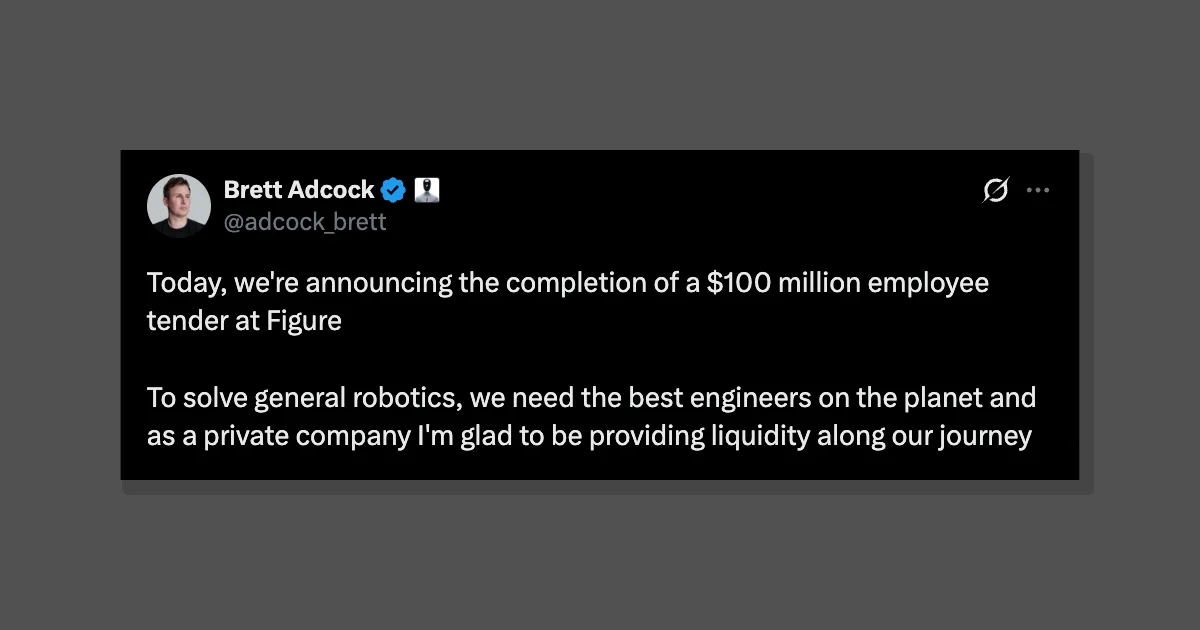
According to Adcock, the secondary sale is an explicit strategy to maintain a competitive advantage in an increasingly cutthroat recruitment landscape. "To solve general robotics, we need the best engineers on the planet, and as a private company I’m glad to be providing liquidity along our journey," Adcock stated. He later confirmed that the liquidity event was structured strictly for the workforce, noting that he did not participate in the tender and has never sold any of his personal Figure stock.
The Recruiting Mechanics of Early Liquidity
In the startup ecosystem, paper wealth often locks engineers into long development cycles with no guarantee of an eventual payout. By offering a pre-IPO exit path, Figure aims to alter the calculus for highly specialized robotics engineers who hold multiple competing offers across the AI and hardware sectors.
The move comes at a time when Figure is aggressively pushing to validate its immense financial backing. Valued at $39 billion following a major Series C funding round, the company is in a relentless race against heavily capitalized tech giants. Adcock has previously framed the humanoid competition as a pure sprint to scale, emphasizing that victory belongs to whichever firm can deploy hundreds of thousands of units into the market first. Capitalizing on that momentum, Figure recently signed a milestone commercial agreement with retail holding company Catalyst Brands to deploy its autonomous machines into real-world logistics infrastructure.
The weekly humanoid robotics briefing
One email a week: the launches, funding and research that mattered, with context from Humanoids Daily.
Read recent issuesA secondary market transaction completely reshapes hiring conversations for a private firm trying to hit those aggressive deployment targets. For engineers deciding where to dedicate their careers, the ability to achieve a tangible, near-term monetization path for equity serves as a powerful retention mechanism. Adcock agreed with this assessment, calling early liquidity "super important for both retention as well as hiring." Following the completion of the program, Adcock joked on social media about the influx of wealth, posting an image of a parking lot packed with luxury sports cars captioned "Figure parking lot on Monday."
Industry Backlash and Ethical Debates
While the financial transaction provides an obvious benefit to Figure's workforce, the public celebration of the tender offer quickly drew sharp criticism from within the robotics community, highlighting a cultural divide on how hardware startups should operate.
Dar Sleeper, the Vice President of Design and Product at competitor 1X Technologies—the firm currently ramping up its own vertically integrated production facility in Hayward, California—expressed strong disapproval of the optics and philosophy behind the move. "I hate this post," the 1X executive wrote in response to the parking lot joke. "I don’t believe in taking money off the table until you’ve created real value for real people." He argued that early windfalls conflict with the foundational support systems that enable founders and early teams to build technology in the first place, adding that his own future liquidity would be directed toward supporting family rather than luxury vehicles.
The critique reflects a broader sentiment held by some hardware purists who believe that financial rewards should be strictly tied to shipping functional, revenue-generating products to market, rather than venture-backed capital milestones. It also mirrors the fundamental philosophical divide between the two companies: while 1X relies heavily on a human-in-the-loop strategy to gather operational data, Figure has historically rejected teleoperation in favor of pure, autonomous neural network execution from day one.
The Reality of Startup Equity Risk
However, other prominent research engineers rushed to defend the structural necessity of employee payouts, pointing to the high casualty rate of heavily funded automation startups.
Kyle Vedder, a robot learning researcher at Physical Intelligence—a startup that recently introduced its own general-purpose π0.7 model—argued that employee compensation should be celebrated regardless of corporate rivalries, invoking past industry failures as a cautionary tale. "I was at the all hands when Argo AI announced they were shutting down," Vedder shared. "People worked for years in part on the promise that their little slice of the company would one day be worth enough to secure their kids' financial future."
The collapse of Argo AI in 2022—an autonomous vehicle pioneer backed by billions from Ford and Volkswagen—serves as a stark reminder of how quickly paper equity can evaporate in capital-intensive deep tech sectors. For engineers devoting years of specialized labor to unproven platforms, tender offers like Figure’s mitigate that existential risk.
Figure has shown remarkable endurance in the lab, recently concluding a grueling 200-hour continuous autonomous sorting marathon without a single hardware breakdown. Yet, as the industry transitions from controlled environments to the unpredictable chaos of commercial deployment, the path to a fully generalized robot remains a massive financial gamble. For the workforce building that future, a $100 million liquidity injection ensures that the workers themselves receive guaranteed compensation, regardless of how long the steep climb to widespread commercialization takes.
Share this article
Read next
- Published on
- Reading time
- 5 min read
Figure Melts Figure 02 With Arnold Schwarzenegger in a Terminator-Style Sendoff
- Published on
- Reading time
- 3 min read
Hasta La Vista, Figure 02: Adcock Teases a Terminator-Style Sendoff
- Published on
- Reading time
- 2 min read
Brett Adcock’s vehicle clip echoes Figure 03’s delivery demo
- Published on
- Reading time
- 6 min read
Figure CEO Brett Adcock Claims Humanoids Are Already Delivering ROI Amid Severe Labor Shortages
- Published on
- Reading time
- 4 min read
Stepping Up: Figure 03 Achieves Autonomous Ladder Climbing, Reigniting the Bipedal Debate
- Published on
- Reading time
- 4 min read
A Golden Milestone: Figure Manufactures Its 1,000th Figure 03 Humanoid
The weekly humanoid robotics briefing
One email a week: the launches, funding and research that mattered, with context from Humanoids Daily.
Read recent issues