- Published on
Inside Sprout: Fauna Robotics Pulls Back the Curtain on its Soft-Bodied Humanoid
One tap, and our reporting appears more often in your Google Top Stories. It makes a real difference to a small newsroom.

Supported by RoboStrategySupport for Humanoids Daily comes from RoboStrategy
Sponsored
Investing involves risk, including possible loss of principal. Read the prospectus before investing.
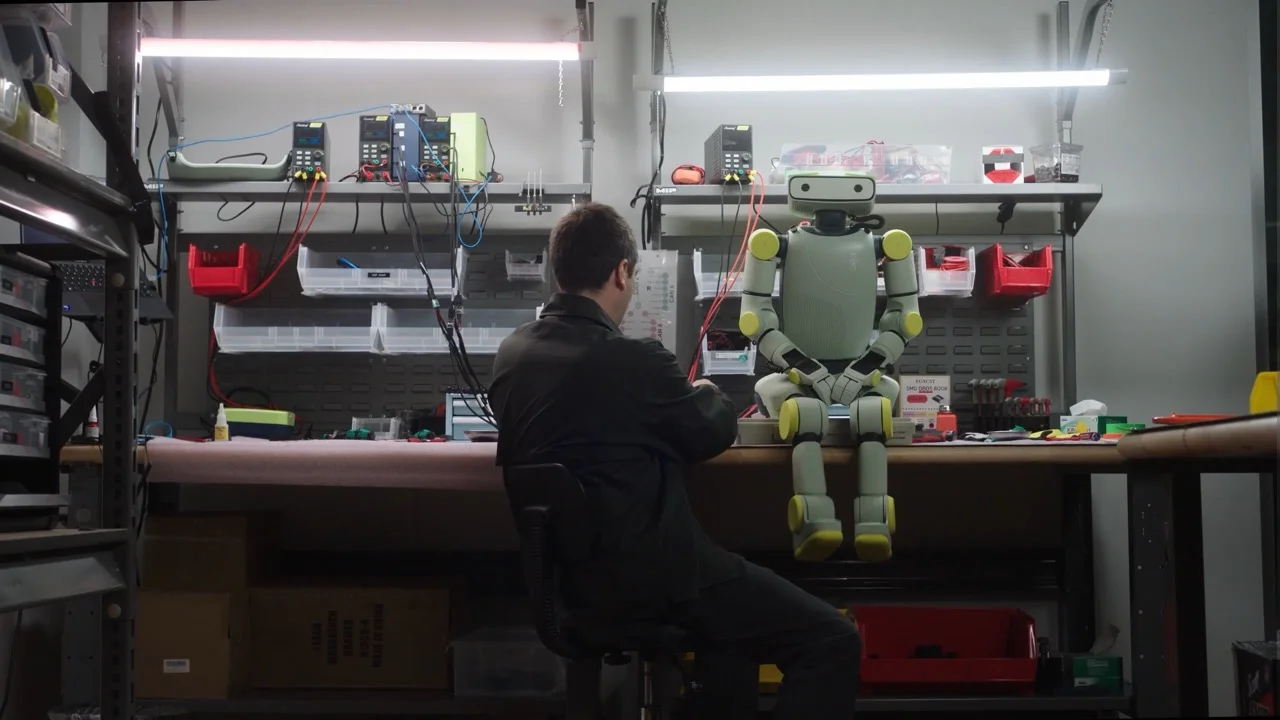
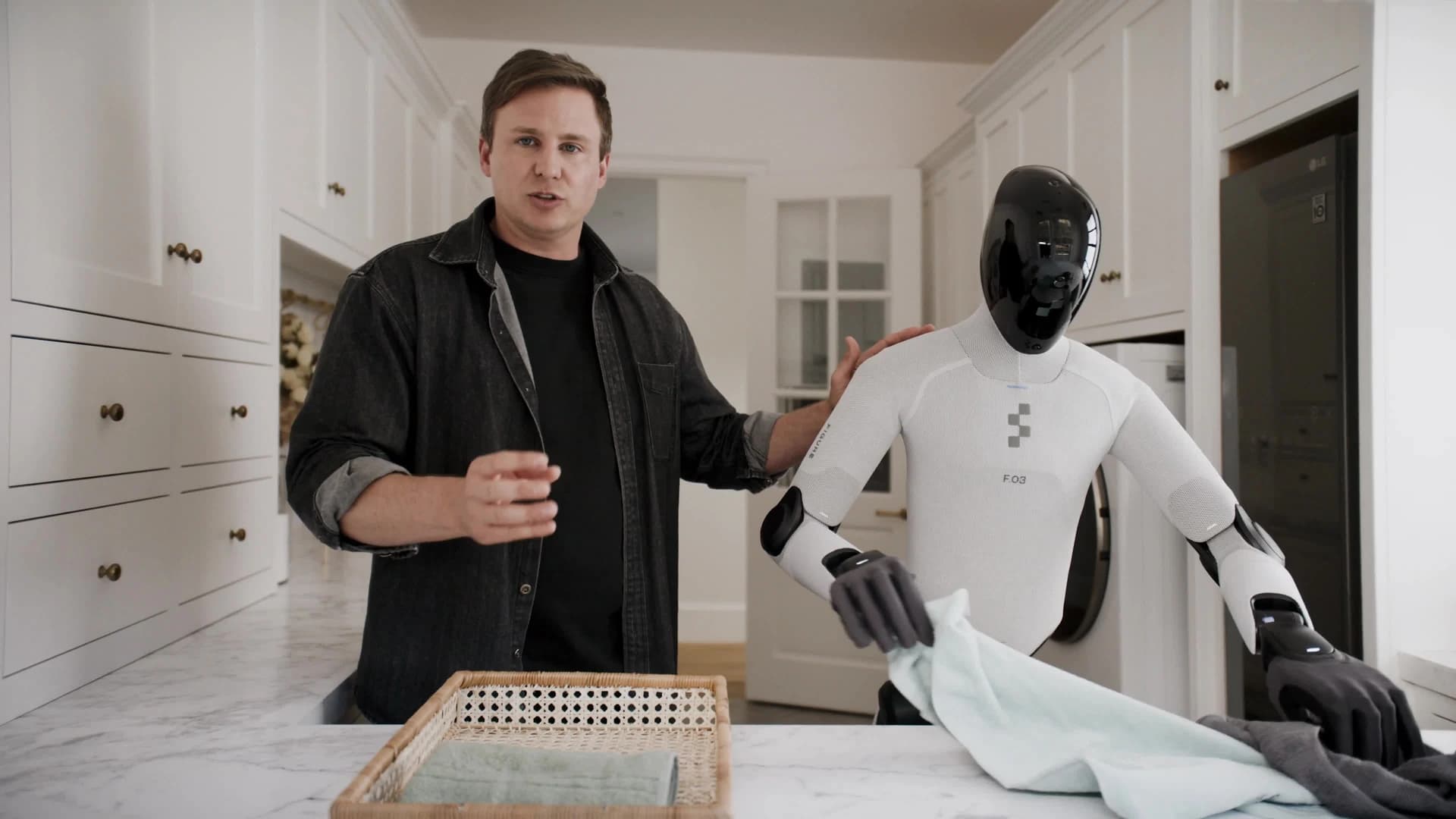
New York-based Fauna Robotics has released a detailed technical report for Sprout, its lightweight humanoid platform, offering the research community an unusually transparent look at the engineering and design choices behind its "Creator Edition" hardware. The release comes shortly after the startup’s high-profile move of exiting stealth, signaling a push toward open, reproducible research in a field often dominated by proprietary systems.
The report, titled "Fauna Sprout: A lightweight, approachable, developer-ready humanoid robot," outlines a system designed to bridge the "deployment gap" between fragile academic prototypes and industrial machines that are often too dangerous for routine operation around people.
Designing for the "Messy Reality"
Sprout’s hardware reflects a "safety-first" philosophy intended for shared human spaces. Standing 107 cm (approximately 40 inches) tall and weighing 22.7 kg (50 lbs), the robot is intentionally compact to reduce kinetic energy and potential impact forces.
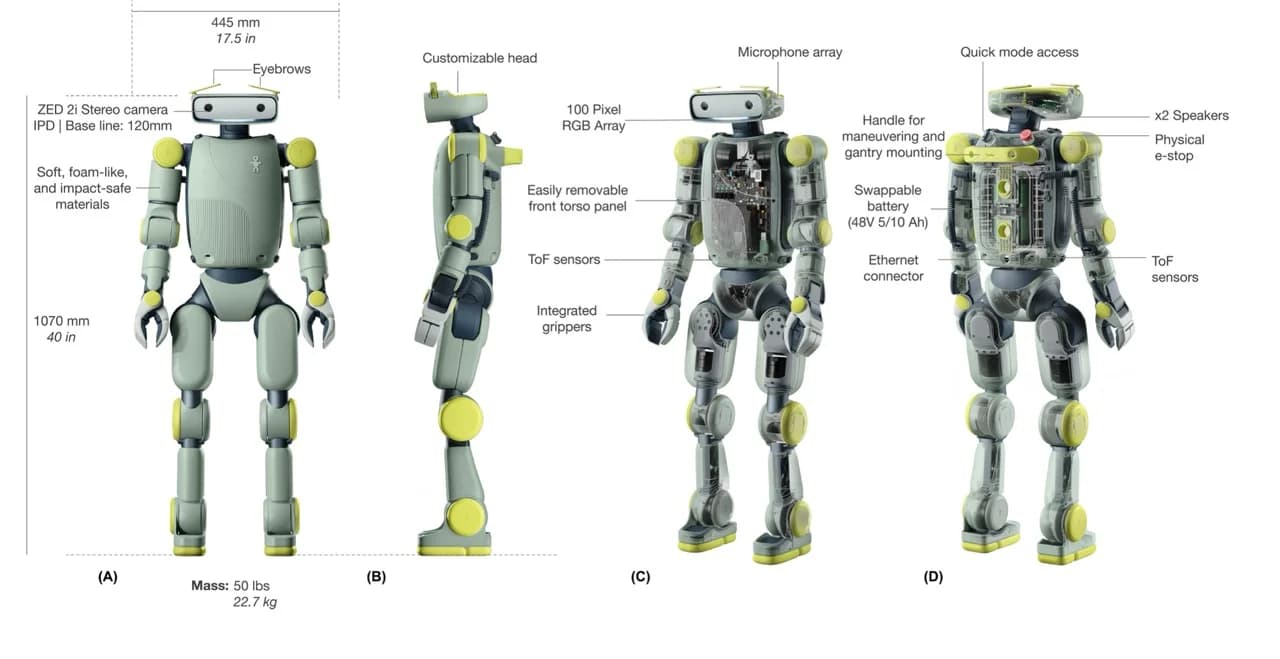
Key hardware specifications detailed in the report include:
The weekly humanoid robotics briefing
One email a week: the launches, funding and research that mattered, with context from Humanoids Daily.
Read recent issues- Soft Materials: The exterior uses soft, deformable foam-like materials to minimize pinch points and reduce force during incidental contact.
- Degrees of Freedom: The biped features 29 degrees of freedom, including motorized eyebrows for social expression.
- Onboard Compute: Primary systems are powered by an NVIDIA Jetson AGX Orin 64GB, which handles perception, planning, and high-level reasoning.
- Sensing Suite: A ZED2i RGB-D stereo camera serves as the primary visual sensor, complemented by four Time-of-Flight (ToF) sensors for obstacle avoidance and a four-microphone array for audio localization and speech recognition.
To ensure robustness, the team opted for simple, single-degree-of-freedom grippers over more complex multi-fingered hands, prioritizing reliable fetching and hand-offs in home or retail environments.
A Modular AI Architecture
The technical report emphasizes a modular, component-based AI platform rather than a "monolithic" end-to-end solution. Built on ROS 2 and Docker, each core service—from navigation to speech recognition—runs in isolated containers, allowing developers to swap out standard implementations for their own custom models.
Fauna has also integrated a Model Context Protocol (MCP) server, enabling LLM-based agents to control the robot’s motor functions, query its location, or execute expressive behaviors like nodding and dancing through standard tool calls. For developers focused on data collection, Sprout supports an immersive VR teleoperation system—compatible with Meta Quest devices—that maps human morphology to the robot's size for intuitive whole-body control.
Shifting the Humanoid Paradigm
The release of the report drew praise from Mario Bollini, human-robot interaction and embodied AI lead at Boston Dynamics, who noted on X that such transparency for a commercially available product is essential for "moving the whole field forward."
In a previous interview, Bollini argued that the humanoid form is a way to turn physical complexity into a "software problem". Fauna appears to be doubling down on this concept by providing a stable, compliant hardware base that allows researchers to focus on the software challenges of long-horizon autonomy and social interaction.
Fauna’s technical deep dive suggests it is betting on safety and "lovability" to define the next era of robotics. By aligning Sprout with the consumer preference for haptically soft, approachable machines, the team aims to transition humanoids from lab curiosities to routine companions in the home.
Share this article
Read next
- Published on
- Reading time
- 3 min read
Watch: Sprout the Humanoid Robot Takes the Stage on NBC’s Top Story
- Published on
- Reading time
- 5 min read
Fauna Robotics Exits Stealth with Sprout, a Soft-Bodied Humanoid for the "Messy Reality" of Shared Spaces
- Published on
- Reading time
- 3 min read
Amazon Acquires Soft-Bodied Humanoid Maker Fauna Robotics
- Published on
- Reading time
- 5 min read
Feather launches a $30,000 wheeled humanoid for developers, announces $7.6M funding
- Published on
- Reading time
- 5 min read
Tesla App Contains Optimus Gen 3 Renders—Here’s What They Show
- Published on
- Reading time
- 5 min read
1X Aims to Ship 50,000 Robots—But Keeping Them Working Is the Test

The weekly humanoid robotics briefing
One email a week: the launches, funding and research that mattered, with context from Humanoids Daily.
Read recent issues