- Published on
Midea’s ‘Super Humanoid’ MIRO U Has Six Arms and Wheels, Challenges 1:1 Human Mimicry
One tap, and our reporting appears more often in your Google Top Stories. It makes a real difference to a small newsroom.


Your guide
Rich Robinson
Jee Chee Ren · Executive tour
See China’s AI and robotics ecosystem first-hand.
Six days exploring AI, robotics and advanced manufacturing.
With Rich Robinson, Clinical Professor of Entrepreneurship at Peking University
Beijing · Guangzhou · Shenzhen
29 November–4 December 2026
Referral partnership · We earn a commission on referred bookings.
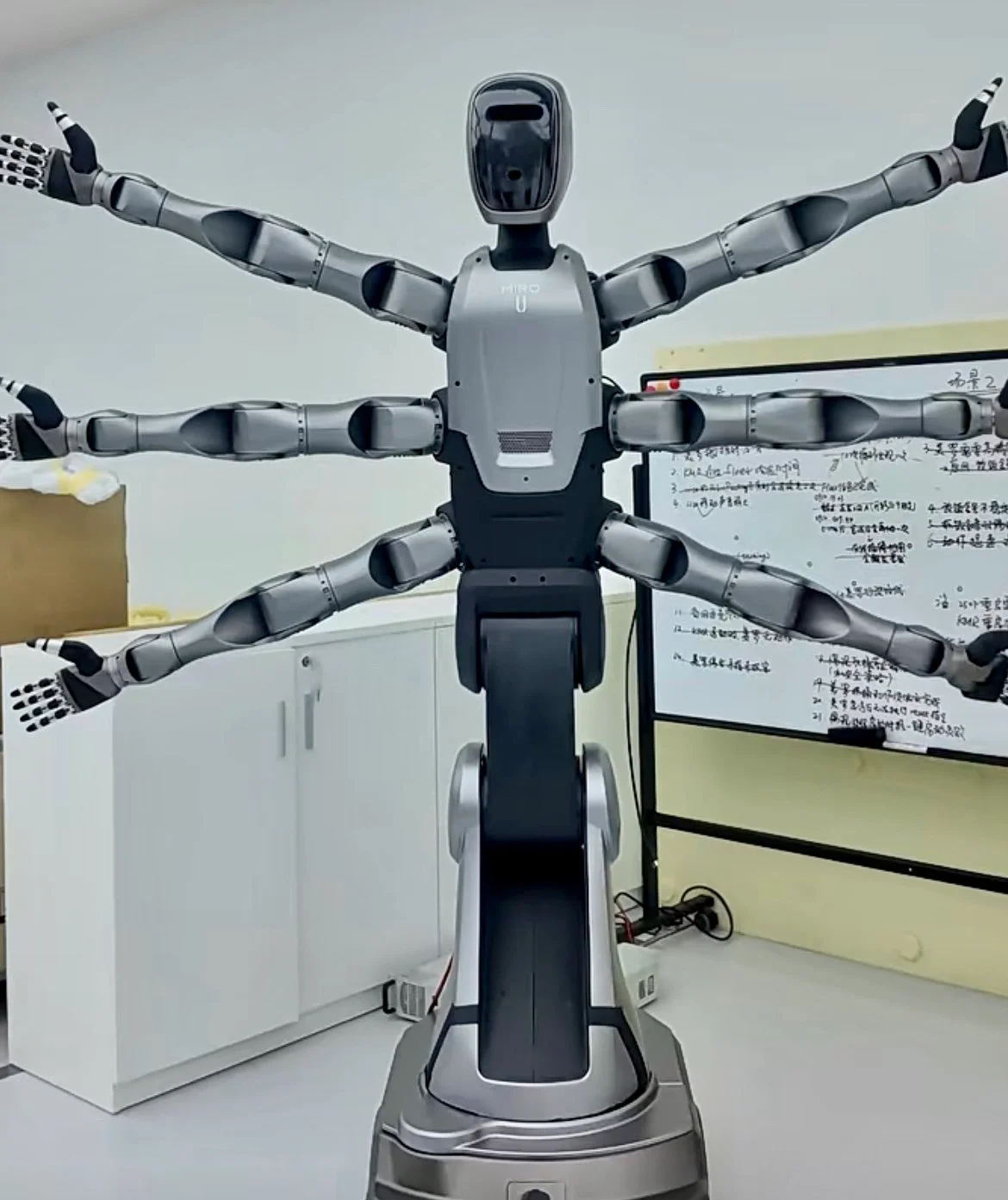
The race to deploy humanoid robots in factories usually centers on a specific philosophy: creating a machine that fits perfectly into a world built for two-legged, two-armed humans. Midea Group, the Chinese appliance giant, is challenging that constraint with its latest release.
At the 2025 Greater Bay Area New Economy Forum on December 5, Midea unveiled the MIRO U, a machine they have dubbed a "super humanoid." The robot marks a striking departure from standard anthropomorphic design. While it features a human-like head and torso, it is mounted on a wheeled-legged chassis and wields six bionic arms, a design choice Midea claims allows it to "break through human physiological limits."
Beyond Morphological Imitation
The MIRO U represents the third generation of Midea’s robotic development, but it is the first to so aggressively decouple "humanoid" from "human-shaped."
Wei Chang, Midea Group VP and CTO, stated during the launch that the core value of the MIRO U is to move beyond morphological imitation. The goal is to achieve a leap in operational efficiency that a standard two-armed worker—biological or mechanical—cannot match.
The weekly humanoid robotics briefing
One email a week: the launches, funding and research that mattered, with context from Humanoids Daily.
Read recent issuesThe design logic is rooted in multi-dimensional collaboration:
- Six-Arm Coordination: The robot can utilize its lower arms to support heavy components while its upper arms perform delicate assembly or fastening tasks.
- Omnidirectional Agility: Unlike humans, who must turn their entire bodies to face a new task, the MIRO U utilizes a wheeled-legged chassis capable of 360-degree in-place rotation and stable vertical lifting.
- Rapid Tooling: The end-effectors are designed for quick-release module switching, allowing the robot to transition between different assembly tools near-instantly.
The "Factory Intern" Starts This Month
Midea is moving quickly from prototype to pilot. The company confirmed that the MIRO U is scheduled to enter the Midea Wuxi High-end Washing Machine Factory by the end of December 2025.
This is not a general-purpose deployment; the robot has a specific KPI. Midea claims the MIRO U will improve the efficiency of production line changeovers and adjustments by 30%. By automating the "beat rate" of the production line with a robot that doesn't need to rest—and effectively does the work of three pairs of hands—Midea hopes to prove the viability of complex automation in variable manufacturing environments.
The Bigger Picture: Miro vs. Meila
The launch of the MIRO U also clarifies Midea's bifurcated robotics strategy. The company has formally split its development into two distinct lineups:
- The Miro Series (Industrial): Focusing on heavy loads, high precision, and factory environments (e.g., the MIRO U).
- The Meila Series (Service): Designed for commercial and home scenarios. These robots are reportedly in the final testing phase and are expected to perform tasks like operating coffee machines or navigating retail spaces. Midea plans to introduce the Meila series into its stores for guide services by 2026.
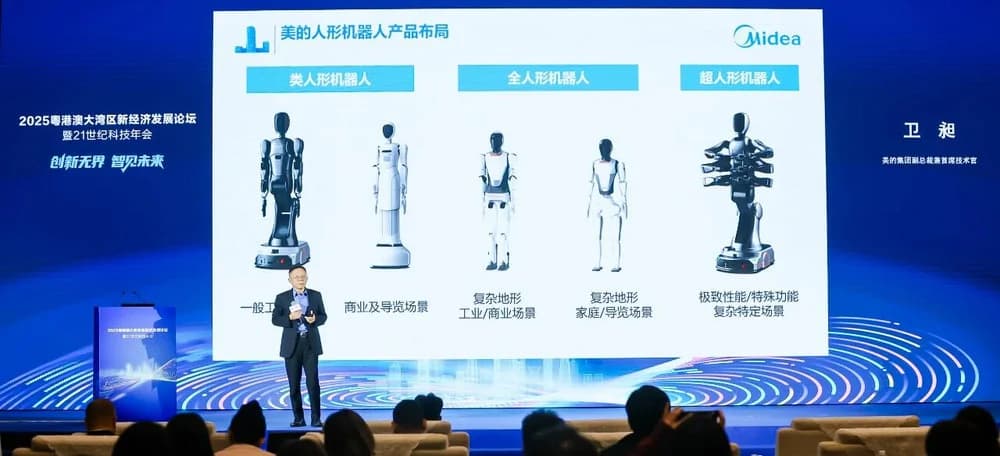
Analysis: Function Over Form
The MIRO U raises an interesting question for the humanoid robotics industry: At what point does a humanoid stop being a humanoid?
By retaining the torso and head, Midea keeps the robot compatible with human-height workstations and visual recognition systems. However, by adding wheels and extra limbs, they acknowledge that the human form is not always the apex of industrial efficiency. The MIRO U is less of a synthetic human and more of a specialized industrial tool that happens to wear a human form factor where it counts.
As the robot begins its "internship" in Wuxi later this month, the industry will be watching to see if six arms are indeed better than two.
Share this article
Read next
- Published on
- Reading time
- 4 min read
Morgan Stanley Survey: Chinese Companies Want Humanoids, But the Products Aren't Ready
- Published on
- Reading time
- 3 min read
UBTech and Midea Push Humanoid Robots Onto Chinese Factory Floors
- Published on
- Reading time
- 3 min read
Noetix Robotics Files for Hong Kong IPO, Bloomberg Reports
- Published on
- Reading time
- 3 min read
Unitree’s H2-X Flips Off Cars in New Kung Fu “Guardian” Video
- Published on
- Reading time
- 3 min read
After Its Stock Surge, Unitree Warns Humanoid Commercialization Is Still in Its Early Days
- Published on
- Reading time
- 3 min read
Schaeffler Puts Humanoids to Work Building Parts for Other Humanoids
The weekly humanoid robotics briefing
One email a week: the launches, funding and research that mattered, with context from Humanoids Daily.
Read recent issues