- Published on
MindOn’s New Demo Unites Humanoids and Dual-Arm Robots Under a Single "Mind"
One tap, and our reporting appears more often in your Google Top Stories. It makes a real difference to a small newsroom.

Supported by RoboStrategySupport for Humanoids Daily comes from RoboStrategy
Sponsored

Investing involves risk, including possible loss of principal. Read the prospectus before investing.
- MindOn’s latest demonstration showcases Unitree G1 humanoids and fixed dual-arm robots collaborating on an end-to-end logistics workflow using a single, unified AI model.
- The system, dubbed "Mind-0," is trained entirely on human-centric data captured via egocentric and whole-body methods, without relying on any task-level, robot-collected data.
- To operate across different hardware, the startup decoupled its architecture into a high-level intelligence layer for reasoning and a low-level controller for embodiment-specific dynamics.
- The company uses a "Real-World Execution Compensation Model" to bridge the sim-to-real gap, reportedly achieving sub-1 cm manipulation accuracy on the Unitree G1.
- This development follows MindOne’s viral November 2025 demonstration of a G1 performing complex household chores autonomously, further cementing its strategy of building hardware-agnostic AI brains.
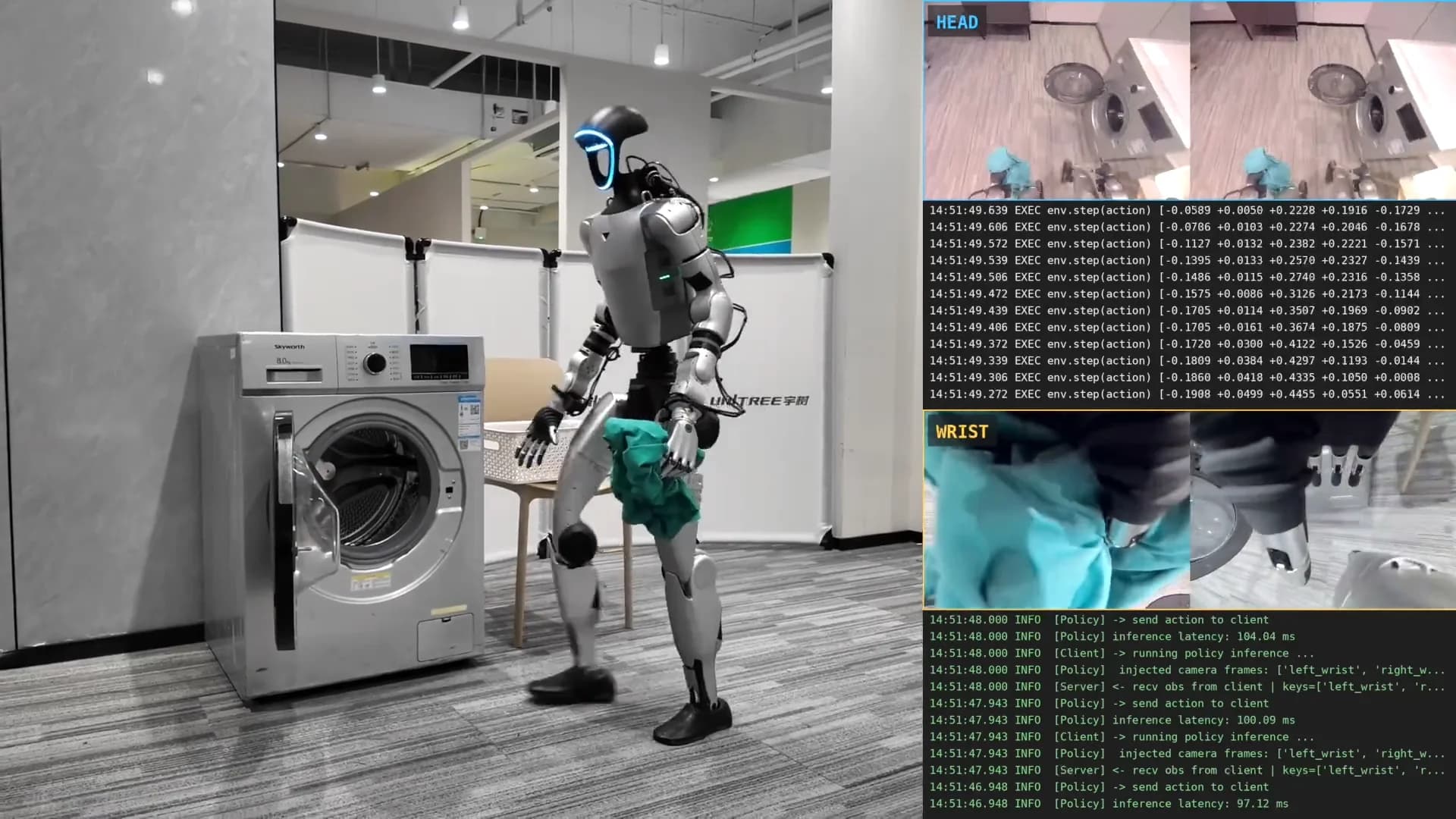
A new video shared by Qingxu Zhu, founder of MindOne Robotics, features a coordinated logistics workflow involving two Unitree G1 humanoid robots and two fixed dual-arm systems. The robots are shown handling a shared sequence—from a G1 picking items off shelves and transporting them, to stationary dual-arm robots precisely packing boxes and sealing them with tape along a conveyor belt. The visual of different form factors working cooperatively is compelling, but the true significance lies in the software driving them. MindOn claims this entire heterogeneous system is powered by a single AI model trained exclusively on human data, without requiring task-level robot teleoperation.
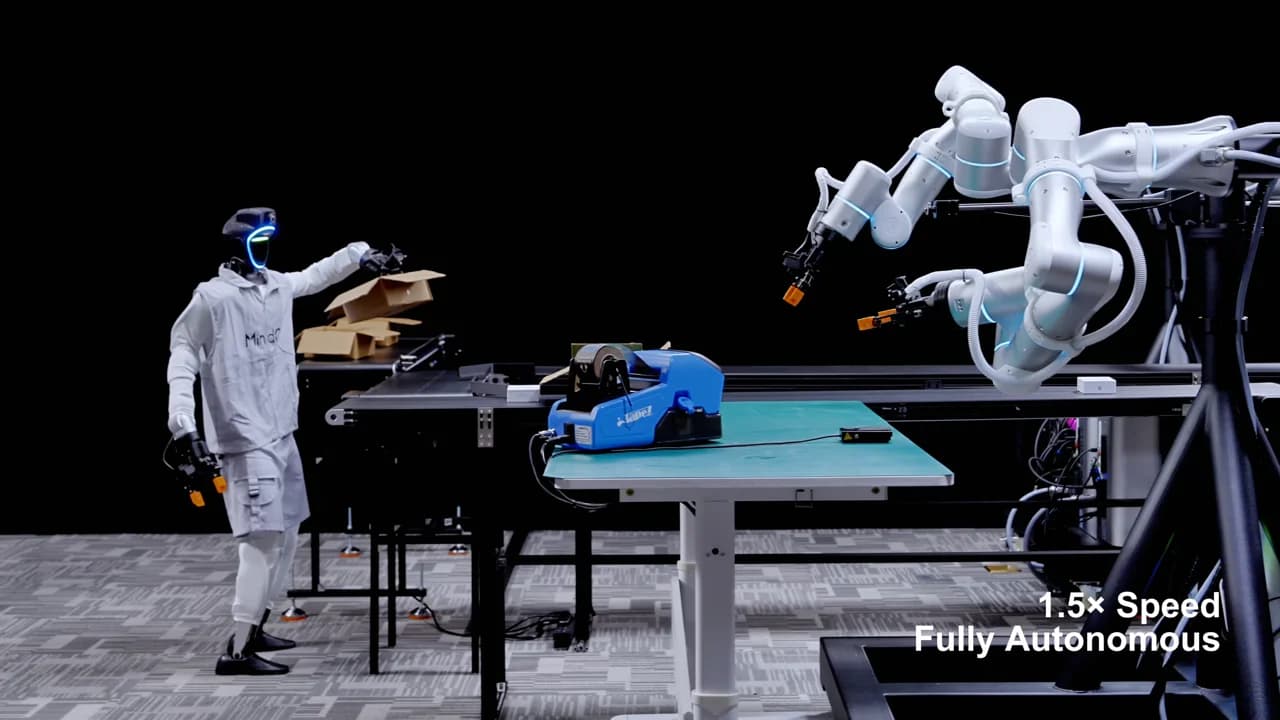
The Heterogeneous Fleet
As the industry races toward general-purpose humanoids, MindOn’s latest blog post argues for a more pragmatic reality: real-world environments require a diverse mix of robotic hardware. Humanoids offer mobility necessary for navigating human-centric spaces and existing infrastructure. In contrast, stationary dual-arm robots provide the precision, efficiency, and repeatability demanded by structured manipulation tasks, such as sorting and packing.
However, this necessary diversity introduces a severe scalability bottleneck. Traditionally, each unique robot platform requires its own specialized data collection, modeling, and training pipeline, making it incredibly difficult to transfer capabilities across different machines.
To solve this, MindOn has separated its software architecture into two distinct layers to decouple intelligence from the robot's physical embodiment. A high-level model handles scene understanding, task reasoning, and behavior generation. A separate, low-level controller translates those cognitive intentions into physical execution, managing the specific dynamics and constraints of the hardware it is deployed on.
The weekly humanoid robotics briefing
One email a week: the launches, funding and research that mattered, with context from Humanoids Daily.
Read recent issuesThe Human Data Bet
Most prominent robotics labs currently rely on extensive teleoperation—where a human manually puppets a robot—to gather the data necessary to train autonomous policies. MindOn argues this approach is fundamentally constrained. During teleoperation, human operators are forced to adapt to the latency, sensing limits, and kinematic constraints of the robot. As a result, the data collected often reflects cautious, unnatural movements rather than the fluid efficiency of a human solving the task naturally.
Instead, MindOn trains its models on "human-centric data" gathered via whole-body motion capture, handheld devices, and egocentric cameras. By capturing demonstrations in this manner, the AI learns the underlying structure of a task directly from human behavior, rather than learning how a specific machine was forced to execute it.
Bridging the Execution Gap
Translating fluid human motion into executable robotic actions is notoriously difficult due to stark differences in kinematics, workspaces, and physical capabilities. Direct imitation is impossible, so MindOn has introduced several technical bridges.
A "Cross-Embodiment Data Pipeline" acts as a translator, converting large-scale human demonstrations into action representations that different robots can understand. At the foundation, a Whole-Body Action model manages low-level tracking, trained on tens of thousands of hours of motion capture data to ensure the robots maintain physical feasibility and balance.
To overcome the inevitable sim-to-real gap—where models trained digitally fail in the physical world—the company employs a lightweight compensation model trained on a small amount of real-world deployment data. MindOn reports that this compensation model corrects tracking errors and dynamics mismatches to achieve sub-1 cm manipulation accuracy on the Unitree G1, a platform typically known for having relatively limited arm precision.
Furthermore, the system utilizes a hierarchical reasoning framework to account for the physical latency inherent in robot execution. Because human data is naturally delay-free, directly imitating it on physical hardware causes synchronization issues. MindOn's high-level policy continuously monitors real-time feedback from the robot's low-level systems, adaptively timing its commands to ensure consistent execution despite mechanical delays.
A Unified Intelligence
MindOne Robotics is a relatively young player, officially established in Shenzhen in May 2025. The company initially made waves last November with a viral video showing a Unitree G1 mastering household chores without speed-ups or teleoperation. While that initial demonstration highlighted complex loco-manipulation for a single robot, this new logistics focus underscores the company's ambition to create a universally applicable, hardware-agnostic AI.
Looking ahead, MindOn says its next steps include scaling its human-centric datasets and expanding deployment to additional form factors, including mobile dual-arm systems. The promise of a universal robotic "brain" trained purely on human data is an ambitious divergence from the teleoperation-heavy pipelines dominating the sector today. If MindOn can reliably scale this approach beyond controlled logistics demonstrations, it could offer a highly efficient pathway for deploying mixed fleets of robots across commercial and industrial environments.
Share this article
Read next
- Published on
- Reading time
- 4 min read
Startup's Viral Video Shows Unitree G1 Mastering Chores
- Published on
- Reading time
- 3 min read
Unitree Says It Won’t Become a Robot Integration Company
- Published on
- Reading time
- 5 min read
Unitree’s Stock Slump Puts China’s Robot IPOs Under Scrutiny
- Published on
- Reading time
- 7 min read
Unitree’s AI models explained: UniFoLM, WLA and X2
- Published on
- Reading time
- 3 min read
Unitree launches G1+ with stronger motors, a moving neck and a $15,000 price
- Published on
- Reading time
- 8 min read
Inside UBTECH’s 10,000-Unit Super Factory: How Robots Are Building Humanoids in Liuzhou

The weekly humanoid robotics briefing
One email a week: the launches, funding and research that mattered, with context from Humanoids Daily.
Read recent issues