- Published on
Niantic Spatial Launches Places Library With 100 Real Environments for Robot Training
One tap, and our reporting appears more often in your Google Top Stories. It makes a real difference to a small newsroom.
Supported by RoboStrategySupport for Humanoids Daily comes from RoboStrategy
Sponsored
Investing involves risk, including possible loss of principal. Read the prospectus before investing.
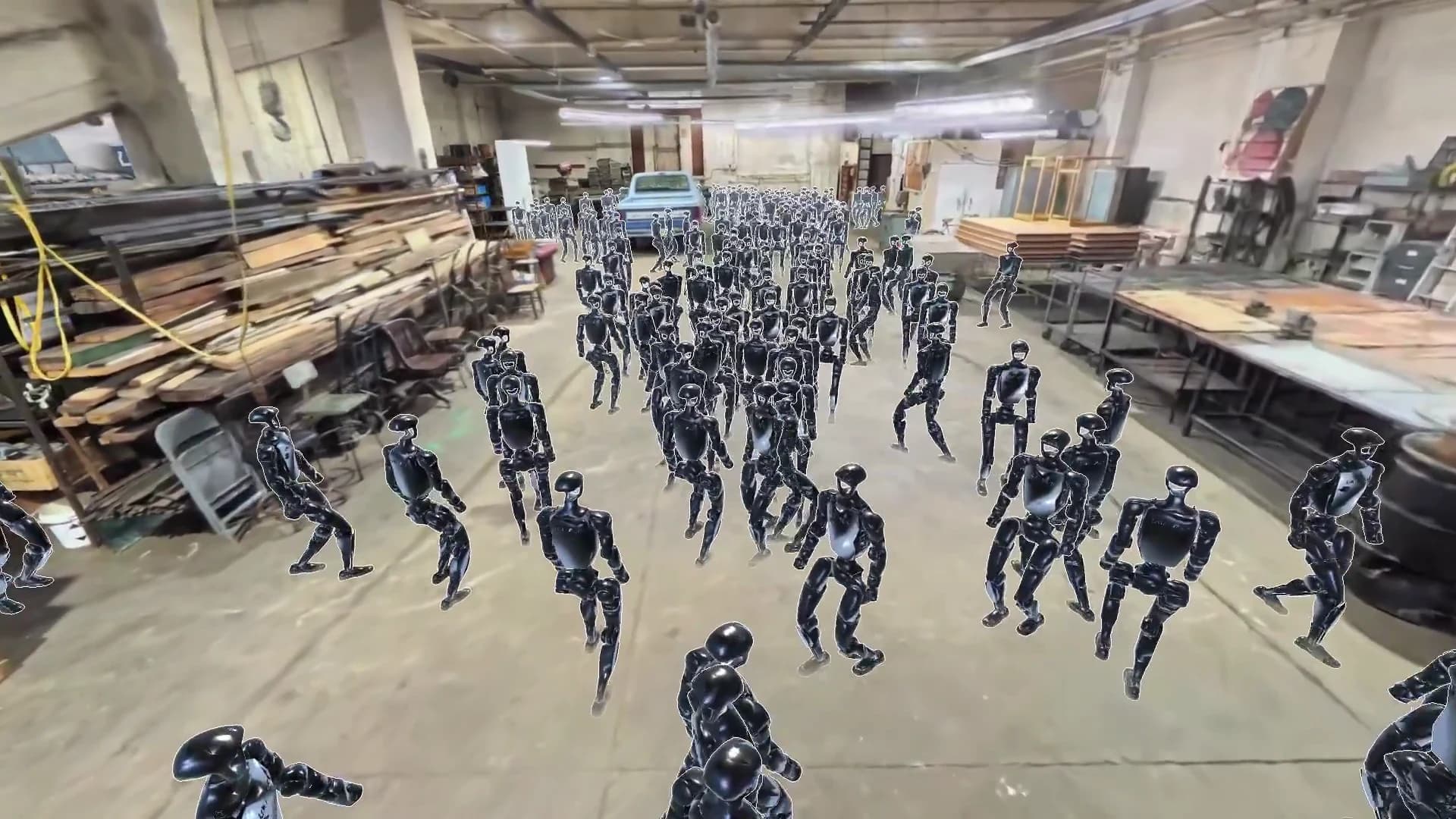
Niantic Spatial is giving robotics developers a catalog of real places to train in before their machines arrive on site. Its new Places Library launches with 100 captured environments, supplied as USDZ assets for embodied AI training and evaluation, according to the company's announcement, dated September 25.
- Places Library starts with 100 real environments for robot simulation.
- Each asset combines a Gaussian splat with aligned collision geometry.
- Free samples are available, with broader access through paid plans.
- Scene relighting remains a beta for selected partners.
What robots see and what they can hit
Each environment packages two representations of the same reconstruction: a Gaussian splat for visual appearance and a mesh for collisions. Niantic says the assets arrive at metric scale, aligned with gravity, and support NVIDIA Isaac Sim, Isaac Lab, and compatible OpenUSD simulators. The shared reconstruction is intended to keep visible surfaces and collision boundaries in agreement. Niantic's launch post describes capture using an ordinary 360-degree camera without LiDAR.
That pairing matters because a visually convincing room is only part of a useful robot simulation. A controller also needs reliable information about where movement stops. Consider a simulated robot approaching a shelf: if the shelf's visible edge and collision boundary differ, its camera observations and physical interactions tell different stories.
Niantic points to MVSAnywhere as part of its reconstruction approach. The CVPR 2025 research combines information from individual images and multiple camera views to estimate depth across different scene types. Its reported depth-estimation results provide technical context; they are not a measurement of how much Places Library improves a deployed robot's performance.
The weekly humanoid robotics briefing
One email a week: the launches, funding and research that mattered, with context from Humanoids Daily.
Read recent issuesFlexion offers an earlier example
The approach already has a humanoid connection through Flexion, the Swiss robotics software company we covered when it raised $50 million. In a July 20 account of its work with Niantic Spatial and NVIDIA, Flexion described training a local navigation policy in reconstructed offices using Isaac Sim and Isaac Lab.
The policy used RGB camera images alongside the robot's internal sensor readings and a nearby target position, issuing velocity commands to a separate locomotion controller. Flexion reported that the simulation-trained policy transferred zero-shot to a real office—without additional real-world training—and handled changes including rearranged furniture.
That demonstration gives a concrete example of how Niantic's reconstructions can support robot learning. It predates Places Library and concerns navigation in reconstructed deployment sites; it does not establish performance across the new 100-environment catalog. The library broadens access to the kinds of captured scenes used in that workflow.
Warehouses, streets, and a route to custom sites
The public catalog includes warehouse interiors and outdoor locations, with examples ranging from a medical warehouse in Staten Island to streets in London and San Francisco. Two scenes are marked as free samples: London's Leake Street Arches and a pallet-rack and storage area in Linden, New Jersey.
For a robotics team, the potential attraction is starting with environments it did not have to capture itself. A useful evaluation could hold a navigation task constant while changing the surrounding scene, then examine where the robot's behavior breaks down. That is a possible use of the library, rather than a result demonstrated by the launch.
Broader access is commercial. Niantic's plans page lists an Evaluate tier with a three-month minimum, 15 library downloads across the term, and 15 capture minutes per month. The Train tier lists a 12-month minimum, 100 downloads, and 60 monthly capture minutes. Those capture allowances let teams add their own sites alongside catalog environments. The page directs prospective customers to sales without displaying dollar prices.
More lighting conditions, with limits
Niantic is also developing ways to vary captured scenes. Its Gaussian Splat Relighting beta, announced September 18, uses accompanying geometry to generate lighting changes and transfer them to the splats while preserving the underlying scene structure.
The company describes experiments with different times of day and weather-related appearances. Access is through selected design partners, and the workflow is not yet a self-service API. Niantic also acknowledges that glass, windows, sharp corners, and indoor surfaces need additional validation. A visually wet floor should not, by itself, be read as evidence that the simulation models the corresponding change in traction.
The practical question is how much these environments improve training and evaluation once teams put them to work. The Places Library announcement does not report a quantified gain in real-world robot success rates. For developers, the next test is concrete: whether training across captured places produces better performance at an unfamiliar deployment site, and how much preparation those scenes still require.
Share this article
Read next
- Published on
- Reading time
- 5 min read
Odyssey Unveils Odyssey-3, With Flexion Building Humanoid Control on Its World Model
- Published on
- Reading time
- 5 min read
Watch: Inside the Zurich Lab Building the "Android" of Humanoids
- Published on
- Reading time
- 5 min read
A Brain in the Alps: Flexion Raises $50M to Build the ''Android'' of Humanoids
- Published on
- Reading time
- 4 min read
HD Hyundai Wants Humanoid AI to Upgrade Its Existing Factory Robots
- Published on
- Reading time
- 8 min read
Tesla Reportedly Builds Hundreds of Optimus Robots a Week
- Published on
- Reading time
- 4 min read
Asimov Open-Sources the Training Code Behind Its Humanoid’s Walk
The weekly humanoid robotics briefing
One email a week: the launches, funding and research that mattered, with context from Humanoids Daily.
Read recent issues