- Published on
Tokyo Researchers Build Robotic Legs With 3D-Printed Muscles, Tendons and Ligaments
One tap, and our reporting appears more often in your Google Top Stories. It makes a real difference to a small newsroom.

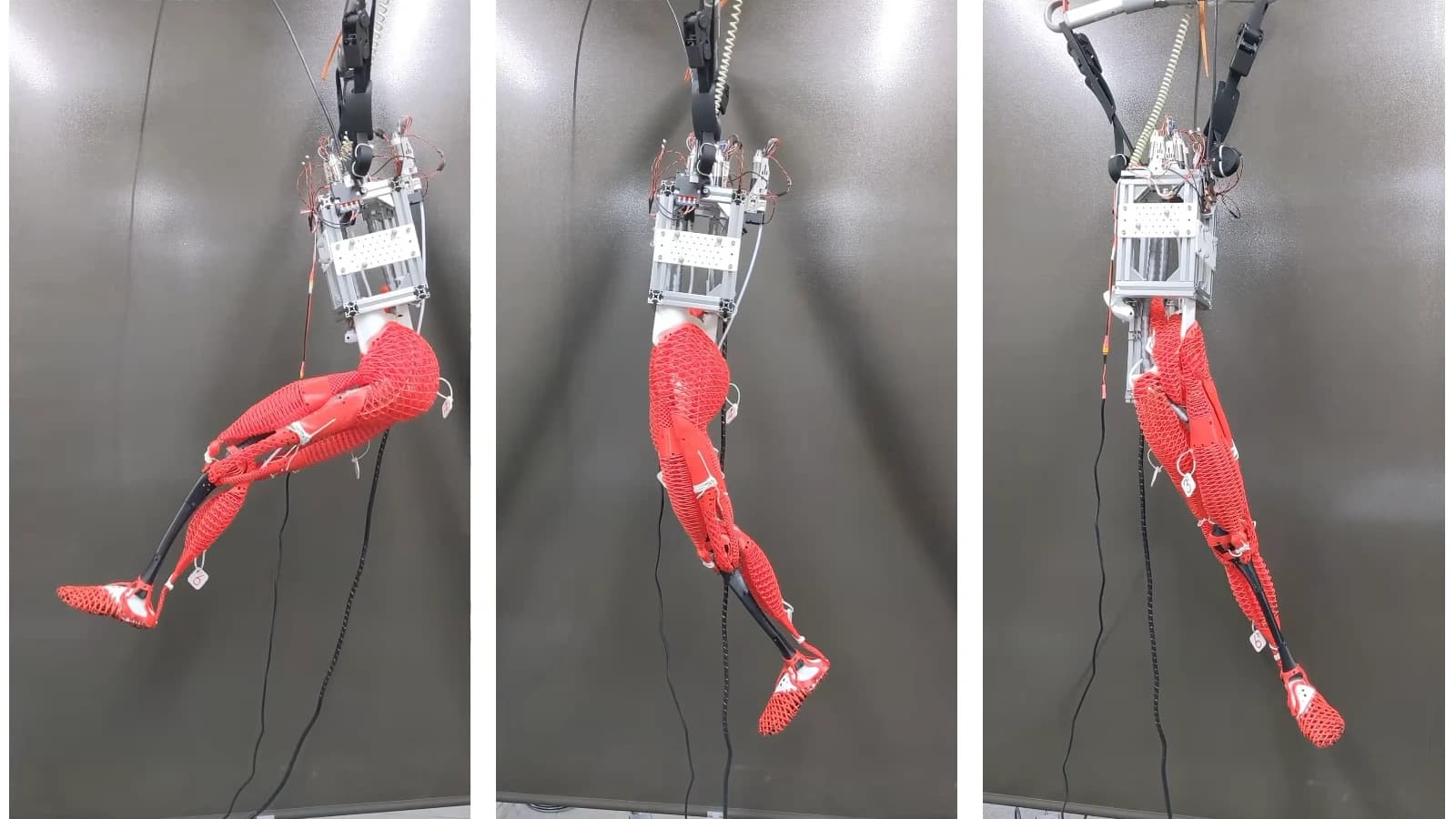
University of Tokyo researchers have built a life-size robotic leg system with 3D-printed structures inspired by muscles, tendons and ligaments. Their approach uses one flexible plastic, changing its geometry to give different parts different mechanical properties. The project explores how more of a robot's movement can come from the design of its body.
- A single TPU material provides muscle-like elasticity, stiffer tendons, ligament constraints and sole cushioning through different printed patterns.
- Electric motors pull wires to actuate the legs; the printed structures supply passive compliance.
- The prototype demonstrates stepping with external support. Independent walking remains a future challenge.
Shunnosuke Yoshimura, Kento Kawaharazuka and Kei Okada describe the work in Advanced Intelligent Systems, where it was published on September 11. The contribution is a shared design and fabrication process for several kinds of compliant body parts that would otherwise require separate customization.
The team varies lattice density, strut thickness and other geometric parameters to tune flexibility. A single print can transition from a softer muscle-like region to a stiffer tendon-like region. Patterned ligaments constrain the hip, knee and ankle without bearings. The accompanying research video presents the structures and motion experiments.
The actuation comes from motors and pulleys mounted on the pelvic frame, with wires routed through Bowden cables to the muscle structures. Keeping motors high on the body reduces the weight carried farther down the legs. Unlike living muscle, the TPU lattice does not generate contraction itself: it deforms as the motor-driven wires pull.
Follow humanoid robotics without following every announcement.
Get the week’s most important launches, funding and research—and why they matter—in one email from Humanoids Daily.
Once a week. Unsubscribe anytime.
Read recent issuesIn the stepping experiments, an external suspension carries part of the body weight and limits torso rotation. The robot follows preset wire-length commands. That setup lets the researchers examine coordinated movement without first solving balance control, but it does not establish autonomous locomotion.
There are practical limits, too. Individual muscle structures take roughly 20–40 hours to print, while cable friction and the material's changing response under repeated loading complicate control. The manufacturing method simplifies fabrication work; it does not eliminate the engineering needed for a reliable walking robot.
For readers following Clone Robotics' synthetic-human roadmap, the parallel is the interest in reproducing internal anatomy. Clone uses fluid-powered Myofiber artificial muscles and a hydraulic system. Tokyo's researchers instead combine motor-driven wires with printed elastic structures. These are distinct approaches to giving robots some of the mechanical properties of biological bodies.
The useful question raised by both is how much movement and adaptability can be built into the body's structure. For this research, the immediate advance is a more consistent way to design and manufacture those structures, with unsupported walking and whole-body integration still ahead.
Share this article
Follow humanoid robotics without following every announcement.
Get the week’s most important launches, funding and research—and why they matter—in one email from Humanoids Daily.
Once a week. Unsubscribe anytime.
Read recent issuesRead next
- Published on
- Reading time
- 3 min read
Donut Robotics Secures ¥300 Million Charm Care Alliance for Eldercare Humanoids
- Published on
- Reading time
- 3 min read
Kawasaki Plans Noetra-Powered Kaleido Rollout Around 2030, With Autonomy Expanding in Stages
- Published on
- Reading time
- 2 min read
Panasonic Targets Humanoid Robot Production by 2029, Citing Battery Safety
- Published on
- Reading time
- 6 min read
O-ID Raises $1.2M to Build Humanoids With Swappable Parts
- Published on
- Reading time
- 4 min read
Tokyo Now Has a Dedicated 911 Service—for Busted Humanoid Robots
- Published on
- Reading time
- 6 min read
SoftBank in Talks for Majority Stake in 1X at $6 Billion — Below the $10 Billion It Sought Last Year