- Published on
Research Spotlight: X-Humanoid ‘Robotizes’ Human Videos to Train the Next Generation of Androids


The biggest bottleneck in general-purpose robotics isn't hardware; it's data. While Large Language Models (LLMs) feasted on the entire textual internet to gain intelligence, humanoid robots are starving. They require massive amounts of physical interaction data to learn, yet operating real robots to collect this data is slow, expensive, and risky.
A new paper titled "X-Humanoid: Robotize Human Videos to Generate Humanoid Videos at Scale," published by Show Lab at the National University of Singapore, proposes a novel solution: using generative AI to rewrite the vast archive of existing human video into robot video.
Led by researchers Pei Yang, Hai Ci, Yiren Song, and Mike Zheng Shou, the project introduces a pipeline that transforms standard third-person clips of humans performing tasks—like repairing a bike or cooking—into highly realistic videos of humanoid robots performing the exact same actions.
The Embodiment Gap
The core challenge in training robots on human data is the "embodiment gap"—the physical differences in shape, joint structure, and movement between a biological human and a mechanical android.
Previously, researchers attempted to solve this by editing egocentric (first-person) videos, simply overlaying rendered robot arms on top of human arms. While useful for tabletop manipulation, this "2.5D" approach fails when applied to third-person videos where full-body dynamics, balance, and complex occlusions come into play.
"Third-person scenario is substantially more complex, involving full-body motions, dynamic backgrounds, and severe occlusions that are beyond the capabilities of simple inpaint-and-overlay techniques," the authors state in the paper.
X-Humanoid attempts to bypass these limitations by adapting a modern video generation model, specifically the Wan 2.2 Diffusion Transformer (DiT), to perform video-to-video translation.
Creating the "Rosetta Stone" of Motion
Generative video models like Sora or Kling are notorious for hallucinating details or failing to keep motion perfectly synchronized—a fatal flaw if the goal is to train precise robotic policies. To force the AI to respect the laws of physics and the specific kinematics of a robot, the team needed paired training data.
Since no massive dataset exists of humans and robots performing identical actions in identical lighting, the researchers built one.
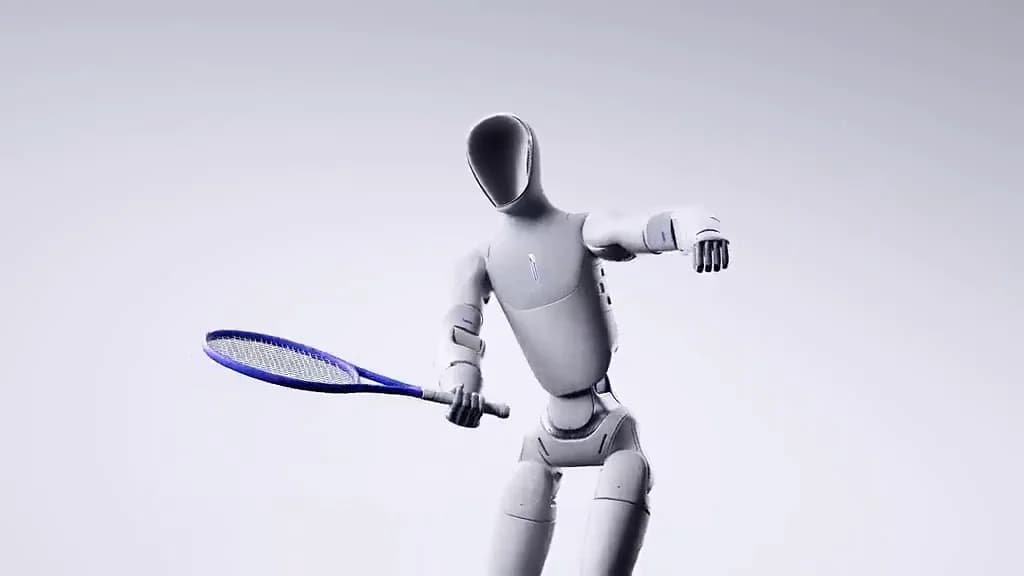
Using Unreal Engine, the team synthesized over 17 hours of paired footage. They took digital human avatars and digital humanoid assets (specifically modeled on the Tesla Optimus form factor) and mapped identical animations to both skeletons.
This synthetic dataset, which included varied camera angles, focal lengths (14-80mm), and lighting conditions, served as the ground truth to fine-tune their diffusion model.
According to Mike Shou, a corresponding author on the paper, this paired data was the key unlock. "Even powerful video gen editing models struggle with Human-to-Humanoid transfer," Shou noted on X. "They fail to maintain the robot's body shape AND keep the motion perfectly synchronized. We've cracked it."
Outperforming Commercial Giants
To validate their approach, the researchers applied X-Humanoid to the Ego-Exo4D dataset, converting 60 hours of real-world human activity into 3.6 million frames of "robotized" video.
The team compared their results against leading commercial video editing models, including Kling, Runway Aleph, and MoCha. The quantitative and qualitative results highlighted significant drift in the baseline models:
- Motion Consistency: In user studies, 69% of participants rated X-Humanoid as having the best motion consistency, compared to just 17.2% for Kling and 0% for Runway Aleph.
- Embodiment Correctness: 62.1% of users preferred X-Humanoid’s ability to maintain the correct robot appearance without warping or hallucinating new limbs.
Visualizations in the paper show competitors struggling with complex interactions; for instance, rival models often failed to render the robot's legs correctly under a table or desynchronized the action of throwing an object.
Implications for World Models
The immediate application for X-Humanoid is training Vision-Language-Action (VLA) models—the "brains" that tell a robot how to move based on visual input. By converting millions of YouTube-style "how-to" videos into data that looks like it came from a robot's own camera, researchers could potentially bootstrap general-purpose robotic capabilities without needing thousands of physical prototypes collecting data in the real world.
However, the authors acknowledge limitations. The current model focuses on single-person activities and can behave unpredictably in multi-person scenes. Additionally, the system currently requires fine-tuning a Low-Rank Adaptation (LoRA) for each specific robot embodiment, meaning it isn't yet a "one-click" solution for any robot design.
Despite these constraints, X-Humanoid represents a significant step toward "sim-to-real" transfer, suggesting that the path to intelligent robots may essentially involve "hallucinating" them into existence using the data we already have.
Share this article
Stay Ahead in Humanoid Robotics
Get the latest developments, breakthroughs, and insights in humanoid robotics — delivered straight to your inbox.