- Published on
1X Goes "All In" on World Models, Hires Luma AI’s Samarth Sinha Amid Leadership Reshuffle
One tap, and our reporting appears more often in your Google Top Stories. It makes a real difference to a small newsroom.


Your guide
Rich Robinson
Jee Chee Ren · Executive tour
See China’s AI and robotics ecosystem first-hand.
Six days exploring AI, robotics and advanced manufacturing.
With Rich Robinson, Clinical Professor of Entrepreneurship at Peking University
Beijing · Guangzhou · Shenzhen
29 November–4 December 2026
Referral partnership · We earn a commission on referred bookings.
- 1X has officially launched the 1X World Model Lab, a new research division dedicated exclusively to pretraining embodied foundation models.
- Former Luma AI founding researcher Samarth Sinha has been hired as Head of World Models to lead the new lab and its "scale up along every damn axis" methodology.
- The aggressive pivot follows rumors of AI department layoffs and the confirmed departures of three top AI executives: Eric Jang, Mohi Khansari, and Daniel Ho.
- CEO Bernt Børnich explicitly criticized the industry standard of fine-tuning language models for robotics, stating, "You can't fine-tune your way to AGI."
- 1X plans to ship thousands of its $20,000 NEO humanoids this year to ignite a "data flywheel," capturing millions of hours of real-world interaction to feed the new world models.
1X Technologies is attempting a hard reset on how it builds artificial intelligence for the physical world. In a significant strategic pivot, the Norwegian-American robotics firm has announced the launch of the 1X World Model Lab, a dedicated research organization aimed at building generalizable foundation models from scratch.
To lead the charge, 1X has hired Samarth Sinha, a founding research scientist at generative video startup Luma AI, as its new Head of World Models.
The announcement arrives at a critical juncture for the company. While 1X has publicly touted its 1X World Model (1XWM) as a generative "cognitive core" that allows the NEO humanoid to imagine tasks before executing them, the company's AI department has recently been defined by high-profile turnover.
The Leadership Exodus
The establishment of the World Model Lab follows a string of notable departures that have hollowed out 1X's legacy AI leadership.
The weekly humanoid robotics briefing
One email a week: the launches, funding and research that mattered, with context from Humanoids Daily.
Read recent issuesThe shift began earlier this year when Eric Jang stepped down as Vice President of AI. Following his exit, 1X formally appointed Mohi Khansari as the new Head of Robot Learning. However, Khansari recently announced his departure on LinkedIn after nearly two years, noting he is taking a "short reset" before his next chapter.
The brain drain didn't stop there. Daniel Ho, who served as Director of Evaluations and was a key public voice for the company's world model strategy, revealed on X (formerly Twitter) late last month that he has left to join the founding team at Project Prometheus.
These confirmed exits coincide with industry rumors suggesting 1X has conducted layoffs within its AI department amid concerns that the company has not progressed as quickly as initially hoped. If true, the launch of the World Model Lab—and Sinha's hiring—reads less like an expansion and more like a fundamental restructuring of 1X's approach to machine intelligence.
"You Can't Fine-Tune Your Way to AGI"
The technical philosophy behind the new lab is a direct rebuke of Vision-Language-Action models (VLAs) that works by basically taking existing Vision-Language Models (VLMs) and "grafting" on robotic action heads.
"The bet is simple: You can’t fine-tune your way to AGI," 1X CEO Bernt Børnich declared in a post on X. "And you definitely can’t fine-tune your way to robots that can operate in the physical world."
Sinha echoed this sentiment in an interview with Forbes, arguing that the robotics industry has historically treated physical data as a "second-class citizen" bolted onto web-scale text and image training. "That principle is so fundamentally broken," Sinha said. "You need to see your most important tokens from step zero."
The lab's stated goal is to pretrain models on a massive, heterogeneous mixture of data: web-scale media, egocentric human videos, simulation data, remote-operated robot data, and on-policy data directly from the NEO fleet.

The Hardware-Data Flywheel
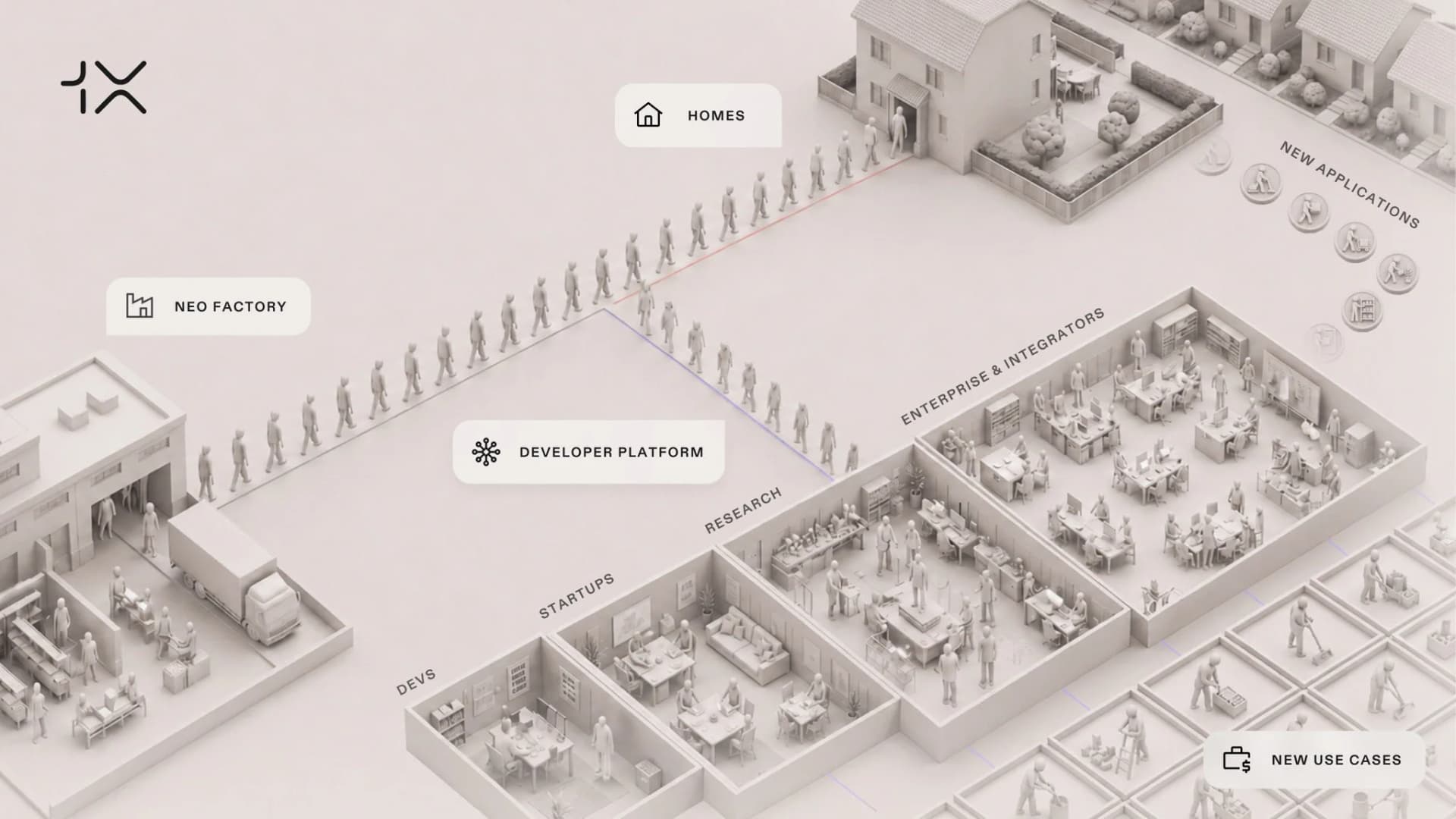
For Sinha, the true competitive advantage in the crowded humanoid sector isn't algorithmic; it's the data moat. And that data moat is entirely dependent on shipping hardware.
As detailed in a recent podcast interview with 1X Head of Product and Design Dar Sleeper, the company has heavily invested in vertical integration to keep the bill of materials low and rapidly iterate on NEO's physical design. This includes the development of highly compliant, tendon-driven joints and proprietary 22-degree-of-actuated-freedom hands.
Børnich noted to Forbes that having a robot with a morphology closely mirroring human anatomy minimizes the "embodiment gap," allowing the AI to more efficiently learn from vast datasets of human internet video.
The ultimate test of this "data-pilled" strategy will begin later this year. Børnich reaffirmed that 1X intends to start shipping its $20,000 NEO humanoids to early adopters by the end of 2026. The expectation is that these early units will act as remote data-collection nodes, feeding real-world edge cases back to the World Model Lab to continuously update the foundation models over the air.
1X is making a massive, highly public wager that by scaling computation and data natively for robotics, they can leapfrog the fine-tuning bottleneck. With a new leader at the helm and immense pressure to deliver, the humanoid industry will be watching closely to see if the World Model Lab can translate internet-scale imagination into physical, household reliability.
Share this article
Read next
- Published on
- Reading time
- 6 min read
1X CEO Bernt Børnich Predicts "Hard Takeoff" in 3 Years, Details NEO Platform and Data Strategy
- Published on
- Reading time
- 5 min read
1X Accelerates NEO Developer Release to Counter U.S. Bans on Chinese Humanoids
- Published on
- Reading time
- 4 min read
One Roof, Four Weeks: Inside 1X’s Vertical Speed Hack as NEO Ramps for 2026 Deliveries
- Published on
- Reading time
- 4 min read
The Robot in the Box: 1X Teases NEO Delivery Logistics as Humanoid Production War Heats Up
- Published on
- Reading time
- 5 min read
1X Unveils 1XWM: The Video-to-Action "Brain" That Lets NEO Imagine Its Chores
- Published on
- Reading time
- 5 min read
1X Reveals Its 'World Model,' A Digital Twin to Accelerate Humanoid AI Training


The weekly humanoid robotics briefing
One email a week: the launches, funding and research that mattered, with context from Humanoids Daily.
Read recent issues