- Published on
AgiBot's 'LinkCraft' Platform Aims to Turn Anyone into a Robot Choreographer
One tap, and our reporting appears more often in your Google Top Stories. It makes a real difference to a small newsroom.


Your guide
Rich Robinson
Jee Chee Ren · Executive tour
See China’s AI and robotics ecosystem first-hand.
Six days exploring AI, robotics and advanced manufacturing.
With Rich Robinson, Clinical Professor of Entrepreneurship at Peking University
Beijing · Guangzhou · Shenzhen
29 November–4 December 2026
Referral partnership · We earn a commission on referred bookings.
Chinese robotics company AgiBot has unveiled LinkCraft, a new software platform designed to eliminate the complex programming typically required to animate a humanoid robot. The company describes it as a "zero-code, barrier-free" tool that allows anyone to create sophisticated robot performances by simply uploading a video of a human.
The platform's core promise is motion imitation. According to AgiBot's announcement, a user can record a video of someone dancing, performing martial arts, or making gestures on a smartphone, upload it to LinkCraft, and the platform’s AI will automatically translate those movements into a control strategy for a robot.
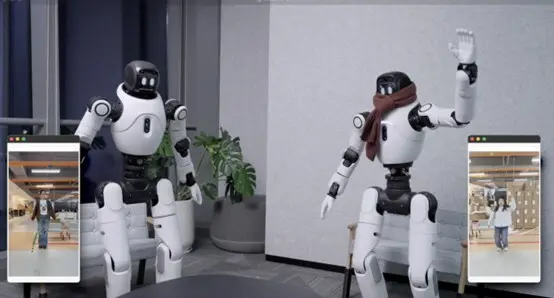
This move directly addresses one of the industry's most significant hurdles: usability. While many humanoid robots have demonstrated impressive physical feats, programming them to do anything useful—or even entertaining—remains a task for highly specialized engineers.
"No programming skills or specialized equipment are needed," said Zhihui Peng, Co-Founder, President, and CTO of AgiBot, in the release. "We're bringing professional-grade capabilities to everyday users."
The weekly humanoid robotics briefing
One email a week: the launches, funding and research that mattered, with context from Humanoids Daily.
Read recent issues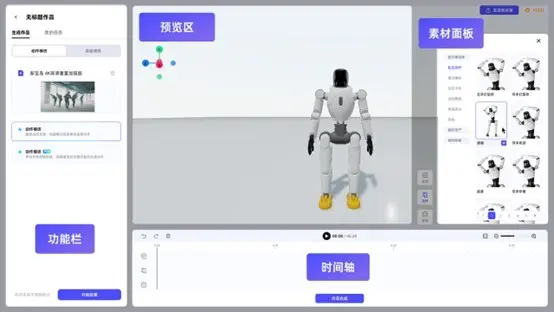
A Director's Toolkit for Robots
LinkCraft appears to function less like a programming environment and more like a video editing application. It's built around three main features:
- AI Motion Imitation: The system uses AI-based motion capture, "intelligent retargeting algorithms," and a cloud-based imitation learning framework to map human actions to the robot's body.
- Voice and Expression Performance: Users can upload audio, record their voice, or use text-to-speech. A multimodal large model then analyzes the content to generate synchronized facial expressions and body movements, complete with customizable tones and emotions.
- Timeline Orchestration: This feature allows users to act as "directors." They can drag and drop different actions, sounds, and expressions onto a timeline to create long-form, narrative-driven sequences, or what AgiBot calls "robot storytelling."
The platform also supports "Group Control," enabling the deployment and synchronization of coordinated performances across multiple robots.
From Acrobatic Demos to Commercial Products
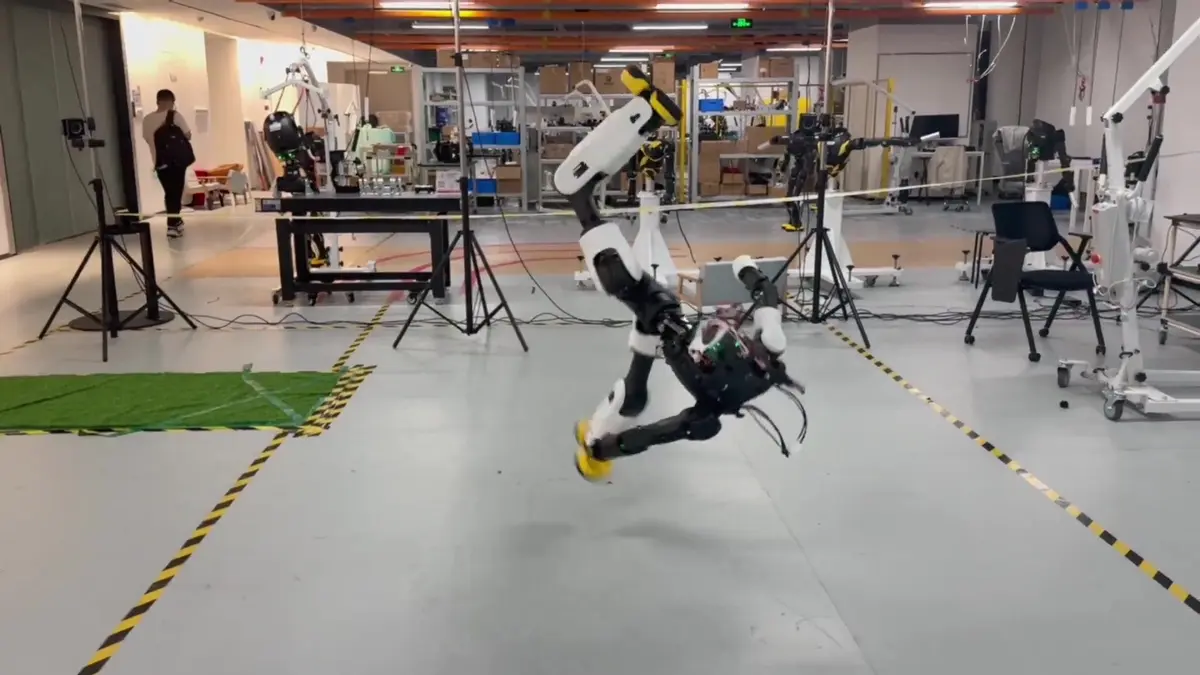
This software launch provides crucial context for AgiBot's recent hardware demonstrations. The company's Lingxi X2 humanoid is the first robot compatible with LinkCraft. This is the same platform that was recently shown executing a Webster flip, a complex acrobatic maneuver.
While the flip demonstrated the X2's raw dynamic capabilities, LinkCraft is the answer to how AgiBot expects customers to use it. The target applications—entertainment, retail guidance, and business receptions—position the X2 as a commercial, public-facing machine. This strategy contrasts with AgiBot's other major initiatives, such as its industrial-focused G2 robot or its plans for a large-scale production plant in Pudong.
Open Questions and Ambition
As with any "zero-code" solution, the central question will be one of fidelity and reliability. It remains to be seen how accurately the platform can translate nuanced human motion or how much "fine-tuning" is required after the initial AI-driven conversion. The press release notes that support for "fine motor control down to individual fingers" is a future goal, suggesting the current iteration is focused on larger body movements.
This platform is a key part of AgiBot's ambitious commercial plans. The company claims the X2 robot is already in mass production and that it expects shipments to "reach thousands in 2025." To sell that many expensive humanoid robots, AgiBot needs a tool that allows buyers in retail or entertainment to create content without hiring a team of robotics engineers.
The public beta for LinkCraft is now live. Its success will be a significant test of whether the barrier to robot creation can truly be lowered from complex code to a simple video upload.
Share this article
Read next
- Published on
- Reading time
- 3 min read
AgiBot's X2 Humanoid Sticks a Webster Flip, Pushing Boundaries of Dynamic Control
- Published on
- Reading time
- 4 min read
Brett Adcock Says Humanoids Will Need More Data and Compute Than LLMs
- Published on
- Reading time
- 3 min read
Foxconn to Deploy NVIDIA-Powered Humanoid Robots in Houston AI Server Plant
- Published on
- Reading time
- 3 min read
1X Opens Pre-Orders for NEO Humanoid Robot at $20,000, Pivoting from R&D to Product
- Published on
- Reading time
- 3 min read
Masayoshi Son's SoftBank Renews Humanoid Robotics Hunt, Targeting AI-Driven Startups
- Published on
- Reading time
- 4 min read
Google DeepMind Robotics Head Details 'Surprising' Cross-Embodiment AI, Calls Home 'The Hardest Environment'


The weekly humanoid robotics briefing
One email a week: the launches, funding and research that mattered, with context from Humanoids Daily.
Read recent issues