- Published on
Beijing Humanoid Half-Marathon: Honor Sweeps Podium as Robots Shatter Human World Record
One tap, and our reporting appears more often in your Google Top Stories. It makes a real difference to a small newsroom.


Your guide
Rich Robinson
Jee Chee Ren · Executive tour
See China’s AI and robotics ecosystem first-hand.
Six days exploring AI, robotics and advanced manufacturing.
With Rich Robinson, Clinical Professor of Entrepreneurship at Peking University
Beijing · Guangzhou · Shenzhen
29 November–4 December 2026
Referral partnership · We earn a commission on referred bookings.
- Honor’s Lightning humanoid won the 2026 Beijing Humanoid Robot Half-Marathon with an autonomous time of 50:26, eclipsing the human world record of 57:20.
- The event featured over 300 robots from 26 brands, a massive scale-up from the 21 teams that participated in the inaugural 2025 race.
- Approximately 40% of entrants utilized autonomous navigation, benefiting from a 1.2x scoring coefficient designed to penalize remote-controlled machines.
- Unitree Robotics focused on sprint milestones, claiming a proportional world record for the 1500m, while their H1 robots utilized ice-filled backpacks for thermal management.
- Industry observers noted a "transatlantic divide," contrasting China’s high-stakes racing with Tesla’s decision to use Optimus as a sideline mascot for the Boston Marathon.
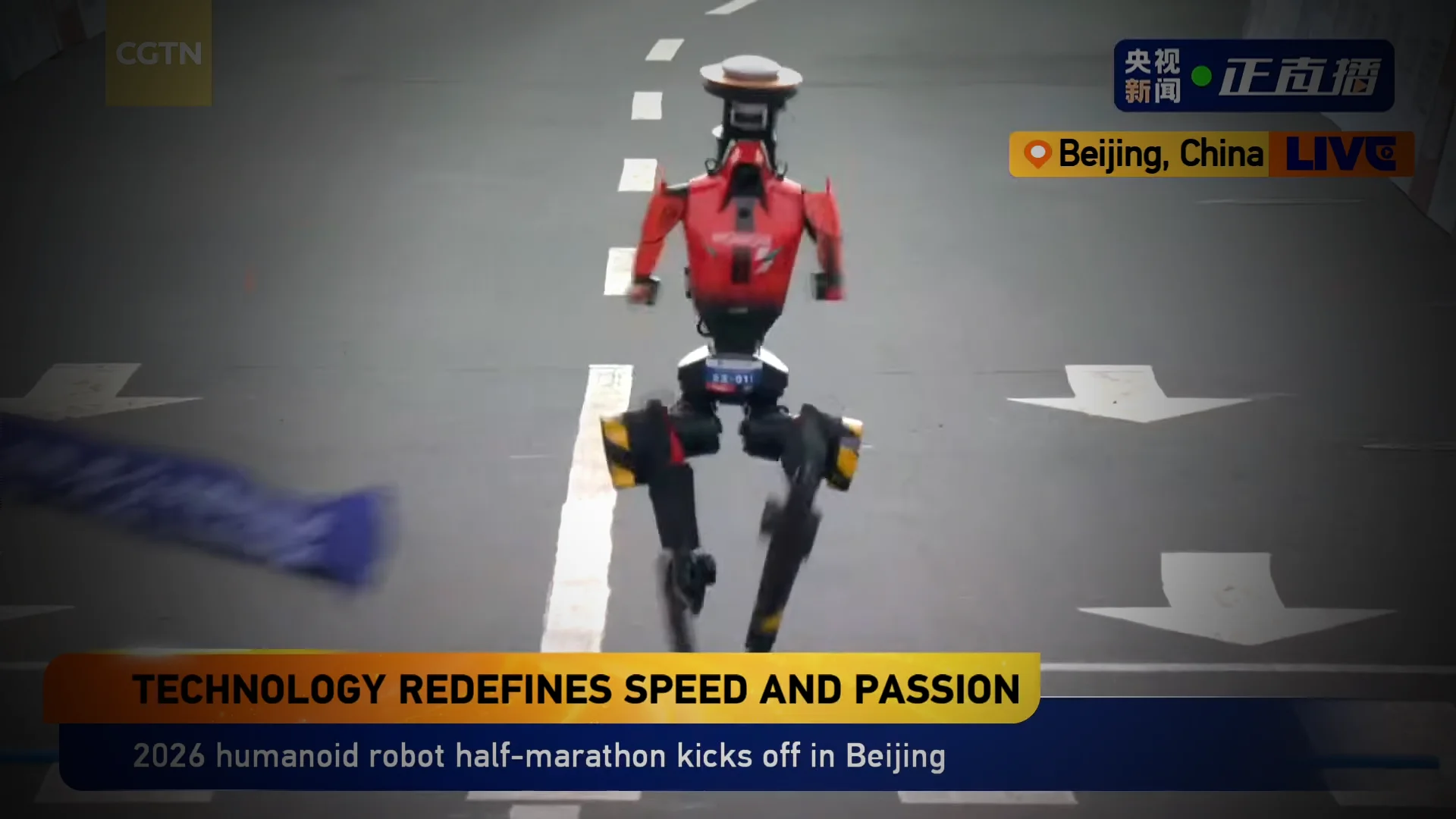
The "utility gap" in robotic locomotion didn't just close this weekend; it was sprinted over at record-breaking speeds. On April 19, 2026, the second annual Beijing Humanoid Robot Half-Marathon transformed the Yizhuang Economic and Technological Development Zone into a high-speed laboratory, where silicon and steel officially outpaced human endurance.
The Lightning Strike: Honor’s Triple Podium
In a dominant display of engineering, smartphone giant Honor swept the top three positions. The winning robot, a 1.69-meter "Lightning" model, completed the 21.0975-kilometer course with a net autonomous time of 50 minutes and 26 seconds.
This result does more than just beat last year’s winning time of 2 hours and 40 minutes—it shatters the human men’s half-marathon world record of 57:20, held by Uganda’s Jacob Kiplimo.
| Rank | Team Name | Robot Model | Time | Navigation |
|---|---|---|---|---|
| 1st | Qi Tian Da Sheng | Honor Lightning | 50:26 | Autonomous |
| 2nd | Thunder Lightning | Honor Lightning | 50:56 | Autonomous |
| 3rd | Xinghuo Liaoyuan | Honor Lightning | 53:01 | Autonomous |
While a remotely controlled Lightning unit actually crossed the line first at 48:19, its raw speed was tempered by late-race instability. With only 100 meters remaining, the unit crashed into a side barrier, requiring a team to quickly assist it back to its feet—an incident that added roughly a minute to its final clocking. Furthermore, the autonomous navigation group rules introduced this year applied a 1.2 coefficient penalty to non-autonomous times, handing the official championship to the self-navigating "Qi Tian Da Sheng" team.
The weekly humanoid robotics briefing
One email a week: the launches, funding and research that mattered, with context from Humanoids Daily.
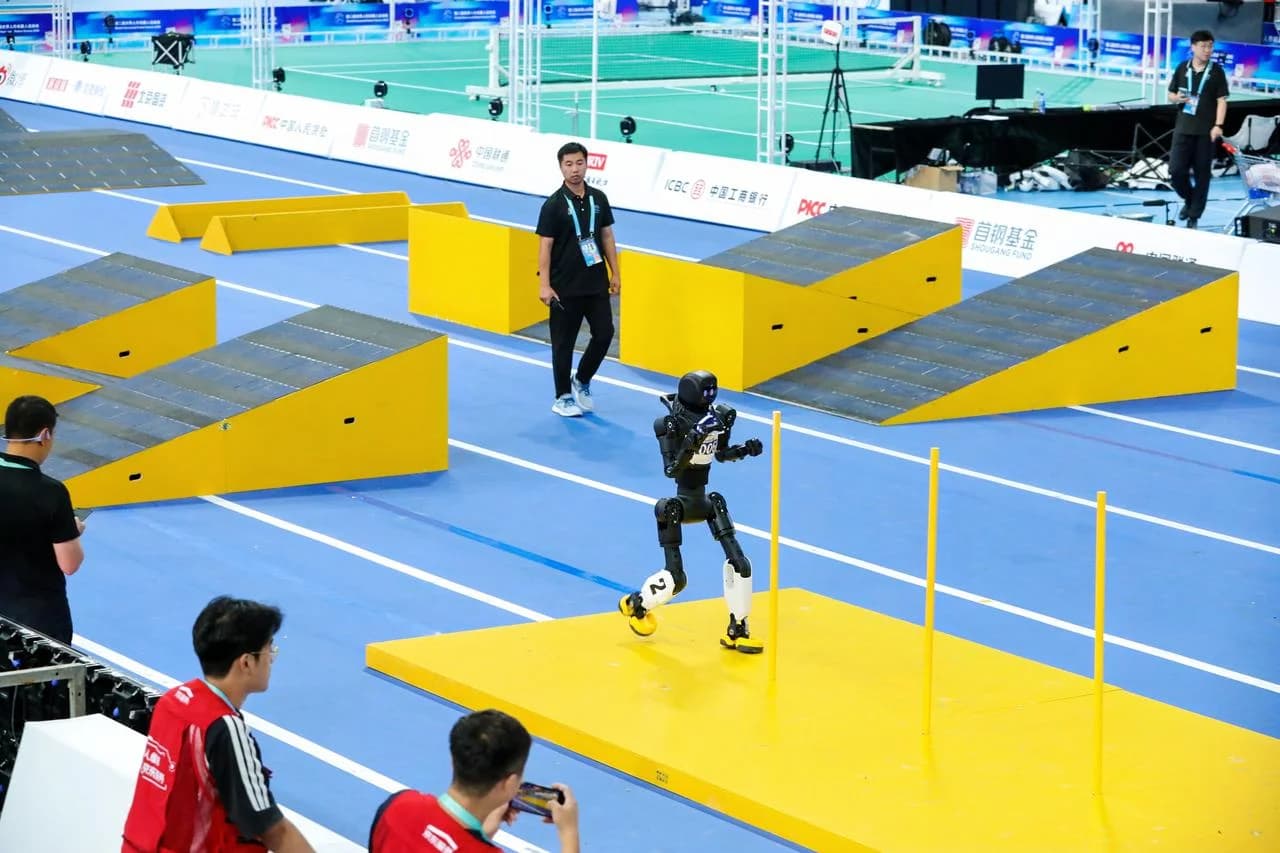
Read recent issuesThe shift toward generalized utility was best exemplified by the Tiangong Ultra. This iteration is an upgraded model of the Tiangong Ultra that claimed victory in the inaugural 2025 race. Though it did not secure a repeat win this year, it completed the full 21.0975 km course in 1 hour and 15 minutes with zero human intervention. Widely praised for the most human-like running form on the track, the platform—developed by the Beijing Humanoid Robot Innovation Center—received the "Best Design" award. More importantly, the Tiangong platform served as the foundation for an open ecosystem, with teams from Peking University, Fudan, TUM, and others fielding different software solutions on the same standardized hardware. This versatility was further proven a day prior during the Robot "Baturu" Challenge, where the Tiangong (Tienkung) successfully navigated obstacle courses.
Thermal Management and the "Ice Backpack"
The race was as much a test of cooling as it was of gait. Honor engineers attributed their success to liquid-cooling technology pivoted from their smartphone division. Meanwhile, Unitree’s H1 units were carrying backpacks filled with ice. This "low-tech" solution addressed the massive thermal loads generated by the H1's high-torque actuators during sustained high-speed locomotion.
Though Unitree did not take the podium in the half-marathon, the company utilized the event to showcase its raw velocity. The company reported that a modified 2023 H1 autonomously completed a 1.9 km qualifying course in 4 minutes and 13 seconds. By proportional calculation, Unitree claims this surpasses the human 1500m world record, maintaining the H1’s reputation as a raw, speed-focused platform.
A Tale of Two Marathons: Beijing vs. Boston
As 300 humanoids from 26 Chinese OEMs navigated the streets of Beijing, a different scene unfolded in the United States. Tesla invited enthusiasts to meet Optimus at its Boston showroom for "Marathon Monday." However, instead of running the 26.2 miles, the Tesla humanoid was scheduled to "cheer from the sidelines" and pose for photos.
The contrast sparked immediate debate among industry analysts. While Tesla has recently teased competitive running speeds in controlled lab settings, the Beijing event demonstrated a Chinese ecosystem willing to risk high-profile failures for "utility validation."
From Marathons to Industrial Reality
As Honor engineer Du Xiaodi noted, the race serves as a high-stress testbed for structural reliability and power density. With Beijing backing the industry with a $14.48 billion investment fund, these "sporting" events are increasingly viewed as the necessary R&D hurdles before mass deployment in China's manufacturing sector.
Share this article
Read next
- Published on
- Reading time
- 3 min read
Honor Enters Humanoid Robotics Fray, Claims 4 m/s Speed for AI-Trained Unitree Robot
- Published on
- Reading time
- 4 min read
AGIBOT Tops Medal Table at 2nd World Humanoid Robot Games as Beijing Showdown Concludes
- Published on
- Reading time
- 5 min read
Robots Outrun Usain Bolt: Inside the Record-Shattering Spree at the 2nd World Humanoid Robot Games
- Published on
- Reading time
- 3 min read
Video: Honor Teases Humanoid Debut for MWC 2026 as "Alpha Plan" Pivot Accelerates
- Published on
- Reading time
- 3 min read
Beijing’s Newest Humanoid: Tiangong 3.0 Breaks Cover with Parkour and Open-Source Ambitions
- Published on
- Reading time
- 3 min read
Beijing Humanoid Robot Innovation Center Secures $100 Million to Scale Commercial Operations


The weekly humanoid robotics briefing
One email a week: the launches, funding and research that mattered, with context from Humanoids Daily.
Read recent issues