- Published on
IntelliProve Raises €2.7M to Bring Camera-Based Vital Signs to Humanoid Robots
One tap, and our reporting appears more often in your Google Top Stories. It makes a real difference to a small newsroom.

Supported by RoboStrategySupport for Humanoids Daily comes from RoboStrategy
Sponsored
Investing involves risk, including possible loss of principal. Read the prospectus before investing.
Belgian healthtech company IntelliProve has raised €2.7 million in seed funding to take its camera-based vital-signs software from smartphone apps to humanoid robots. The Ghent-based startup, founded in 2021, announced the round on November 19. Miles Ahead, a Belgian early-stage deep tech fund, led it, with home-nursing organization Wit-Gele Kruis, the imec.istart fund and several business angels taking part.
- IntelliProve has raised a €2.7 million seed round led by Miles Ahead, with Wit-Gele Kruis, imec.istart and business angels participating.
- Its software reads heart rate, HRV, respiratory rate, blood pressure and resonant breathing from a 30-second scan of a person's face with an ordinary camera, without a cuff or wearable.
- The product is already embedded in the apps of care providers, health insurers and wellbeing platforms in more than 50 countries. Humanoid and assistive robots are the next target.
- IntelliProve says the scan is already live on robots with partners it cannot name under NDA, and that it expects to announce a major robotics company using it soon.
- It shared blood pressure figures showing a mean error under 1 mmHg against a reference cuff; the full validation has not yet been published. Part of the round goes to clinical validation toward Class IIa certification under the EU Medical Device Regulation.
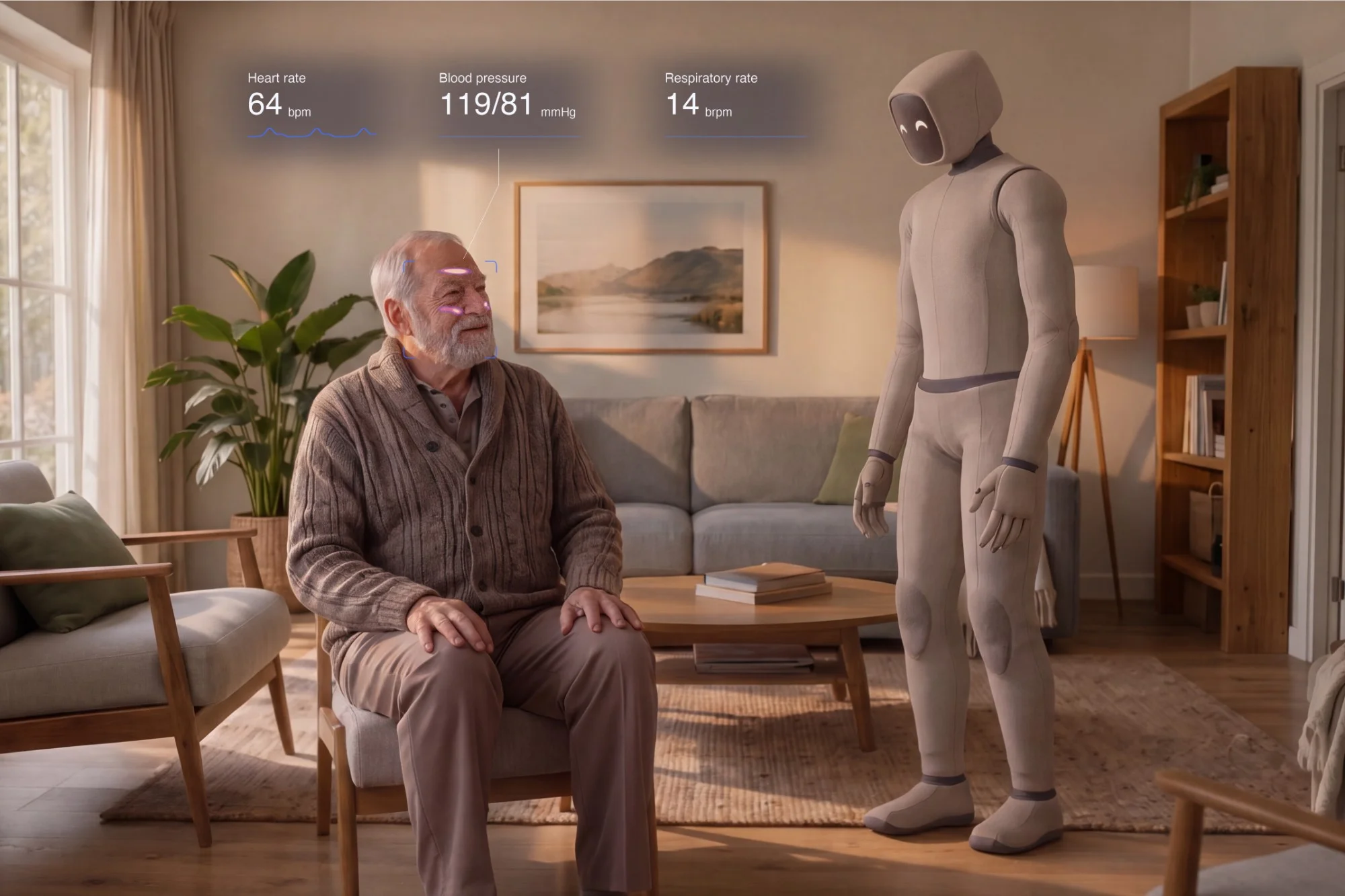
What the software measures
The technique behind the product is remote photoplethysmography, or rPPG. Each heartbeat pushes blood through the face and shifts skin color by an amount too small to see but large enough for a camera sensor to pick up. IntelliProve's software tracks the skin as the person moves, extracts a pulse signal from those color changes and combines it with the small movements of breathing.
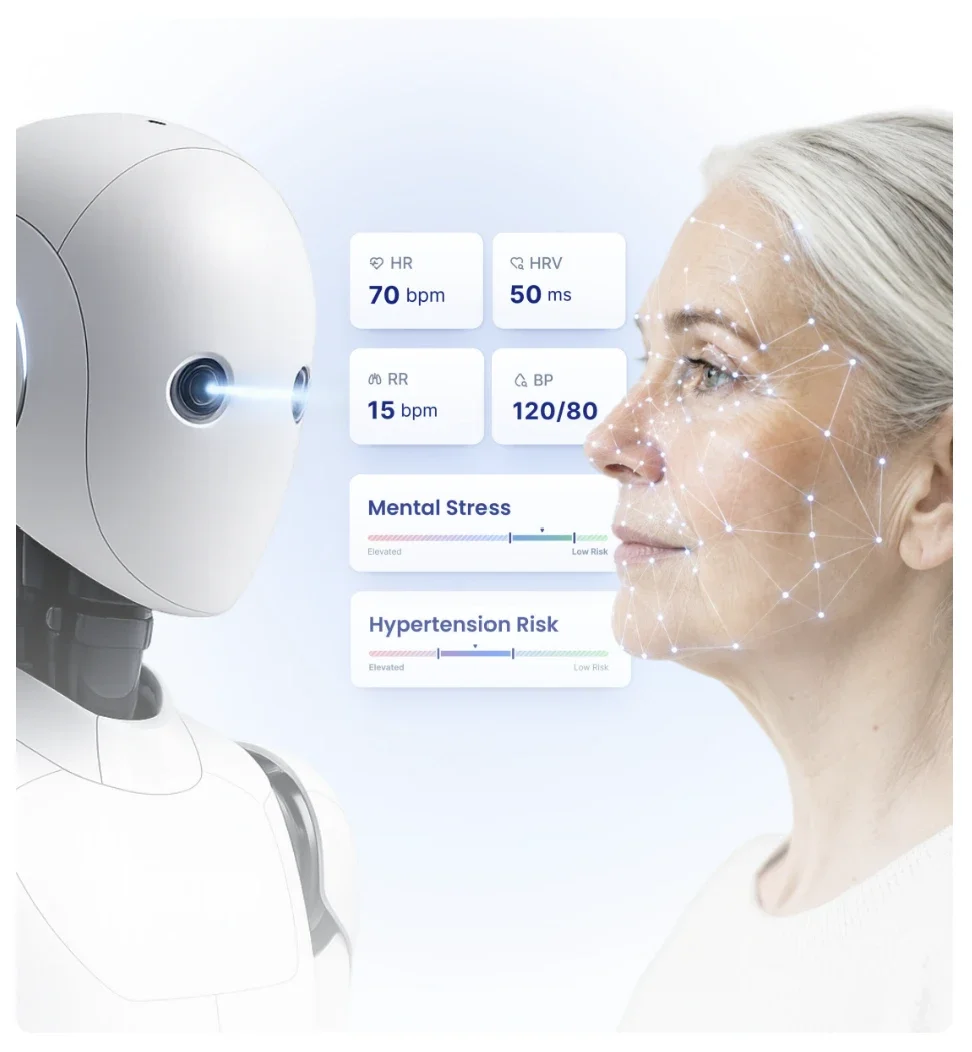
From a 30-second scan it returns six biomarkers: heart rate, heart rate variability, respiratory rate, systolic and diastolic blood pressure, and resonant breathing. Blood pressure is estimated from the shape of the pulse wave by a deep learning model the company trained in-house.
Camera-based vitals are hard to get right outside a lab because people move, the lighting changes and every camera processes color differently. IntelliProve has built three proprietary components for this: VitalMesh for following the skin, PulseShape for the blood pressure model and TripleGate, which runs quality checks on the video, on the extracted signal and on the final values during each scan.
Follow humanoid robotics without following every announcement.
Get the week’s most important launches, funding and research—and why they matter—in one email from Humanoids Daily.
Once a week. Unsubscribe anytime.
Read recent issuesThe company says its models have been validated on more than 6 million data points from several tens of thousands of people, and that its R&D team has authored or co-authored several peer-reviewed papers. Its academic and clinical partners include TU Delft, Ghent University Hospital and Wit-Gele Kruis. The software carries a CE mark, and IntelliProve is ISO/IEC 27001 certified.
The six readings are not equally hard. Researchers have measured heart rate from ordinary webcam video since the late 2000s, and at rest, in good light, it tracks reference devices closely. HRV is harder, because it depends on timing individual heartbeats to within milliseconds from a 30-frames-per-second video. Blood pressure is the hardest. A cuff measures pressure physically by closing off an artery; a camera can only observe the pulse wave, and a model trained on cuff readings converts its shape into an estimate. Published cuffless methods, including wrist-worn devices that touch the skin, have tended to struggle most with readings far from the average, and most wearables that report blood pressure still require periodic calibration against a cuff.
IntelliProve shared its blood pressure figures with Humanoids Daily ahead of publishing the validation. Against reference cuff measurements, its systolic estimates have a mean error of 0.81 mmHg with a standard deviation of 12.31 mmHg, across readings from 89 to 175 mmHg. For diastolic pressure the figures are −0.64 ± 8.42 mmHg across 51 to 110 mmHg. These numbers come from the company's own validation set. Blood pressure monitors are normally validated under the ISO 81060-2 standard, which sets its own test protocol and accuracy limits, and the Class IIa certification IntelliProve is working toward will require clinical evidence on blood pressure accuracy.
From apps to robots
Today the face scan runs inside other companies' apps. A care provider, insurer or wellbeing platform integrates it under its own brand, and its users check in from their phone or laptop at home.
The robotics pitch rests on the fact that humanoids moving into homes and care facilities already carry cameras for navigation and perception. IntelliProve wants to add a 30-second check of heart rate, breathing and blood pressure using that same hardware, with no extra sensors on the robot. In elderly care, the company describes the readings as added context for carers about a resident. In its description, the robot only passes the values on, and a person interprets them and decides what to do.
"Humanoid robots are next: they are becoming very good at understanding the world around them, and the next step is helping them understand the people within that world," said Joeri Tulkens, IntelliProve's co-founder and co-CEO.
IntelliProve says it is working with selected robotics partners and will use the round to add more internationally, among robot makers and among the companies that build perception and software stacks for them. The partners are under non-disclosure agreements, but the company told Humanoids Daily that the scan is already live on robots today, and that it expects to announce a major robotics company running its technology soon. The company also lists smart glasses and self-service kiosks as possible devices.
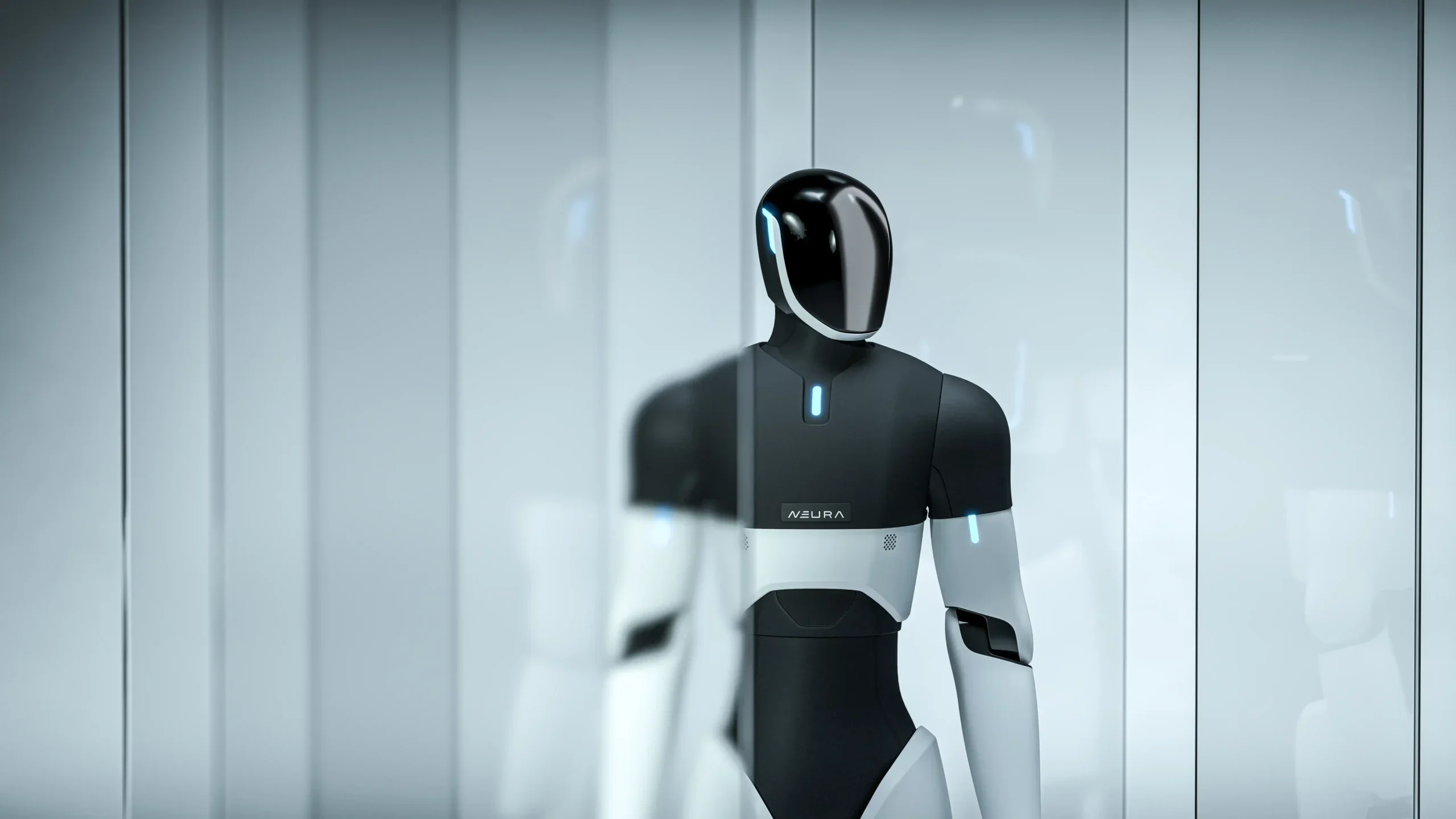
Interest in care robotics has picked up this autumn. In October, Japanese nursing-home operator Charm Care agreed to invest ¥300 million in Donut Robotics, which is trialing its cinnamon humanoid at a care facility. In September, NEURA Robotics set up a HealthTech unit and is training its wheeled MiPA robot for patient-room assistance. Wit-Gele Kruis, the largest non-profit home-nursing organization in Flanders, cared for 129,091 patients in 2025, and its place on the cap table gives IntelliProve an investor whose staff would be among the users of the readings.
Where the money goes
IntelliProve lists four uses for the round:
- More data, extending its validation set across more skin tones, ages, lighting conditions and devices
- Accuracy work, benchmarking each biomarker against reference methods such as blood pressure cuffs and breathing belts, starting with blood pressure and HRV
- Certification, with further clinical research toward Class IIa under the EU Medical Device Regulation and approvals in markets outside Europe
- Growth, signing more virtual-care partners and bringing the software to new devices, starting with humanoid robots
"Whether the scan runs on a smartphone or on a humanoid robot, the bar stays the same," said Tanguy Sanglet, co-founder and CTO.
Luc Burgelman, founder of Miles Ahead, pointed to the company's focus on scientific validation and certification as the reason the fund led the round. Miles Ahead launched its first fund at the end of 2022 with €30 million under management and backs first-time founders in deep tech and AI. imec.istart is the startup accelerator of Belgian research center imec and has supported more than 380 startups since 2011.
Share this article
Follow humanoid robotics without following every announcement.
Get the week’s most important launches, funding and research—and why they matter—in one email from Humanoids Daily.
Once a week. Unsubscribe anytime.
Read recent issuesRead next
- Published on
- Reading time
- 5 min read
Genesis AI Raises $500M Series A at $3.5B Valuation as Eno Heads Into Production
- Published on
- Reading time
- 5 min read
Agile Robots Raises $500 Million Series F at $8.5 Billion Valuation
- Published on
- Reading time
- 3 min read
The Billion-Dollar World Model: Yann LeCun’s AMI Labs Secures $1.03B to Challenge LLM Dominance
- Published on
- Reading time
- 4 min read
Neura Robotics Reportedly Secures €1 Billion from Tether to Scale Humanoid Vision
- Published on
- Reading time
- 8 min read
Foundation Misses Payroll After CEO Borrowed $4.6 Million to Buy a Home
- Published on
- Reading time
- 4 min read
J.P. Morgan Forecasts 300,000 to 400,000 US-Made Humanoids by 2030