- Published on
Military Humanoids: Army Trials, New Entrants and the Gap Between Ambition and Deployment
One tap, and our reporting appears more often in your Google Top Stories. It makes a real difference to a small newsroom.


Military humanoid robotics is attracting more than ambitious sales pitches. The U.S. Army has completed a competition involving live demonstrations, while developers in the United States and Poland are proposing machines for reconnaissance, logistics and hazardous work.
But the latest announcements describe very different stages of development. IHMC’s Alex has won an Army technology competition. Vision One is promoting Titan’s finalist status. Si Robotics is proposing a tracked alternative to walking humanoids. Skylark Labs pairs defense ambitions with research into adaptation after deployment. Foundation’s more expansive military claims are facing renewed scrutiny.
- IHMC’s Alex was among five xTechHumanoid winners selected after demonstrations at Quantico. The competition evaluated emerging technology; its results do not establish operational deployment.
- Vision One’s Titan reached the finalist stage, while Poland’s Si Robotics proposes human-supervised, tracked manipulation through JOULE.
- Foundation’s military ambitions remain relevant, but disputed contract and Ukraine claims require clearer evidence. Its connection to IHMC does not make the two organizations or their current robots interchangeable.
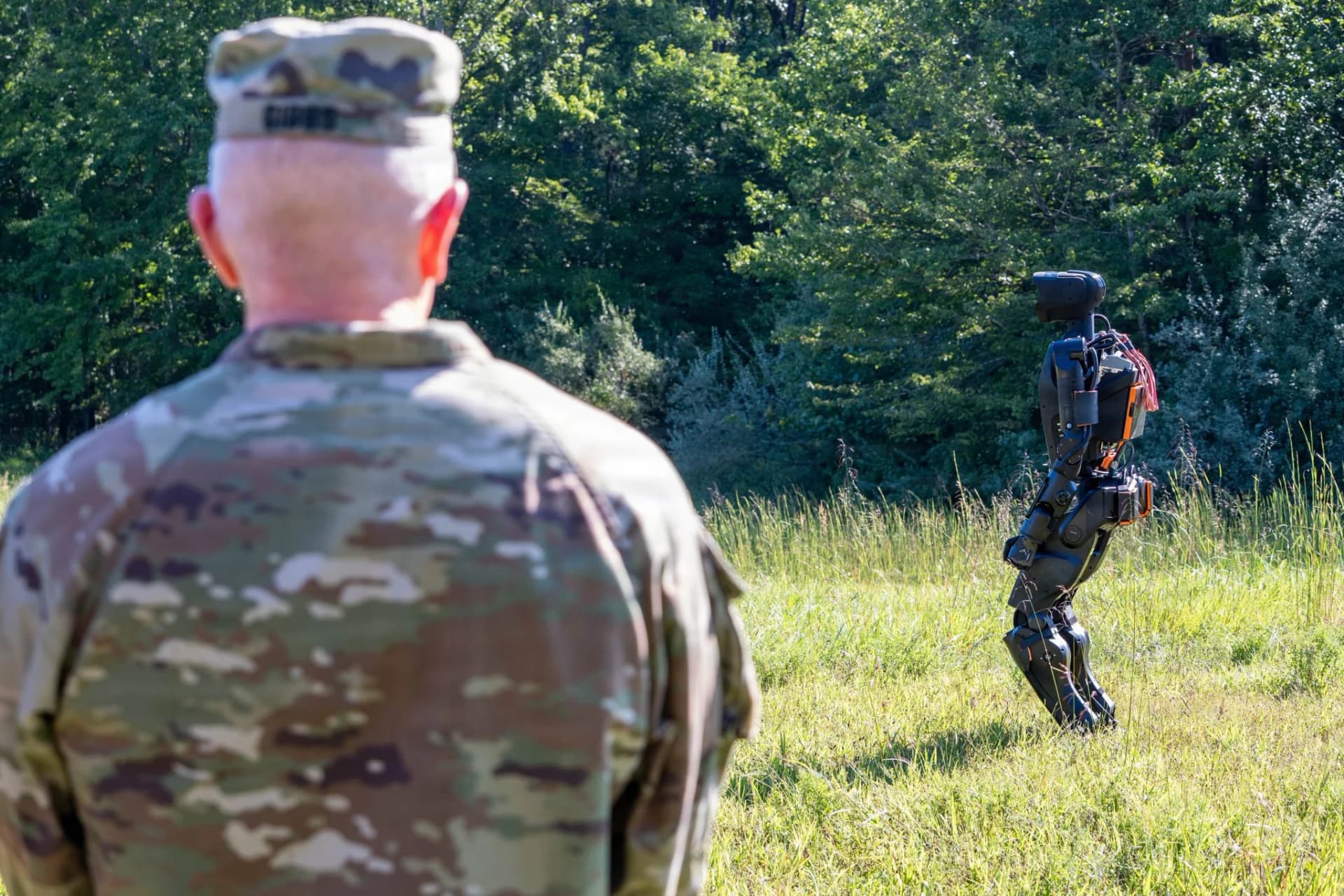
IHMC’s Alex: an Army evaluation and a competition win
The clearest recent milestone comes from the Army’s xTechHumanoid results. The competition received 103 submissions covering complete humanoids and subsystems. Ten entrants reached the finals, and nine demonstrated their technology at Marine Corps Base Quantico on September 9–10. Five winners were selected on September 11.
Among them was the Florida Institute for Human and Machine Cognition, or IHMC, with Alex. The Army describes the robot as combining impact-resilient actuators, ballistic protection and hybrid autonomy using AI and human control.
The weekly humanoid robotics briefing
One email a week: the launches, funding and research that mattered, with context from Humanoids Daily.
Read recent issuesThe other winners address supporting technologies: power systems from ACEs Group and Hydroplane, tactile sensing from RAS Labs, and command-and-control software from Velocity Explorations. Their inclusion highlights how much useful military robotics depends on energy, sensing and control alongside the robot body.
IHMC separately reported an earlier untethered demonstration for the Office of Naval Research, involving gravel, slippery surfaces and uneven pavement. Its stated goal is a robot that can approach buildings and assess dangerous interiors before people enter. That remains a development objective, rather than evidence of routine military use.
IHMC also represents a different funding model from venture-backed humanoid manufacturers. It is a nonprofit research institute affiliated with Florida’s university system, working across robotics, AI and human health and performance. Alex has a multiyear, multimillion-dollar ONR development contract; IHMC’s robotics program also names the Army Research Laboratory and Army Data Analysis Center as funders. Separately, its September 2025 board minutes report $9.34 million in recurring state appropriations for FY2025–26, supporting the wider institute rather than Alex alone. Its role highlights a publicly funded research contribution to American humanoids that can be obscured by the focus on startup fundraising and production targets.
Vision One’s Titan: finalist status, with missions still ahead
Vision One’s September 30 press release presents Titan as a machine intended to take on dangerous tasks while people retain mission authority. Proposed applications include reconnaissance, hazardous-environment assessment, logistics and cooperation with small drones.
The announcement’s competition framing needs context. The Army’s current roster lists Vision One and Vigil Robotics as baseline-humanoid finalists, alongside IHMC as a winner in that category. Vision One was not among the five announced winners. The 103 submissions also included subsystems, so the field was not composed of 103 complete humanoid robots.
Titan’s release describes supervised autonomy as the goal, including human judgment over consequential decisions. It acknowledges further work on mobility, manipulation, endurance and reliability. Its proposed missions should therefore be read as the company’s development agenda, rather than a list of demonstrated operational capabilities.
JOULE: a military robot does not necessarily need legs
Poland’s Si Robotics offers a different approach. Its JOULE program combines tracked mobility with two robotic arms, targeting tasks including logistics, ammunition handling and hazardous manipulation.
The company argues for useful operation under human supervision before general-purpose autonomy is available. Teleoperation and assisted control would provide an initial route to use, with experience informing further automation.
Its FAQ describes JOULE as a platform concept and explains why it does not require a fully human-shaped body: tracks can offer stability and payload capacity while the arms provide human-scale manipulation. The published material sets out a proposed approach, not evidence of an established military fleet.
That makes JOULE a relevant counterpoint to bipeds. The practical question is which body can perform a particular job reliably, with acceptable demands on its operators.
Skylark Labs: learning after deployment
Skylark Labs combines explicit defense ambitions with research into robots that continue adapting after deployment. Its defense website lists humanoid applications including weapon engagement, IED detection and breaching.
In a September research preprint, the company’s researchers and collaborators describe Continual Field-Adaptive Models, or CFAMs. The approach keeps a core model frozen while storing verified new experience on-device, enabling bounded adaptation without retraining that core. The authors report evaluations across five robot types, including a humanoid.
The distinction between research and deployment remains important here, too. The paper excludes unrestricted adaptation to entirely novel situations, and its reported results do not establish operational readiness for the military applications Skylark advertises.
Foundation: military ambitions under scrutiny
Foundation has been unusually explicit about its defense ambitions, as we have covered in its plans for armed robots and CEO Sankaet Pathak’s account of a Ukraine pilot. The latter coverage relayed the company’s account, rather than independently establishing the pilot’s location or scope.
Commentator Mike Kalil has now challenged Foundation’s contract claims and questioned reports of testing in Ukraine. His posts raise questions for further reporting; they do not, by themselves, establish intentional deception.
There is earlier reporting on the contract issue. WIRED reported that contracts Foundation supplied to the publication were inherited from Boardwalk Robotics or came through IHMC, complicating descriptions of a direct Pentagon award. Foundation had acquired Boardwalk, which worked closely with IHMC.
As our earlier look inside Foundation’s factory explained, Boardwalk’s commercial Alex platform and IHMC’s separate bipedal Alex research robot share engineering lineage. That history helps explain the family resemblance between the projects. It does not establish that IHMC’s current Alex and Foundation’s Phantom have identical hardware, software or capabilities. The Army’s xTechHumanoid recognition was awarded to IHMC.
Across these projects, military interest is tangible, but the milestones matter. A competition result establishes that technology was evaluated and selected within that program. A proposed mission describes what a developer hopes to enable. A deployment claim needs evidence of where the robot operated, what it did and under whose control. Keeping those distinctions visible makes the progress easier to assess.
Share this article
Read next
- Published on
- Reading time
- 6 min read
From Stadiums to the Front Line: How China and the US Are Preparing Humanoids for Combat
- Published on
- Reading time
- 5 min read
The Great Dexterity Divide: Why Robotics Leaders Are Warring Over Tendon vs. Direct-Drive Hands
- Published on
- Reading time
- 5 min read
Foundation Robotics CEO Details Ukraine Pilot, "Super-Heavy" Phantom 2, and Rejection of Companion Bots
- Published on
- Reading time
- 4 min read
Watch: Foundation Puts Phantom Through a Gauntlet of Marbles and Banana Peels
- Published on
- Reading time
- 4 min read
Decoupling the Brain: Inside Foundation’s Phantom Head Assembly
- Published on
- Reading time
- 4 min read
"Peace Through Strength": Foundation CEO Showcases Phantom Robot on Fox Business

The weekly humanoid robotics briefing
One email a week: the launches, funding and research that mattered, with context from Humanoids Daily.
Read recent issues