- Published on
After SuperMimic, Open-Source Humanoid Motion Trackers Now Train in Minutes on One GPU
One tap, and our reporting appears more often in your Google Top Stories. It makes a real difference to a small newsroom.

Supported by RoboStrategySupport for Humanoids Daily comes from RoboStrategy
Sponsored
Investing involves risk, including possible loss of principal. Read the prospectus before investing.
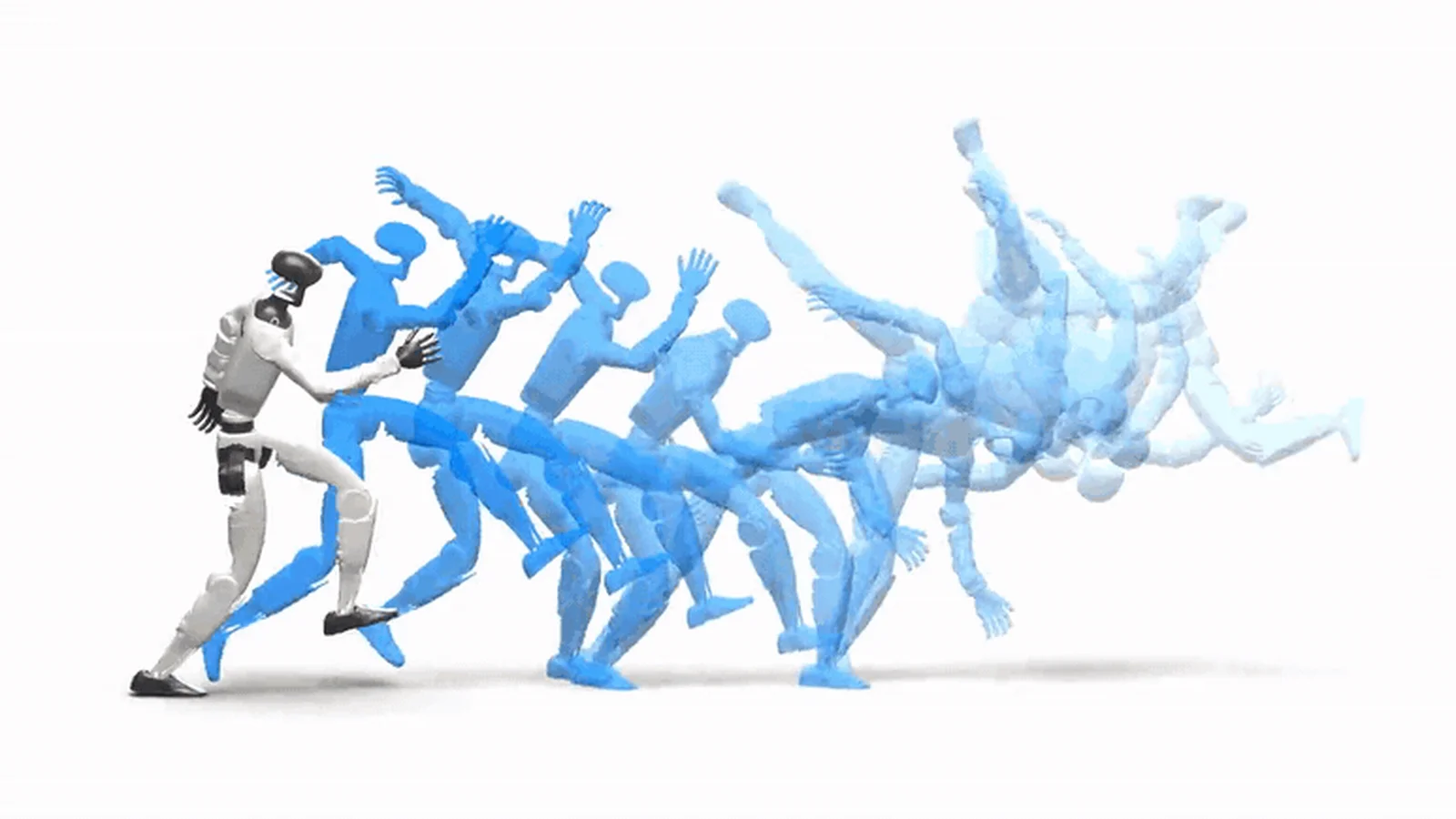
Training a whole-body controller for a humanoid used to be a job for a GPU cluster. In under four weeks, a UC Berkeley paper called SuperMimic and a string of open-source projects built on it have cut the time to train a working motion tracker for the Unitree G1 to a few minutes on a single graphics card. Each new project took the last one's code and made it faster.
- SuperMimic, posted to arXiv on October 20 by a UC Berkeley team, trains a tracking policy by backpropagating through a learned world model. The authors say 3 hours on one GPU beats a baseline trained for 7 days on 128 GPUs.
- No code came with the paper. ETH Zürich's Chong Zhang published an unofficial reimplementation the next day, and InstantTrack, BlinkMimic and XMimic followed on top of it.
- BlinkMimic reports 3.4 minutes on one RTX 4090, and XMimic 0.86 minutes on four H100s, both measured on a 40-clip benchmark in simulation. None of the community projects reports a real-robot test.
Ros Shinkle, founder and CEO of Tuesday Labs and formerly a staff roboticist at Boston Dynamics, summed up the change on X this week. "Before October 20 it took 1 week to train a whole body controller (ie robot walking model) on 128 GPUs," she wrote. "Now it takes 3 minutes on 1 GPU." In replies, she listed the projects as they appeared and noted that the paper that started it shipped without source code.
What SuperMimic changed
Most humanoid motion trackers, including NVIDIA's SONIC, are trained with model-free reinforcement learning. The policy learns from very large numbers of simulated trials, and the physics engine is treated as a black box.
SuperMimic: Scaling Humanoid Whole-Body Control with One Differentiable World Model takes a different approach. The team trains a neural network to predict how the robot's body responds to its actions, using transitions logged from an ordinary rigid-body simulator. Because that learned model is differentiable, the tracking policy can be improved by backpropagating through short imagined rollouts. The world model and the policy train together in one loop. The authors are Qiayuan Liao, Yiyang Shao, Junfeng Long, Kevin Zakka, Roberto Horowitz, Pieter Abbeel and Koushil Sreenath, and the paper is listed as a CoRL 2026 oral.
Follow humanoid robotics without following every announcement.
Get the week’s most important launches, funding and research—and why they matter—in one email from Humanoids Daily.
Once a week. Unsubscribe anytime.
Read recent issuesThe abstract reports that SuperMimic, trained for 3 hours on one GPU, exceeds the return of a state-of-the-art tracker trained for 7 days on 128 GPUs. The authors put the GPU-hour reduction at more than 1,000 times. On a benchmark of 129,514 motions, SuperMimic fails on 25 against the baseline's 179. With 9.8 hours on two GPUs, it fails on none. The paper also says the policy transfers to a physical Unitree G1 across "diverse and acrobatic motions."
The official code, from Berkeley's Hybrid Robotics group, appeared on GitHub around November 10 under an Apache-2.0 license. By then the community had already rebuilt the method several times.
A reimplementation in a day
On October 21, Chong Zhang of ETH Zürich published supermimic_vibed. The repository's description says Zhang "vibe coded supermimic within 1h", working only from the paper. Like most of what followed, it trains a single G1 policy for all 40 clips in the LAFAN1 motion-capture dataset. The first version reached the target normalized return of 0.82 in 1.11 hours, with no failed clips at 1.31 hours. The current version is at about 0.95 GPU-hours on one RTX PRO 6000 Blackwell. It runs on Isaac Lab 3 with the Newton and MuJoCo Warp solvers, and the README describes it as independent of the paper's authors.
Zhang's code became the starting point for the projects that came after it. A community list on GitHub, awesome-supermimic, now tracks more than 40 SuperMimic implementations, extensions and demos.
From hours to minutes
InstantTrack, published by GitHub user Huy-Quang-Dao, released version 1.0 on October 30 at 0.25 hours to target. Over the next week it added:
- a policy that outputs a correction to the next reference pose instead of an offset from a standing pose;
- an averaged copy of the network as the deployed policy;
- the Muon optimizer, CUDA-graph updates and a smaller network.
Version 1.4, released on November 7, reports 2.74 minutes on one RTX 5090, averaged over 15 seeds. The README notes that this gain over version 1.3 is "a trend, not yet statistically established."
BlinkMimic, by Fuyi Chen, appeared on GitHub on November 2, and the accompanying arXiv paper followed on November 12. It reports 3.4 minutes on one RTX 4090. That clock runs until three consecutive checkpoints hold a normalized return of at least 0.82 with no failed clip, averaged over three seeds. The first checkpoint above 0.82 arrives at 2.94 minutes on average. BlinkMimic builds on InstantTrack v1.2 and adds three changes:
- a learning rate that starts at four times the base rate and drops once training return passes 0.75;
- a share of resets aimed at motions where the deployed policy fails;
- capture of the entire training iteration as a single GPU graph.
InstantTrack folded those changes back into its own version 1.3 two days later.
XMimic, released on November 7 by Nico Bohlinger, is a JAX rebuild of BlinkMimic's trainer. It keeps BlinkMimic's algorithm and hyperparameters, and runs the simulator, replay buffer, world model, policy and critic in JAX so each iteration compiles to XLA and can be split across GPUs. The repository reports BlinkMimic's target reached in 0.86 minutes on four H100s, against 3.19 minutes for BlinkMimic on one H100 in the same tests. On a single H100, XMimic takes 2.47 minutes. Its README cites a paper by Bohlinger and Jan Peters, titled "XMimic and XSoma: Learning Humanoid Motion Tracking and Locomotion in Under a Minute."
What the minutes measure
The three-minute figures and SuperMimic's headline comparison measure different tasks. SuperMimic's 3-hour result covers a benchmark of 129,514 motions. The community projects time a single policy on LAFAN1's 40 clips, which has become their shared yardstick. The SuperMimic paper's own LAFAN1 time, cited in the supermimic_vibed README, is 1.2 hours on an H100.
The community results are also simulation-only. InstantTrack's README says there is no sim-to-real experiment, and BlinkMimic's paper reports no hardware deployment. Its stated limitations include one robot, one motion library, one GPU type, and three seeds that cannot resolve differences below about 15%. XMimic's timings are its own H100 reruns, which differ from BlinkMimic's published RTX 4090 figures. SuperMimic is the only work in the chain that reports a policy running on a physical G1.
On the 40-clip benchmark, the time to train a G1 tracker fell in 17 days from 1.31 hours on one GPU to about 2.5 minutes on one H100, or 0.86 minutes on four.
That speed matters for smaller teams. The G1 has become a base platform for a number of US startups, including Tuesday Labs. A training run that takes minutes lets a small team test many more variations of a controller in a day, without renting a cluster.
Share this article
Follow humanoid robotics without following every announcement.
Get the week’s most important launches, funding and research—and why they matter—in one email from Humanoids Daily.
Once a week. Unsubscribe anytime.
Read recent issuesRead next
- Published on
- Reading time
- 6 min read
Boston Dynamics Puts Atlas on Wheels to Push Its Motors to the Limit
- Published on
- Reading time
- 6 min read
Apple's HALO Teaches a Unitree G1 to Navigate Unseen Rooms With Simulation-Generated Data
- Published on
- Reading time
- 5 min read
Skild AI’s S1 Learns Soccer Through More Than 140 Years of Simulated Self-Play
- Published on
- Reading time
- 5 min read
From Representation to Reality: AGIBOT Unveils Genie Envisioner 2.0 as a Scalable “World Simulator”
- Published on
- Reading time
- 5 min read
1X Reveals Its 'World Model,' A Digital Twin to Accelerate Humanoid AI Training
- Published on
- Reading time
- 4 min read
ETH Zürich Teaches a Humanoid to Climb, Vault and Recover by Planning Body Contacts