- Published on
Nucleus Pivots to Wheeled Base for "Nucleus II" Following Factory Floor Pushback
One tap, and our reporting appears more often in your Google Top Stories. It makes a real difference to a small newsroom.


Your guide
Rich Robinson
Jee Chee Ren · Executive tour
See China’s AI and robotics ecosystem first-hand.
Six days exploring AI, robotics and advanced manufacturing.
With Rich Robinson, Clinical Professor of Entrepreneurship at Peking University
Beijing · Guangzhou · Shenzhen
29 November–4 December 2026
Referral partnership · We earn a commission on referred bookings.
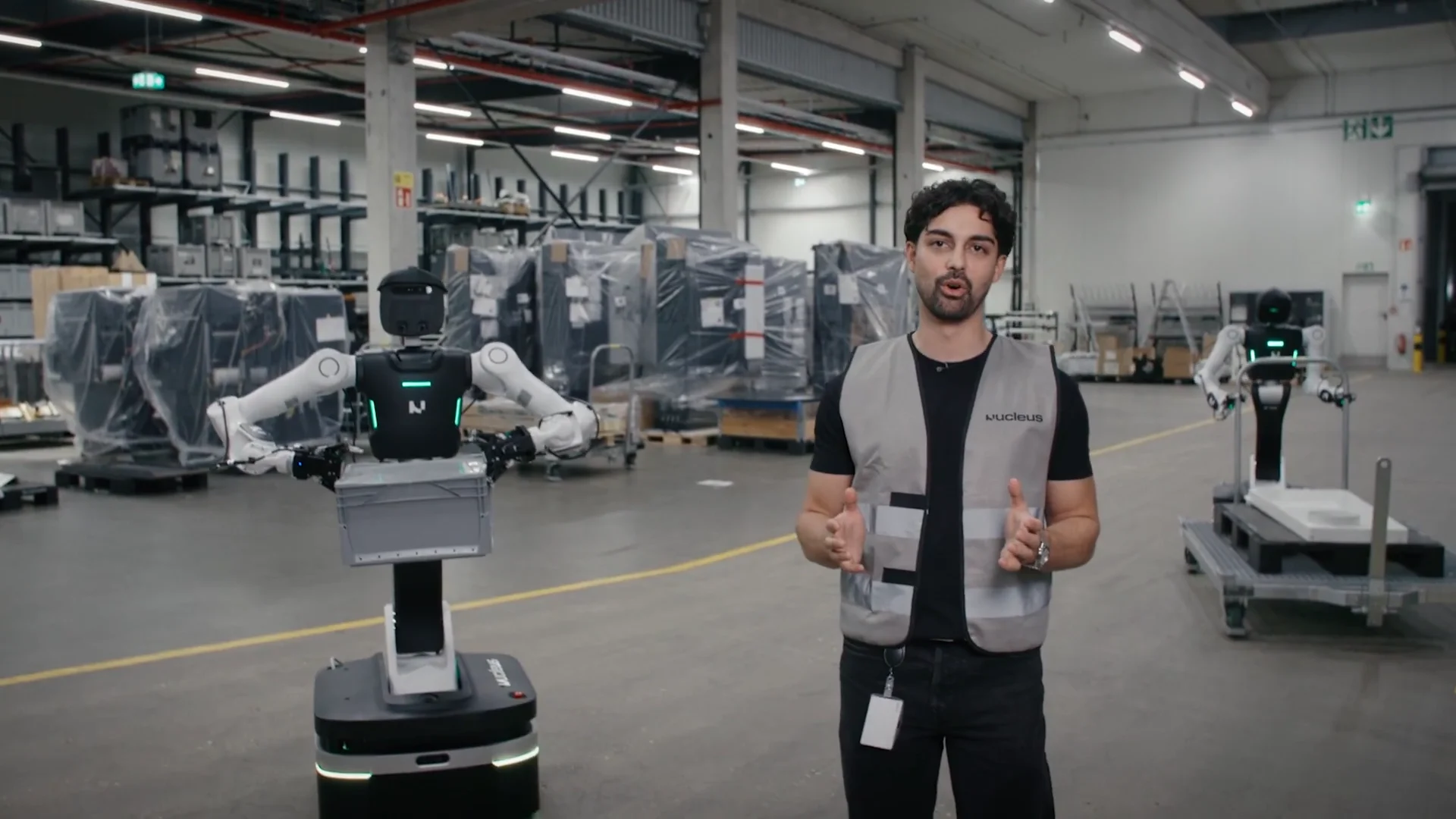
- Nucleus has deployed "Nucleus II," abandoning bipedal locomotion for a wheeled mobile manipulator chassis based on direct customer demand.
- The new platform provides a 10 kg per-arm payload, a sixfold increase in battery capacity, and five to nine hours of continuous operational uptime.
- Nucleus has not yet disclosed the manufacturer or base model of the underlying wheeled hardware, though custom 3D-printed components outfit the new units.
- The company targets deploying up to 25 robots by the end of Q1, running its hardware-agnostic teleoperation and embodied AI software stack on the new platform.
- The shift mirrors a broader industrial realignment, echoing recent industry trends toward wheeled dual-arm manipulators over complex legged form factors.
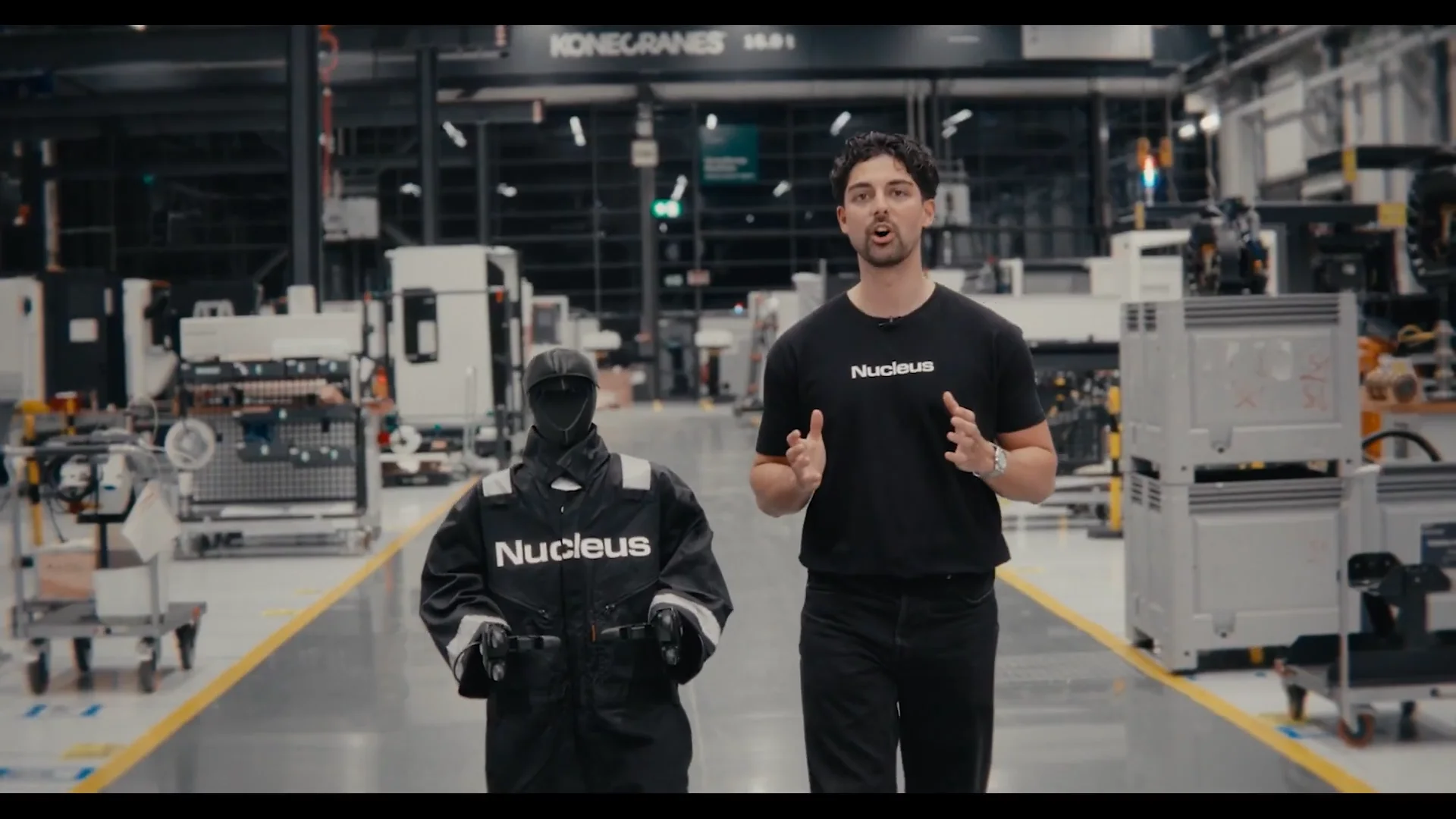
When European startup Nucleus exited stealth in August 2026, it did so alongside a bipedal Unitree G1 robot outfitted in a branded protective suit. Just one month later, real-world deployment data has led the company to an abrupt hardware pivot.
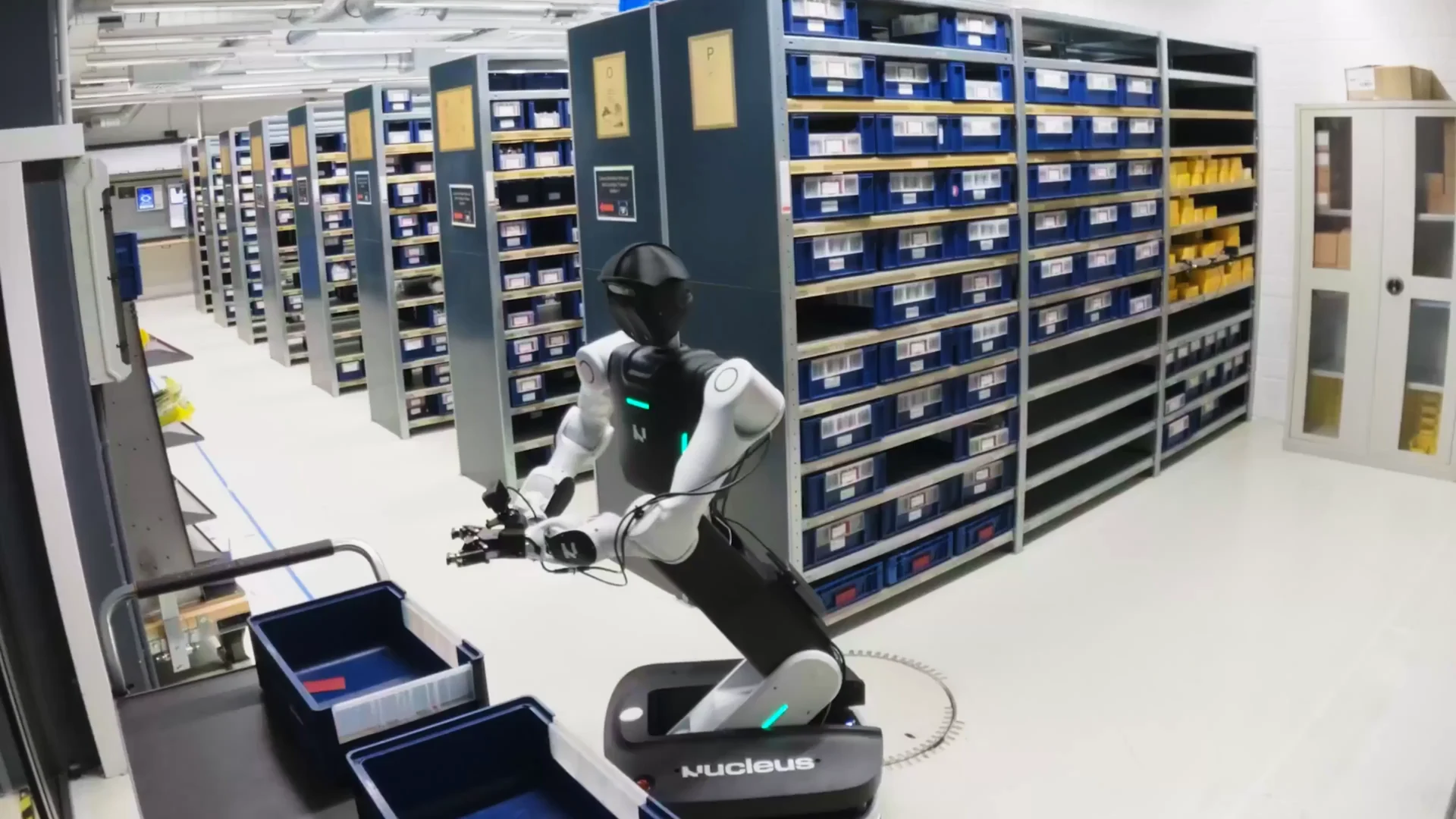
In an update shared by co-founder Melvin Schwarz, Nucleus revealed that it has begun deploying its next-generation platform, dubbed Nucleus II, in an active industrial logistics facility. The headline change: the legs are gone, replaced entirely by a wheeled mobile base.
According to Schwarz, the decision was driven squarely by customer feedback after deploying inside manufacturing and logistics environments. Plant managers were blunt about operational priorities: they wanted higher payloads (10 kg or more), multi-hour shift uptime (5–9 hours), and superior operational safety—specifically requesting "no legs."
Factory Demands Trump Bipedal Ambition
"Only the factory tells you what to build," Schwarz wrote in an update detailing the deployment. "You can spend weeks making something work perfectly in the office/lab, then discover a completely different set of problems within the first few hours of a real deployment."
The weekly humanoid robotics briefing
One email a week: the launches, funding and research that mattered, with context from Humanoids Daily.
Read recent issuesThe resulting Nucleus II configuration addresses three major limitations common to compact bipedal platforms:
- Payload: Nucleus II can handle up to 10 kg per arm, allowing it to move heavier totes and parts bins that strain smaller bipedal frames.
- Battery Endurance: The wheeled platform incorporates six times the battery capacity of the original Nucleus I setup, supporting continuous operation across full work shifts without frequent recharging.
- Tipping Resistance & Safety: The wheeled base removes the risk of catastrophic falls, providing an inherently stable foundation that satisfies stricter factory floor safety protocols.
Nucleus has not yet publicly revealed the make, model, or manufacturing partner behind the underlying wheeled mobile platform. We reached out to Schwarz for details on the base hardware, but did not receive a response prior to publication. Video footage of the deployment indicates that Nucleus is outfitting the third-party chassis with custom 3D-printed parts and brackets tailored to its task setups.
Hardware-Agnostic Software Stack
Despite the physical overhaul, Nucleus emphasizes that its core software layer remains intact. The startup designs its control and data pipelines to be hardware-agnostic, running the same embodied intelligence and teleoperation stack across both Nucleus I and Nucleus II.
Nucleus operates on a Robotics-as-a-Service (RaaS) model, billing customers for completed physical tasks rather than selling hardware outright. When the robot encounters an edge case or physical obstruction during logistics workflows, remote operators intervene via teleoperation. The company noted recent improvements to its teleoperation interface, including haptic vibration on contact, fine-grained force feedback scaled by arm positioning error, and visual force indicators to prevent component damage.
Each intervention is fed directly into the company’s training pipeline to reinforce edge-case autonomy—a workflow Nucleus aims to scale as it prepares to deploy up to 25 robots by the end of Q1.
A Familiar Industrial Realignment
The rapid transition from bipedal legs to wheels is not unique to Nucleus. While research institutions and promotional showcases remain captivated by walking humanoids, practical industrial customers continue to vote with their purchase orders.
Recent commercial deployments, such as Lumos Robotics rolling out its MOS 2 wheeled dual-arm manipulator across Mitsubishi Electric lines, reflect a broader consensus: factory floors with flat, polished concrete rarely require the mechanical complexity of legged locomotion. Furthermore, Counterpoint Research's recent data showed that even as global humanoid shipments surged in H1 2026, commercial volumes have been substantially driven by multi-tier portfolios that incorporate wheeled platforms.
By listening to plant operators early and ditching bipedal mechanics for its core commercial push, Nucleus is trading futuristic aesthetics for raw throughput. The company stated its next update will showcase continuous multi-hour shift runs—complete with unscripted failures and live edge-case recoveries.
Share this article
Read next
- Published on
- Reading time
- 3 min read
Nucleus Shares Nearly Two Hours of Factory Work, Says Demo Is 60% Autonomous
- Published on
- Reading time
- 4 min read
Europe’s Nucleus Exits Stealth, Deploying Teleoperated Humanoids to Factories on "Day 91"
- Published on
- Reading time
- 4 min read
AGIBOT Brings 300-Plus Robots to Chimelong Theme Park
- Published on
- Reading time
- 4 min read
Robros Adds Full-Body Teleoperation to Its Korean Humanoid
- Published on
- Reading time
- 3 min read
Boston Dynamics Opens Atlas Training Center at Hyundai’s Georgia Factory
- Published on
- Reading time
- 3 min read
Hyundai Eyes Czech Factory for Atlas Humanoid
The weekly humanoid robotics briefing
One email a week: the launches, funding and research that mattered, with context from Humanoids Daily.
Read recent issues