- Published on
Europe’s Nucleus Exits Stealth, Deploying Teleoperated Humanoids to Factories on "Day 91"
One tap, and our reporting appears more often in your Google Top Stories. It makes a real difference to a small newsroom.

Supported by RoboStrategySupport for Humanoids Daily comes from RoboStrategy
Sponsored

Investing involves risk, including possible loss of principal. Read the prospectus before investing.
- Nucleus has officially exited stealth mode, announcing it has successfully deployed humanoid robots into a real German factory in under 90 days.
- The company bypasses the wait for full autonomy by leveraging large-scale teleoperation and supervision, allowing humanoids to perform useful work—and generate training data—from day one.
- Founded by veterans from CERN, ESA, 1X, NEURA, and Agile Robots, Nucleus uses a three-stage rollout that relies on 3D scanning, simulation, and initial human supervision.
- Rather than selling robots, Nucleus operates a robotics-as-a-service model, billing by the hour for completed physical work, while building a proprietary dataset of long-tail industrial edge cases.
The robotics industry is currently locked in a race to achieve true general-purpose autonomy, a milestone that requires massive amounts of physical training data. But a new European startup, Nucleus, is arguing that the industry doesn't need to wait for full autonomy to start putting humanoids to work.
Coming out of stealth today, Nucleus announced that it has successfully deployed humanoid robots into a real-world factory—reportedly one of Germany's leading industrial champions—in under 90 days.
Led by a team of veterans who previously tackled robotics challenges at CERN, ESA, 1X, NEURA, and Agile Robots, the company is pivoting away from the R&D lab and leaning heavily into teleoperation and supervised deployment to help solve Europe's physical labor shortages.
Bypassing the Autonomy Bottleneck
In a video and accompanying X post released today, Nucleus co-founder Melvin Schwarz laid out a pragmatic strategy: deploy early, supervise heavily, and let the robots earn their keep while generating training data.
The weekly humanoid robotics briefing
One email a week: the launches, funding and research that mattered, with context from Humanoids Daily.
Read recent issues"Most of the industry is waiting for full autonomy before a real-world deployment. We move faster. Our humanoids perform useful work from day one," the company explained in its launch video.
Nucleus explicitly compares its approach to the data-gathering strategies of Tesla and Waymo in the autonomous driving sector. By actively "driving" the robots through real-world tasks using large-scale supervision and AI agents, Nucleus is simultaneously delivering immediate value to clients and accumulating a "long-tail dataset that cannot be scraped or simulated."
The company utilizes a rapid three-stage rollout for its clients:
- Scanning: Conducting 3D scans of the facility and the specific tasks.
- Simulation: Importing the scans into a simulated environment to identify bottlenecks and select the appropriate hardware configurations.
- Supervision: Controlling the robots via human supervision for the first three weeks of deployment, performing useful work while gathering rich data to train their models in parallel.
Custom Hardware and the Logistics Challenge
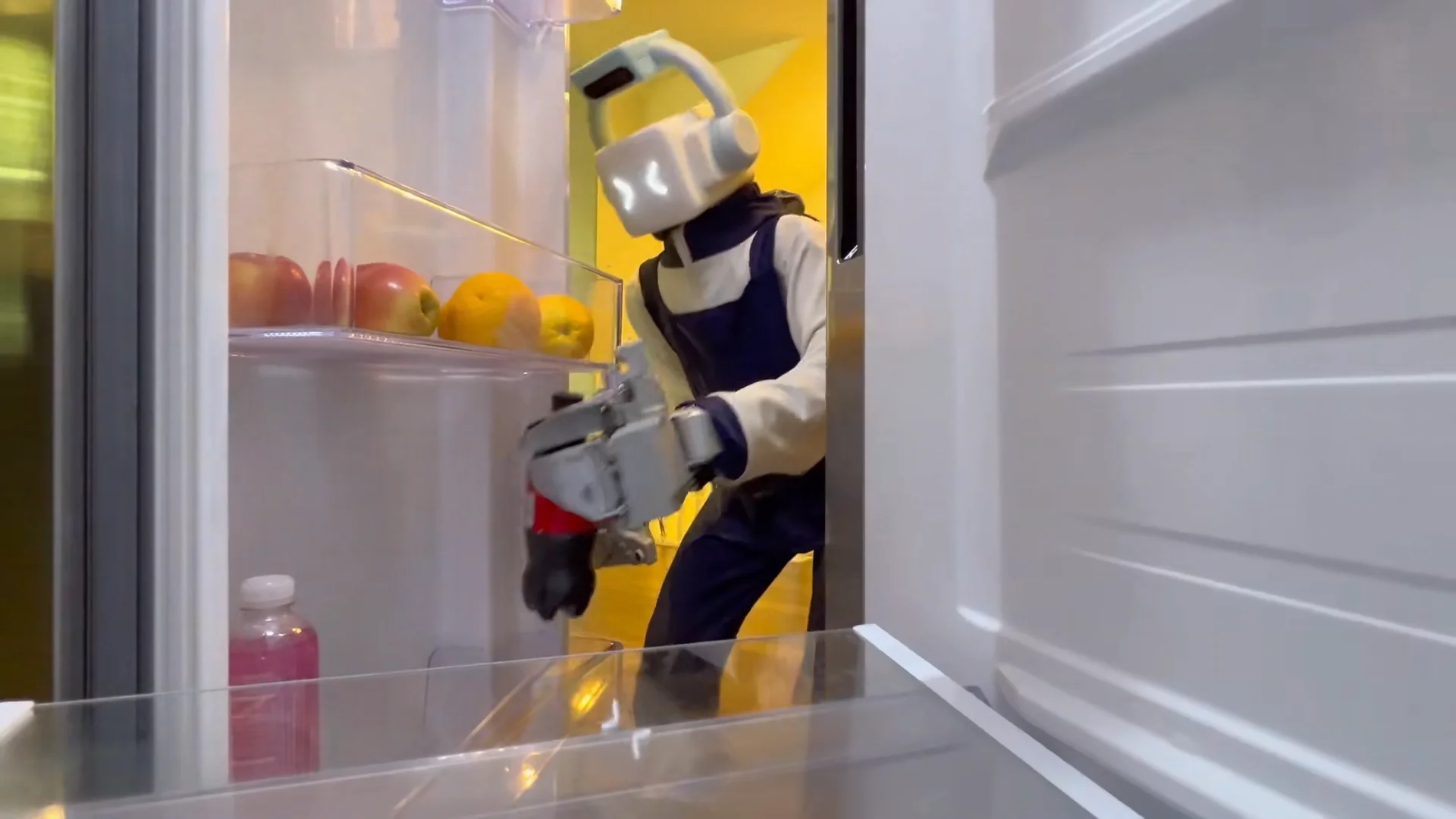
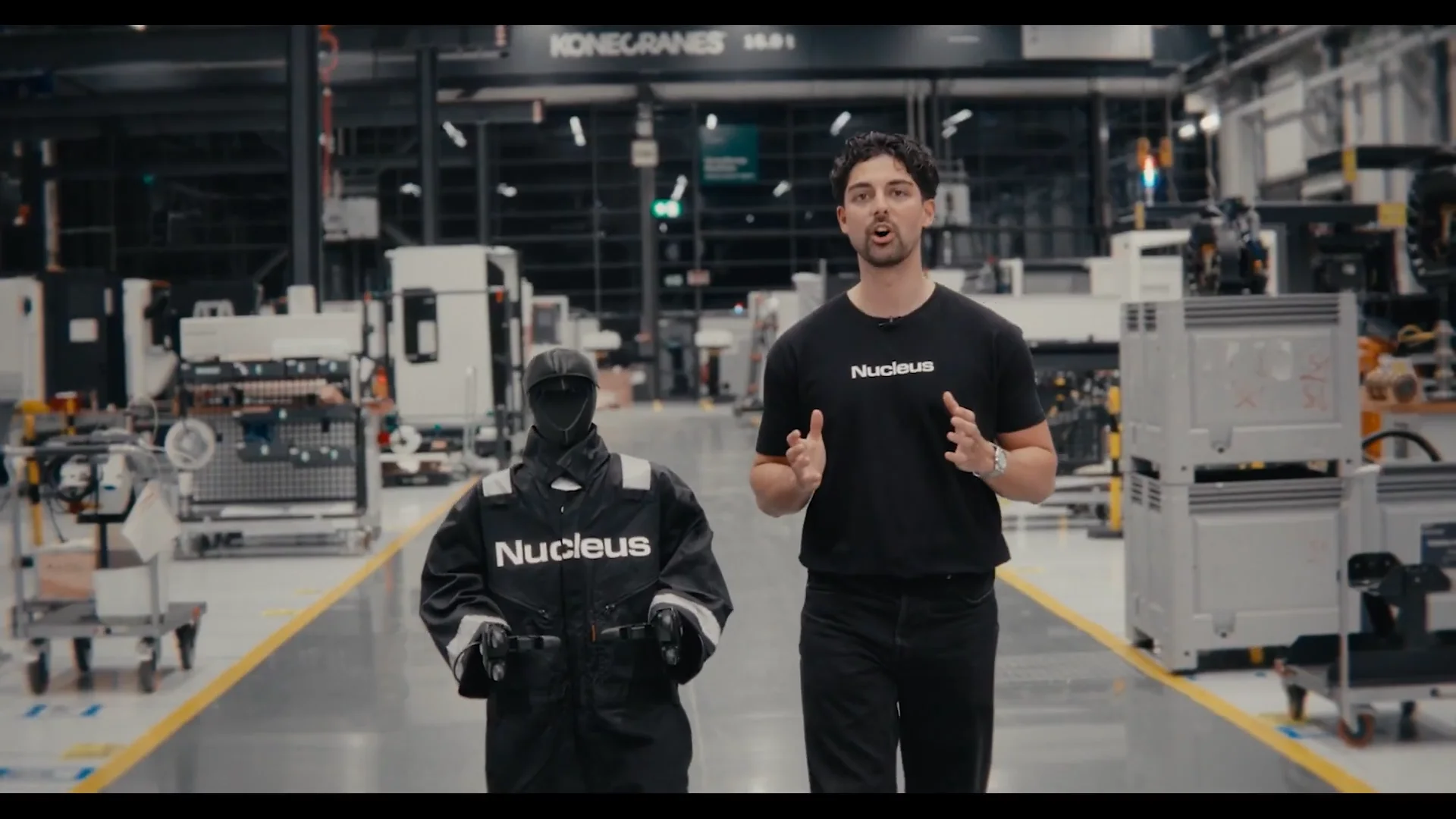
While Nucleus is focusing heavily on its data and deployment pipeline, it is not building its base bipedal hardware from scratch. Visual materials released today show the company utilizing Unitree G1 humanoid platforms, clad in black, Nucleus-branded protective suits.
However, the team found that off-the-shelf hardware is rarely sufficient for the messy reality of factory logistics. Schwarz noted that logistics remains one of the greatest hurdles for their industry partners. In one deployment, clients needed to pull boxes from shelves—a task that human workers accomplished by barely using their fingertips.
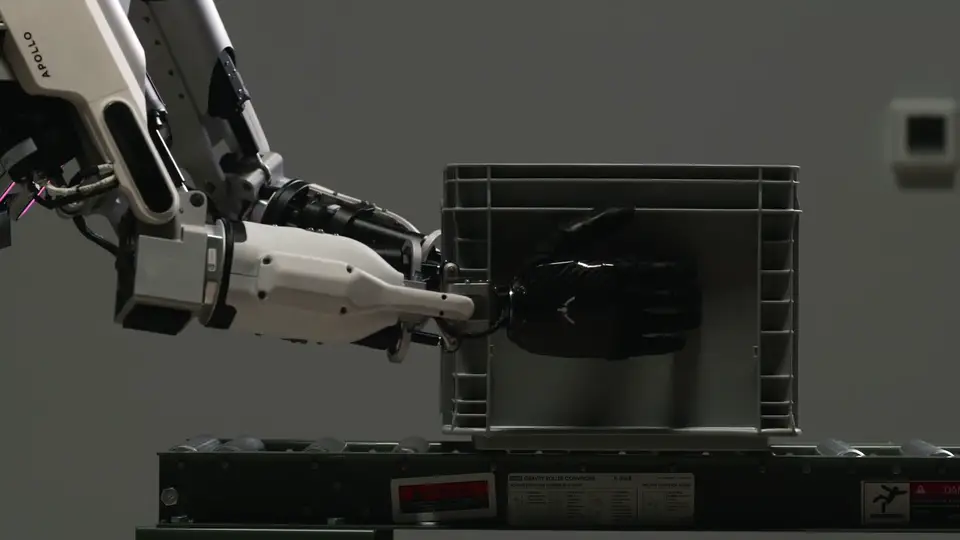
Recognizing that this maneuver is incredibly difficult for even the most sophisticated robotic hands on the market, Nucleus had to design and develop its own custom end effectors to get the job done reliably.
The "Endgame" of Technology and Economics
Nucleus's business model reflects a growing trend in the commercial robotics sector: a shift toward service-oriented deployment. "Industrial customers want to employ robots, not learn how to deploy them," Schwarz wrote. As such, Nucleus does not sell robots; its product is "physical work," billed strictly by the hour.
The startup’s underlying thesis is that large language models (LLMs) and foundational AI agents will eventually become commoditized and highly capable of controlling robotic bodies. When that happens, the true competitive moat will not be the model itself, but the proprietary, real-world factory data used to ground it.
By getting humanoids onto the factory floor today, Nucleus aims to build a compounding data advantage that grows autonomy faster than expected. Schwarz describes the endeavor as "the most brutal thing" he has ever done, but the company’s ambitions are clear: by the end of 2027, Nucleus intends to operate one of the largest deployed humanoid fleets on the planet.
With Europe facing severe demographic shifts and a pressing need to remain industrially competitive, Nucleus's strategy of pairing offshore hardware with localized, supervised intelligence might just be the fastest way to get humanoids onto the payroll.
Share this article
Read next
- Published on
- Reading time
- 5 min read
Nucleus Pivots to Wheeled Base for "Nucleus II" Following Factory Floor Pushback
- Published on
- Reading time
- 3 min read
UBTECH Brings Walker C1 to Slovenia in Balkan Expansion Push
- Published on
- Reading time
- 5 min read
KIST Chief Says Korea Can Join the US and China as a Humanoid Power
- Published on
- Reading time
- 5 min read
Odyssey Unveils Odyssey-3, With Flexion Building Humanoid Control on Its World Model
- Published on
- Reading time
- 4 min read
Munich stealth startup shows walking humanoid “Kyle,” targets early 2027 reveal
- Published on
- Reading time
- 25 min read
The Humanoids of Europe: Built by Their Customers
The weekly humanoid robotics briefing
One email a week: the launches, funding and research that mattered, with context from Humanoids Daily.
Read recent issues