- Published on
Why Ningbo Matters to Tesla’s Optimus Ambitions
One tap, and our reporting appears more often in your Google Top Stories. It makes a real difference to a small newsroom.

Supported by RoboStrategySupport for Humanoids Daily comes from RoboStrategy
Sponsored
Investing involves risk, including possible loss of principal. Read the prospectus before investing.
- Reports of Tesla supplier audits in Ningbo highlight the potential role of the city’s automotive manufacturing base in scaling Optimus.
- Analyst Georg Stieler says the Yangtze River Delta is at least as important as Shenzhen to the industry, endorsing the regional argument in an analysis by Ming.
- Local policy explicitly encourages automotive suppliers to adapt to humanoid robotics, but manufacturing preparation does not establish Optimus output or commercial readiness.
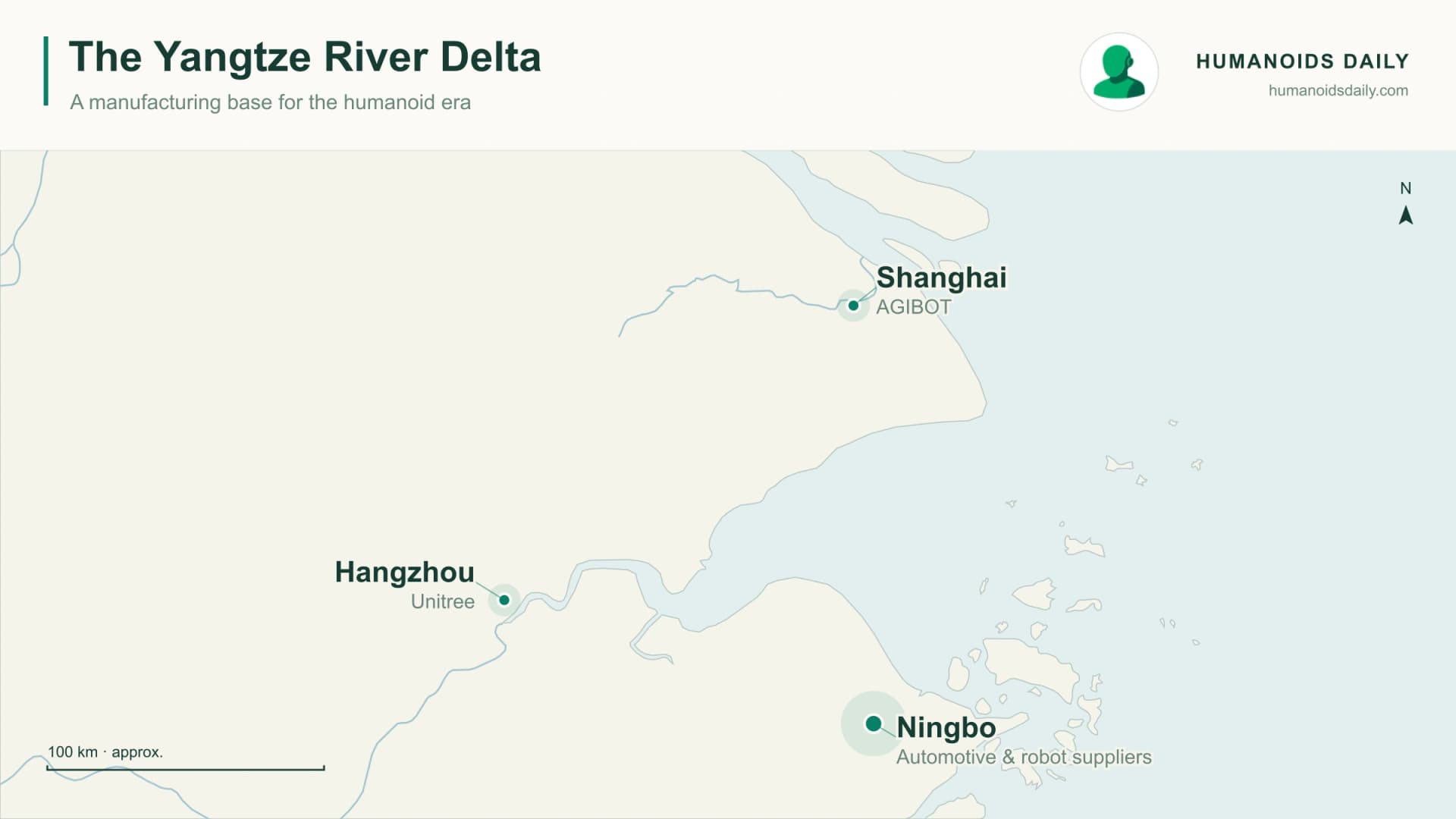
Tesla’s reported supplier visit to Ningbo raises a question that goes beyond the next Optimus prototype: where will the expertise to build robots consistently, in volume, come from?
As we reported earlier, Chinese media said a Tesla team arrived in Ningbo on September 16 and began a new round of Optimus supplier audits the following day. A subsequent analysis by Ming on X argues that the location matters because the city’s automotive supply base offers skills that humanoid manufacturers need as they move toward production.
Robotics and automation analyst Georg Stieler endorsed the regional point. “The Yangtse Delta is at least as important as Shenzhen for this industry,” he wrote in response.
The wider Yangtze River Delta also hosts major humanoid developers: Unitree is headquartered in Hangzhou, in the same province as Ningbo, while AGIBOT is based in Shanghai. Their presence helps put Stieler’s regional comparison in context: the delta combines robot developers with industrial hubs such as Ningbo, rather than concentrating the entire ecosystem in a single city.
The weekly humanoid robotics briefing
One email a week: the launches, funding and research that mattered, with context from Humanoids Daily.
Read recent issuesThat observation offers a useful way to read the audit reports: as a possible connection between Tesla’s robot ambitions and an established industrial ecosystem, rather than a shipment announcement.
Automotive experience that can carry over
Ming’s argument centers on repeatability. A functioning prototype establishes that a design can work. Producing thousands requires parts and assemblies that stay within specification across batches, with costs, deliveries and quality problems kept under control.
The analysis points to overlapping capabilities in automotive and robotics manufacturing, including motors, power electronics, precision gears and lightweight structures. It also emphasizes the less visible work of tracking production batches and managing suppliers further down the chain.
These are plausible advantages for an established manufacturing cluster. They do not mean a car component can simply be installed in a humanoid. Robot designs still impose their own requirements for weight, movement, durability and power consumption. The transferable asset is also the experience of designing, inspecting and repeatedly making demanding parts.
Ningbo is explicitly pursuing that transition
The automotive-to-robotics connection is present in the city’s own planning documents. A draft AI development action plan for 2025–2030, released for public consultation in July 2025, calls for helping automotive-parts businesses adapt their products and production lines to humanoid robotics.
The proposal also links local robot manufacturers with application scenarios intended to support technical validation and commercialization. It is evidence of the city’s intended industrial direction, rather than proof that the transition has already succeeded.
A 2026 consultation document on priority industrial projects similarly identifies robot components including motors, encoders, reducers, planetary roller screws and end effectors. The emphasis extends from individual parts to reliability and manufacturing processes.
The potential benefit of clustering these capabilities is faster coordination. When an assembly fails a test or a design changes, engineers need to work back through materials, machining, electronics and suppliers. Proximity can make that process easier, although it cannot guarantee a particular production rate or cost.
Tuopu provides a concrete connection
The clearest reported link to Tesla is Tuopu Group. In Yicai’s September 18 supplier follow-up, a company representative said Tesla research and development staff routinely worked at its Ningbo factory on automotive and robotics projects. The representative described cooperation on linear, rotary and dexterous-hand actuators, and said the robot-component base was ready.
However, that same representative had received no notification of a new audit. Sanhua’s representative was unaware of the reported inspections, while Joyson declined to discuss downstream customers, citing confidentiality. Tesla had not responded by publication.
Those qualifications remain important. Established engineering cooperation supports the broader supply-chain story; it does not independently verify the latest visit, new contracts or production volumes.
The U.S.–China policy tension
The supplier relationship also sits against a more restrictive U.S. policy backdrop. As we covered in our examination of the FCC’s foreign-robot restrictions, the agency has blocked new equipment authorizations for covered foreign-produced advanced robotic devices, subject to conditional approvals. The measure extends beyond Chinese humanoids.
That is not a blanket ban on buying Chinese robot parts. However, Sidley Austin’s analysis of the rules explains that the definition of a domestic end product considers both U.S. manufacturing and domestic component costs. Individual components are not separately listed under the robotics entry, but their origin can still matter to the finished robot’s status.
The reported Ningbo cooperation does not establish how those rules would apply to Optimus. It does illustrate the practical challenge behind reshoring: building a U.S. assembly plant and reducing dependence on Chinese components are different undertakings. Replacing an established supplier network also means developing alternative sources with the required quality, capacity and cost. The same manufacturing strengths that make Ningbo attractive can make that transition harder.
Retaliation adds another source of uncertainty. China’s commerce ministry warned on July 30 that it would retaliate if Washington maintained the robot and power-inverter restrictions, Reuters reported. That warning does not establish any action against Tesla or its Optimus suppliers. It does underline why sourcing decisions involve more than production economics: American robot makers must weigh the benefits of Chinese manufacturing expertise against exposure to an escalating trade dispute.
Manufacturing progress leaves other tests ahead
The Ningbo discussion complements the physical buildout of Tesla’s Texas Optimus factory. One concerns the building and the other the network of companies that could help supply it.
Neither resolves whether a robot can perform useful work reliably enough to justify its cost. Manufacturing consistency and autonomy are separate requirements, and progress on one does not establish the other.
Stieler’s regional comparison is therefore the stronger takeaway from the discussion. Understanding humanoid production requires looking beyond the robot makers themselves to the industrial clusters that can support them. For Optimus, the reported Ningbo audits put that relationship into focus—even while the scale and timing of the eventual rollout remain uncertain.
Share this article
Read next
- Published on
- Reading time
- 3 min read
Tesla Reportedly Begins New Optimus Supplier Audits in China
- Published on
- Reading time
- 3 min read
Tesla’s Optimus Factory Nears a Steel-Frame Milestone in Texas
- Published on
- Reading time
- 4 min read
Supply Chain Rumors Hint at Massive Optimus Order as Fremont Production Line Ramps Up
- Published on
- Reading time
- 3 min read
Tesla Targets 1 Million Unit Optimus Production Line, V3 Prototype Set for Q1
- Published on
- Reading time
- 3 min read
Tesla Confirms Optimus Production Lines Are Being Installed; 'V3' Unveil Eyed for Q1
- Published on
- Reading time
- 3 min read
Tesla App Code Hints at Optimus Charging and Home Integration

The weekly humanoid robotics briefing
One email a week: the launches, funding and research that mattered, with context from Humanoids Daily.
Read recent issues