- Published on
From Nuts to Needles: Kyber Labs Debuts Autonomous Wet Lab Assistant
One tap, and our reporting appears more often in your Google Top Stories. It makes a real difference to a small newsroom.

Supported by RoboStrategySupport for Humanoids Daily comes from RoboStrategy
Sponsored

Investing involves risk, including possible loss of principal. Read the prospectus before investing.
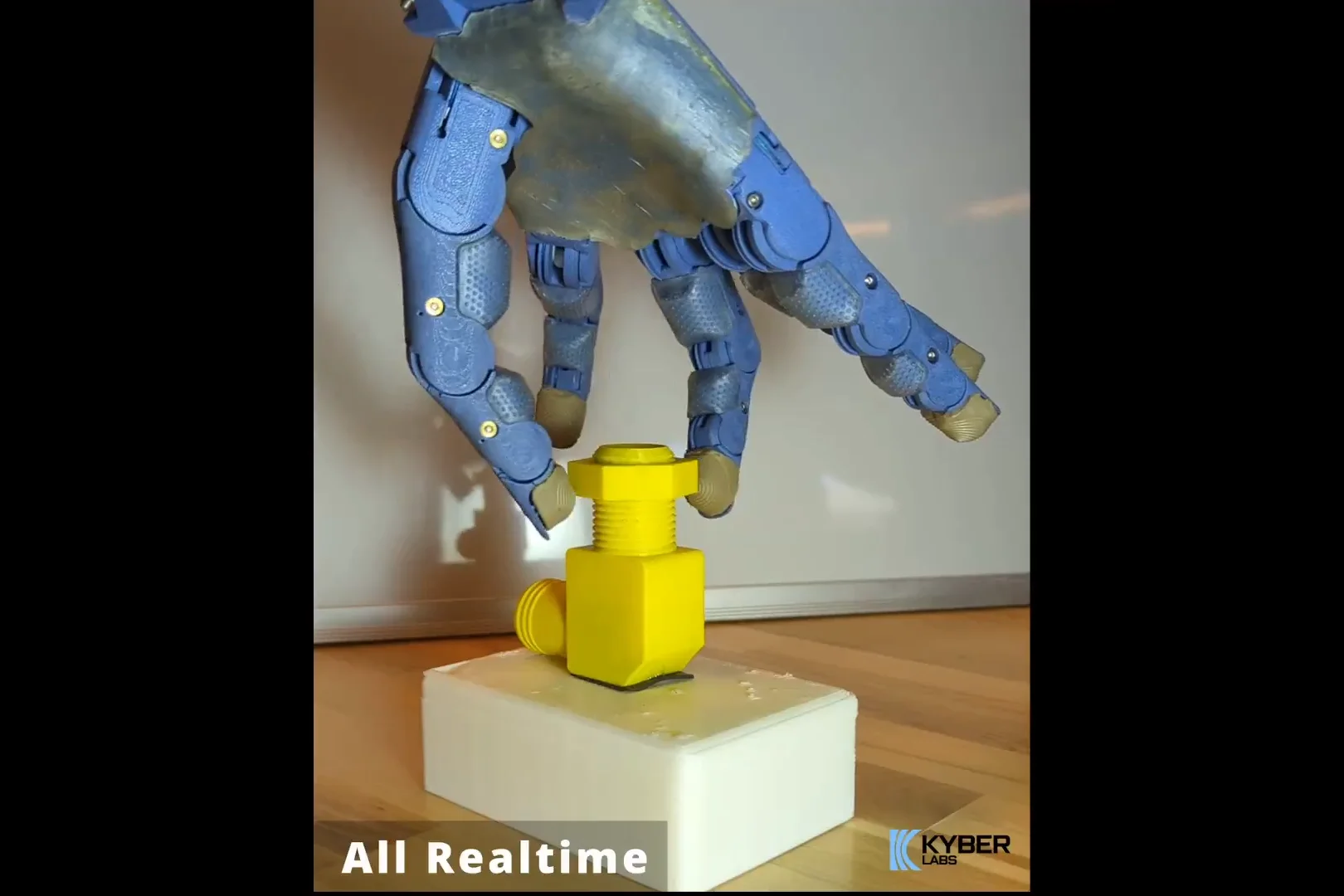
Just months after emerging with a high-speed, backdrivable hand that dominated robotics social media, Brooklyn-based Kyber Labs is pivoting from industrial fasteners to the sterile confines of the pathology lab.
In a new demonstration released this week, the company’s 20-degree-of-freedom (DOF) hand performed a series of "wet lab" tasks including pipetting, unscrewing micro-centrifuge caps, and operating a vortex mixer. The demo, conducted in collaboration with Emory University, highlights Kyber’s ambition to solve "boring" logistics and labor shortages in clinical environments without the need for a full humanoid form factor.
The Pathology Workflow
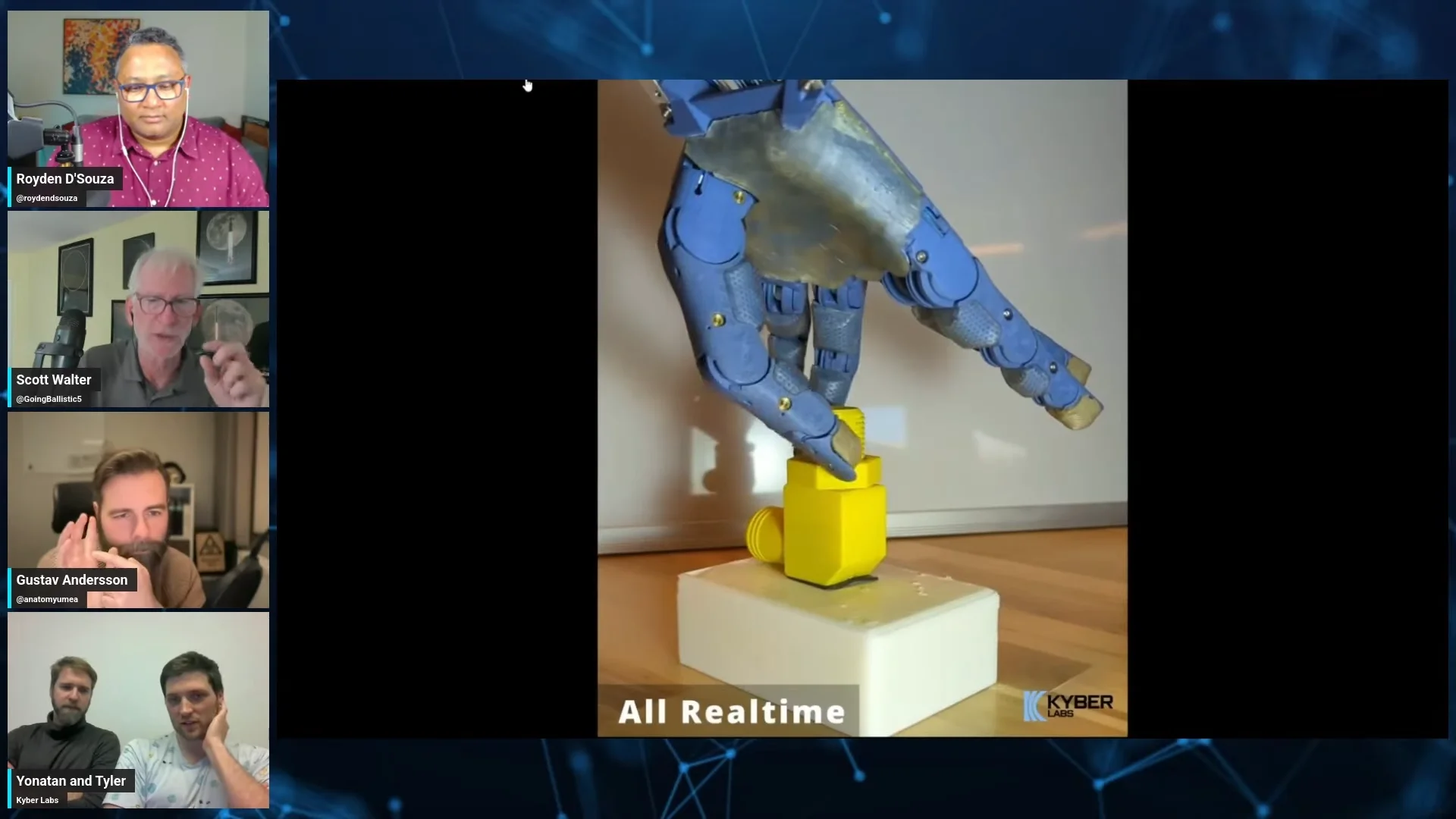
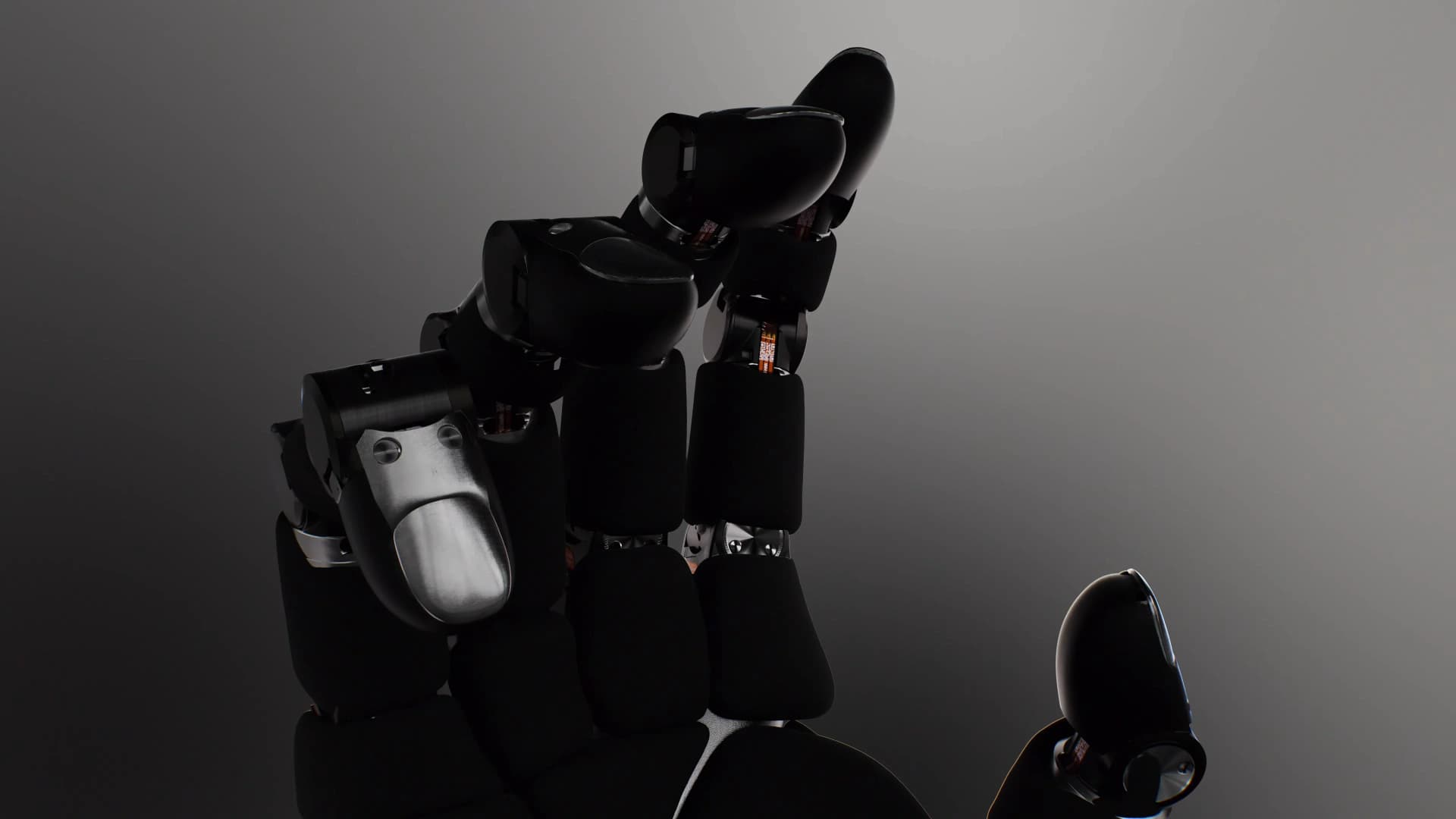
The latest video shows the blue, skeletal Kyber hand—the same hardware used in their previous "reflex-level" demos—navigating a standard lab bench. Unlike simple parallel grippers, the anthropomorphic hand is shown managing the delicate ergonomics of a manual pipet and the high-torque requirement of "uncapping and recapping" slippery plastic tubes.
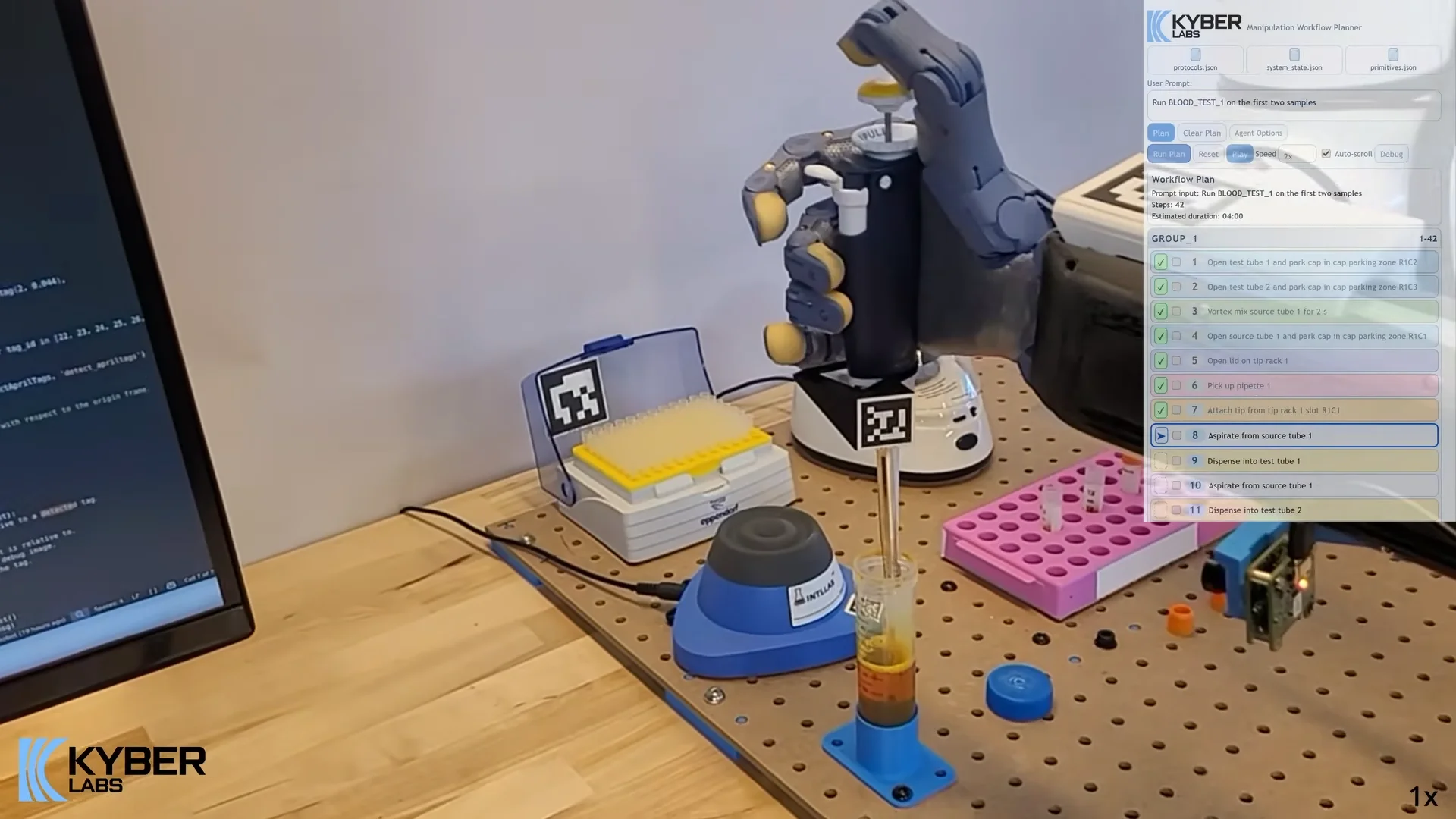
Speaking on the Over the Horizon podcast, co-founder Tyler Habowski explained that the use case was born from a direct need expressed by researchers at Emory University. Lab technicians are currently facing significant backlogs due to labor constraints, yet the $50,000 machines they use—readers, centrifuges, and vortexers—are designed for human hands, not traditional automation.
The weekly humanoid robotics briefing
One email a week: the launches, funding and research that mattered, with context from Humanoids Daily.
Read recent issues"They don't want just a slightly better machine that makes pipetting faster," Habowski told the panel. "They want something where you can say, 'run the blood tests on these samples,' and it handles the entire workflow from beginning to end."
Deterministic AI vs. "The Vibe"
Technically, the most significant revelation from the new demo isn't the hardware, but the software architecture driving it. Kyber Labs is distancing itself from the industry trend toward "monolithic 10-billion parameter" Vision-Language-Action (VLA) models, which can be prone to unpredictability.
Instead, Kyber is utilizing what they call a "primitive workflow" approach. The system breaks tasks down into independent, deterministic actions—such as "pick up pipet" or "rotate centrifuge holder"—which are then strung together by a high-level agent. This allows for:
- Auditability: A clear trail of every step taken, crucial for clinical validity.
- Interpretability: The ability for a human to edit or remove specific steps in a work plan.
- Edge Computing: The "leaner" software can run on the hand itself without a constant, high-bandwidth cloud connection.
This strategy contrasts with competitors like Sharpa Robotics, whose MoDE-VLA architecture relies on complex mixtures of dexterous experts to handle contact-rich tasks.
Hardware Evolution: From 3D Prints to Anodized Aluminum
While the current prototype relies on motor currents for "proprioception"—sensing resistance without tactile sensors—Kyber confirmed that a proprietary tactile sensor is currently in development and will be featured in upcoming iterations of the hand.
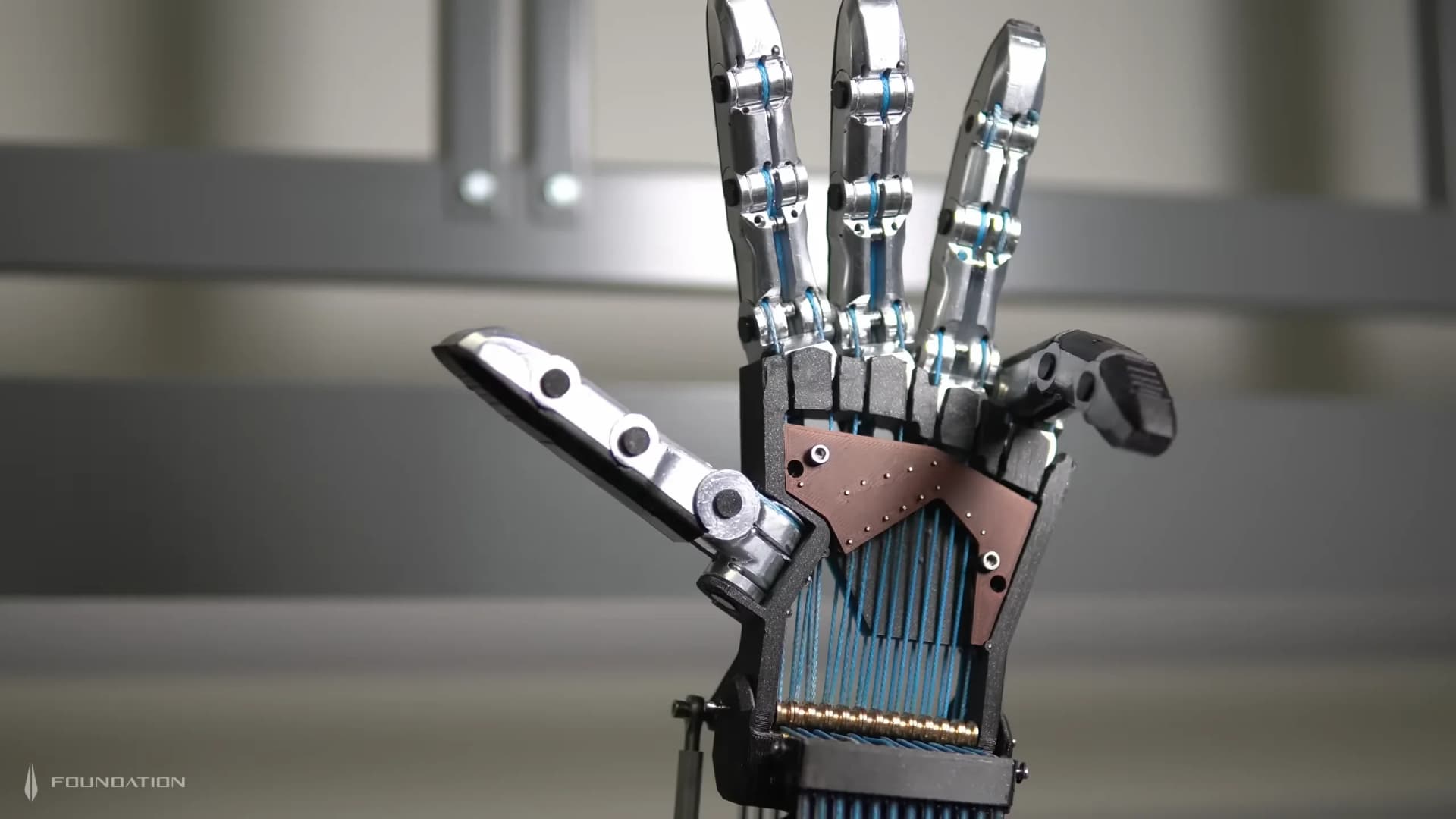
The founders also noted that the next generation of the hand will transition from the current 3D-printed components to anodized aluminum to increase durability. Despite the mechanical complexity of 40 full tendons and 20 motors housed in the forearm, the team maintains that the hand is designed to be "indestructible" and eventually cost "in the hundreds of dollars, not thousands".
The Path to Clinical Deployment
Kyber Labs remains firmly in its "anti-humanoid" positioning, focusing on a bimanual platform that can be wheeled up to existing workbenches. The immediate goal is to transition from these "surreal" demos to running actual patient samples in a pilot deployment.
The company is currently fundraising to scale production beyond its three-person core team. If they can successfully automate the "flick things with a fingernail" complexity of a modern lab bench, Kyber may find its first major market not in a factory, but in the diagnostic labs that underpin modern healthcare.
Watch the Over the Horizon episode below:
Share this article
Read next
- Published on
- Reading time
- 4 min read
Kyber Labs Founders Crash the "Over the Horizon" Podcast for a Technical Deep Dive
- Published on
- Reading time
- 5 min read
Kyber Labs Emerges with a High-Speed, "Backdrivable" Robotic Hand
- Published on
- Reading time
- 5 min read
The Great Dexterity Divide: Why Robotics Leaders Are Warring Over Tendon vs. Direct-Drive Hands
- Published on
- Reading time
- 6 min read
The "Final Boss" of Home Robotics: 1X Unveils Next-Gen Robotic Hands for NEO Alongside New CFO
- Published on
- Reading time
- 10 min read
The Contact Problem: How AGILINK’s New OmniHand 3 Ultra-M is Teaching Robots to Feel
- Published on
- Reading time
- 5 min read
Wuji Tech Teases Wuji Hand 2: High Engineering Ambitions Behind a CGI Veil

The weekly humanoid robotics briefing
One email a week: the launches, funding and research that mattered, with context from Humanoids Daily.
Read recent issues