- Published on
Mimic Robotics Previews FLUX-mimic-x, Claiming the Top RoboLab Score for Real-Time Robot Policies
One tap, and our reporting appears more often in your Google Top Stories. It makes a real difference to a small newsroom.

Supported by RoboStrategySupport for Humanoids Daily comes from RoboStrategy
Sponsored
Investing involves risk, including possible loss of principal. Read the prospectus before investing.
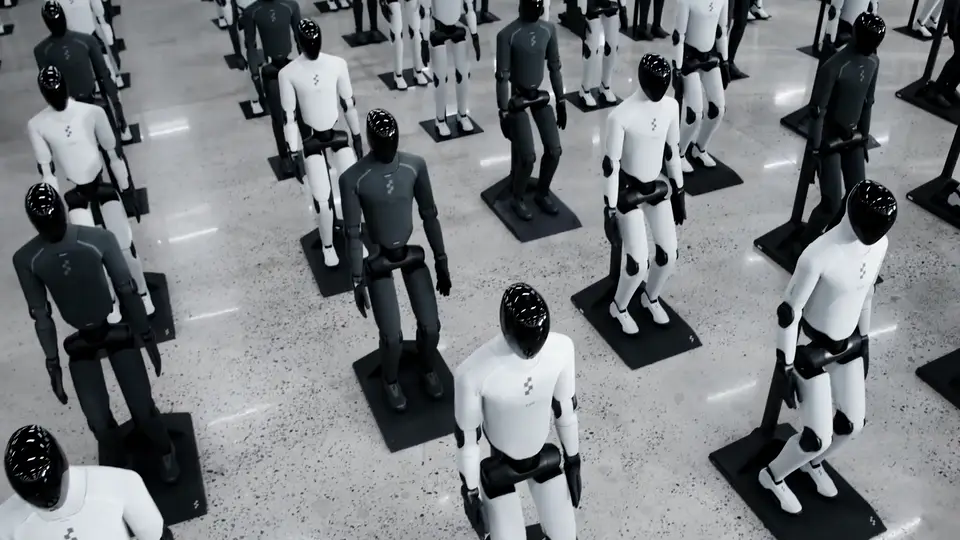
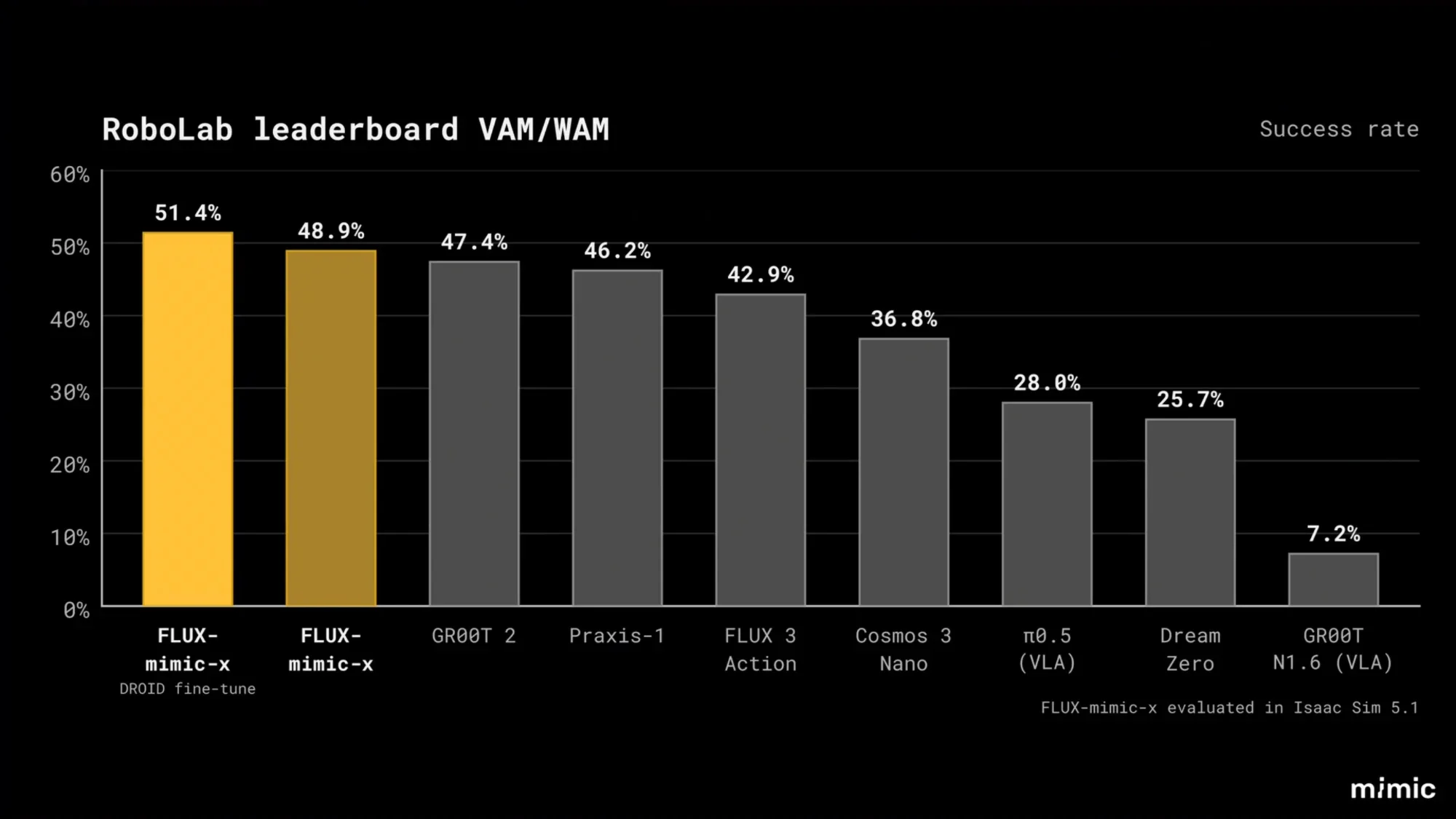
Zurich-based Mimic Robotics on Monday previewed FLUX-mimic-x, a 7-billion-parameter robot policy built on Black Forest Labs' FLUX 3 video model. Mimic reports a 51.4% success rate on NVIDIA's RoboLab simulation benchmark, which it says is the highest score among real-time "system 1" models, the fast controllers that turn camera input directly into motor commands.
The announcement so far consists of a post on X and three slides. Mimic has not published a blog post, paper or weights for the model, and FLUX-mimic-x does not yet appear on NVIDIA's public RoboLab leaderboard.
- FLUX-mimic-x is a 7B Video-Action Model trained with an updated version of Mimic's mimic-video recipe on top of Black Forest Labs' FLUX 3.
- Mimic's chart puts its DROID fine-tune at 51.4% on RoboLab, ahead of NVIDIA's GR00T 2 at 47.4%, Runway's Praxis-1 at 46.2% and Black Forest Labs' own FLUX 3 Action at 42.9%.
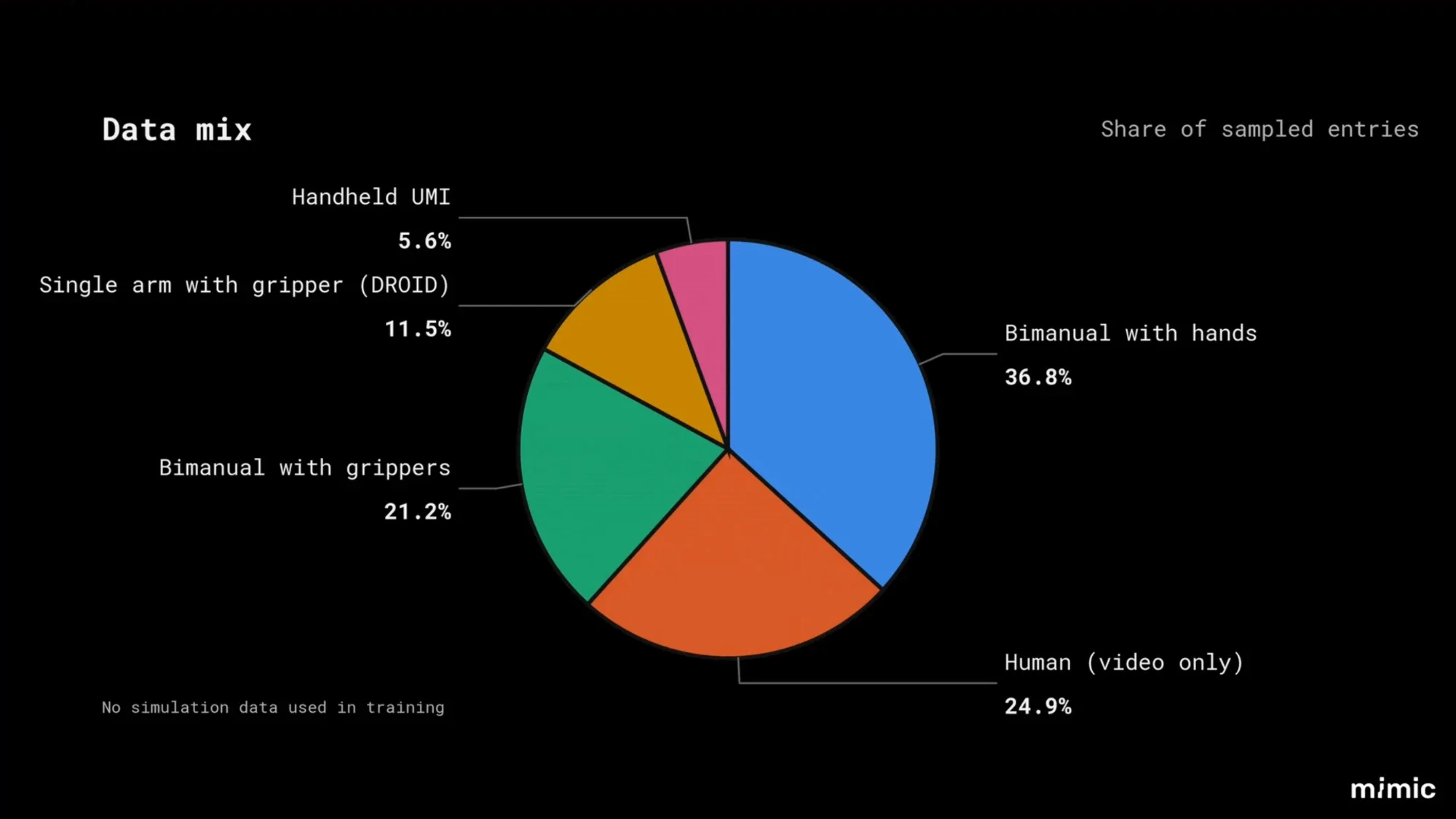
- About 37% of the training data comes from bimanual robots with dexterous hands and a quarter is human video with no action labels. No simulation data was used.
- Mimic says the model runs on-device in real time and transfers tasks learned from single-arm gripper data to two dexterous two-handed robots.
What the model is
FLUX-mimic-x is a Video-Action Model, Mimic's term for a robot policy built on a pretrained video generator rather than on a vision-language model. In the mimic-video design the company open-sourced in April, a lightweight action decoder reads intermediate features from the video model's prediction path and outputs motor commands, so the system does not have to render full video frames at every control step. That first release used NVIDIA's 2-billion-parameter Cosmos-Predict2 as its backbone.
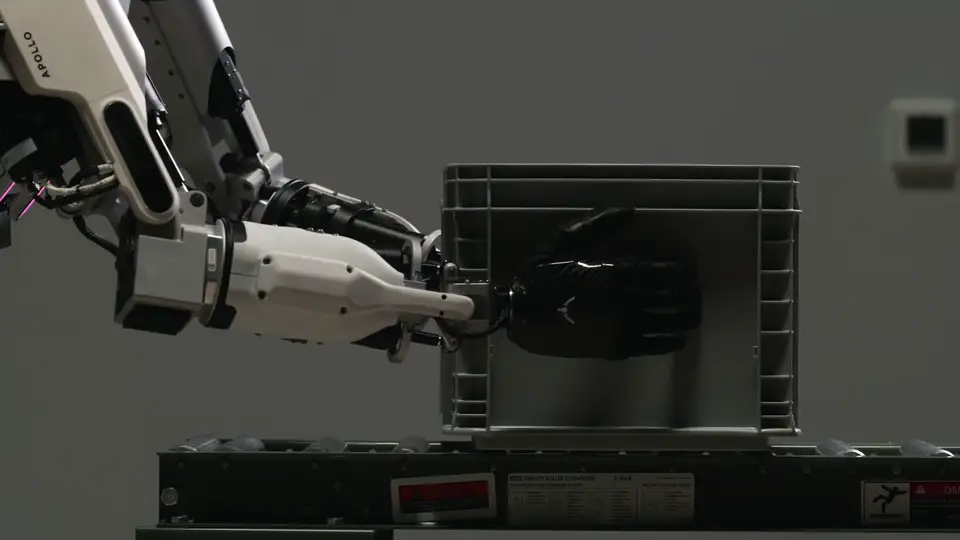
Mimic moved to Black Forest Labs' FLUX 3 in July with FLUX-mimic, which Black Forest Labs said had been tested and deployed at Audi on tasks such as kitting parts into trays and inserting electronic control units into fixtures. At the time, Black Forest Labs reported that the backbone ran in under 80 milliseconds on a single NVIDIA RTX 5090 and that the complete robot system reacted in 101 milliseconds. Mimic has not given latency or hardware figures for FLUX-mimic-x beyond saying it runs on-device and in real time.
Follow humanoid robotics without following every announcement.
Get the week’s most important launches, funding and research—and why they matter—in one email from Humanoids Daily.
Once a week. Unsubscribe anytime.
Read recent issuesThe RoboLab numbers
RoboLab-120 is NVIDIA's suite of 120 simulated manipulation tasks on a Franka arm, with each task run ten times. Mimic's chart shows two FLUX-mimic-x results: 51.4% for a version fine-tuned on DROID, the open dataset of single-arm Franka demonstrations, and 48.9% for a second entry without that label.
The closest comparison is FLUX 3 Action, the open-weight 7B world-action model that Black Forest Labs derived from the same FLUX 3 backbone in September. It scores 42.9% on the leaderboard, 8.5 percentage points below Mimic's fine-tune. Mimic also lists NVIDIA's GR00T 2 at 47.4%, Runway's Praxis-1 at 46.2% and NVIDIA's Cosmos 3 Nano at 36.8%. Among vision-language-action models, Physical Intelligence's π0.5 scores 28.0% and NVIDIA's GR00T N1.6 7.2%.
Mimic's chart covers only video-action and world-action models. On the full public RoboLab leaderboard, two agentic systems that call frontier models score higher: AMP1 at 86.0% and SenseNova-RoboRSI at 57.1%. The next entries are Lakeside, a 5B latent world model, at 51.0%, and BiMind v0.5, an 8B VLA that was fine-tuned on RoboLab data, at 49.2%. Both are below Mimic's 51.4%. Neither FLUX-mimic-x nor GR00T 2 is listed on the public board, which says submissions are temporarily paused while the process is revised.
Mimic says FLUX-mimic-x saw no simulation data in training and no data from RoboLab's robot beyond what is in the original DROID dataset.
Training data and cross-embodiment transfer
By share of sampled entries, 36.8% of the training mix comes from two-armed robots with dexterous hands and 21.2% from two-armed robots with grippers. Human video with no action labels makes up 24.9%, DROID's single-arm gripper data 11.5%, and recordings from handheld UMI grippers 5.6%.
Mimic's September paper on FLUX-mimic, written with four co-authors from BMW Group, described a dataset of 295.8 hours across 31 industrial tasks, recorded on Franka arms with dexterous hands and Trossen arms with grippers, plus 76.8 hours of camera-only footage from a wearable rig. Mimic has not said how large the FLUX-mimic-x dataset is.
The company also claims cross-embodiment transfer. According to Mimic, none of the RoboLab tasks it evaluated appear in the bimanual hand data. The model learns them from DROID's single-arm gripper demonstrations and then performs them on two dexterous two-handed robots. The slides Mimic posted do not include success rates for those transfer tests or name the two robots.
Mimic, an ETH Zurich spin-off, raised a $16 million seed round in November 2025. The company says it can deploy FLUX-mimic-x "on any robot and any task with minimal adaptation." It has not said when the model will be available beyond this preview, or whether, like mimic-video, any of it will be released openly.
Share this article
Follow humanoid robotics without following every announcement.
Get the week’s most important launches, funding and research—and why they matter—in one email from Humanoids Daily.
Once a week. Unsubscribe anytime.
Read recent issuesRead next
- Published on
- Reading time
- 8 min read
Gemini 4 Hydrogen Takes Over From Gemini Robotics ER 2 as Google Launches a Robotics Plugin for Antigravity
- Published on
- Reading time
- 7 min read
Anthropic Says Claude Fable 5.2 More Than Doubles GPT-6 Astra on a Robot-Control Benchmark
- Published on
- Reading time
- 9 min read
"Robotics Is No Longer an Elitist Sport": NVIDIA Unveils GR00T 2 and Open-Sources the Stack Behind It
- Published on
- Reading time
- 12 min read
How Frontier Language Models Are Speeding Up Robotics Research
- Published on
- Reading time
- 8 min read
Gemini Robotics 2.5 Puts Apollo 2 on Mercedes-Benz Lines as Argon Speeds Up Training
- Published on
- Reading time
- 7 min read
After SuperMimic, Open-Source Humanoid Motion Trackers Now Train in Minutes on One GPU