- Published on
The Great Numbers War: Unitree Claims Global Shipment Lead, Rebuts AgiBot's 'No. 1' Title
One tap, and our reporting appears more often in your Google Top Stories. It makes a real difference to a small newsroom.


Your guide
Rich Robinson
Jee Chee Ren · Executive tour
See China’s AI and robotics ecosystem first-hand.
Six days exploring AI, robotics and advanced manufacturing.
With Rich Robinson, Clinical Professor of Entrepreneurship at Peking University
Beijing · Guangzhou · Shenzhen
29 November–4 December 2026
Referral partnership · We earn a commission on referred bookings.
The humanoid robotics industry has moved from a race of technical demos to a high-stakes war of spreadsheets. Just days after Shanghai-based rival AgiBot claimed the title of "No. 1 Global Shipments" for 2025, Unitree Robotics has struck back with a pointed "clarification" of its own.
In a statement released on January 22, 2026, the Hangzhou-based company disclosed that its 2025 shipment volume of humanoid robots exceeded 5,500 units, with total mass-production output topping 6,500 units. The figures, which Unitree says represent actual deliveries to end customers rather than mere orders, appear intended to decisively reclaim the top spot in a market increasingly obsessed with scale and commercial viability.
Reclaiming the Crown
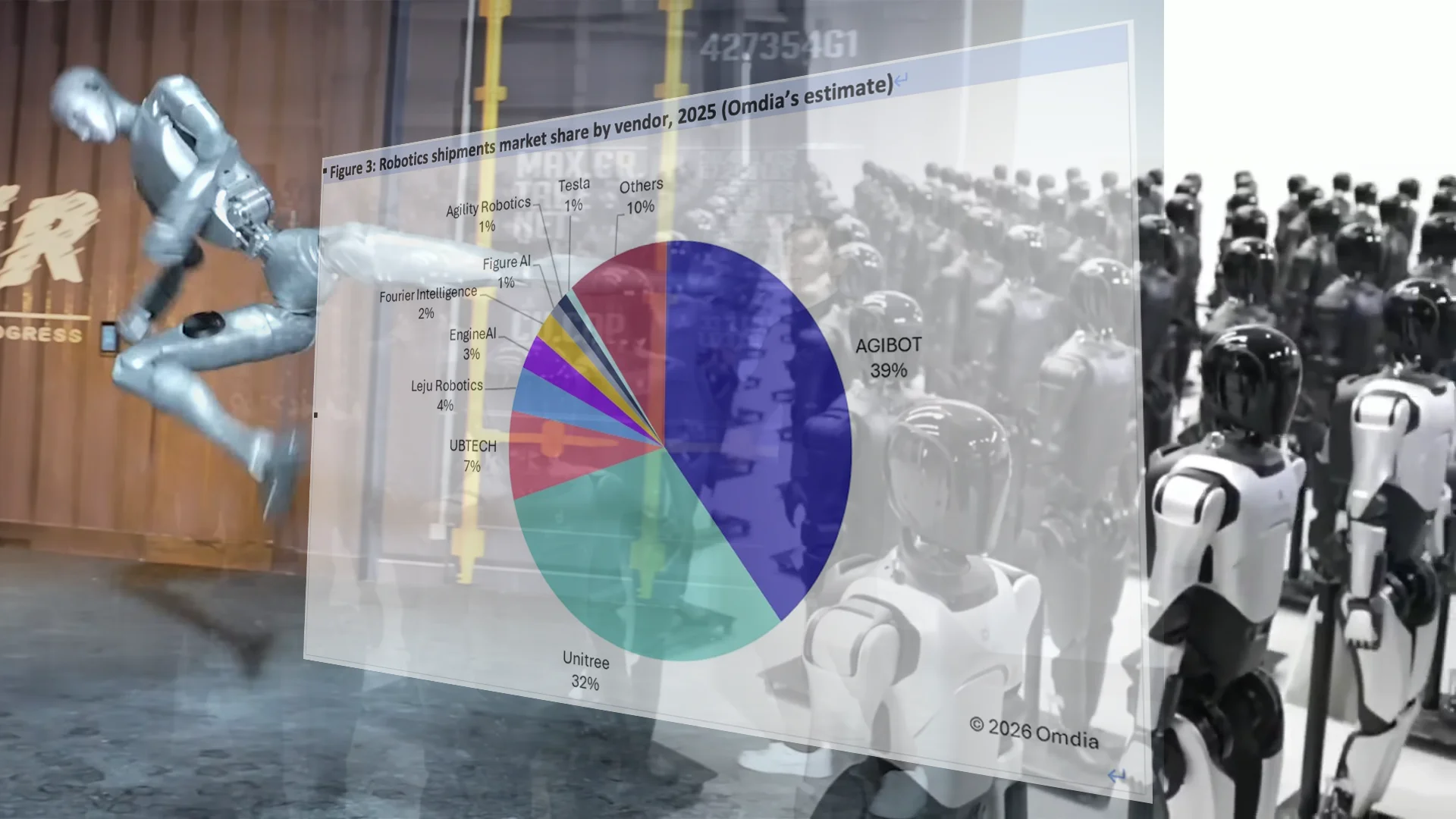
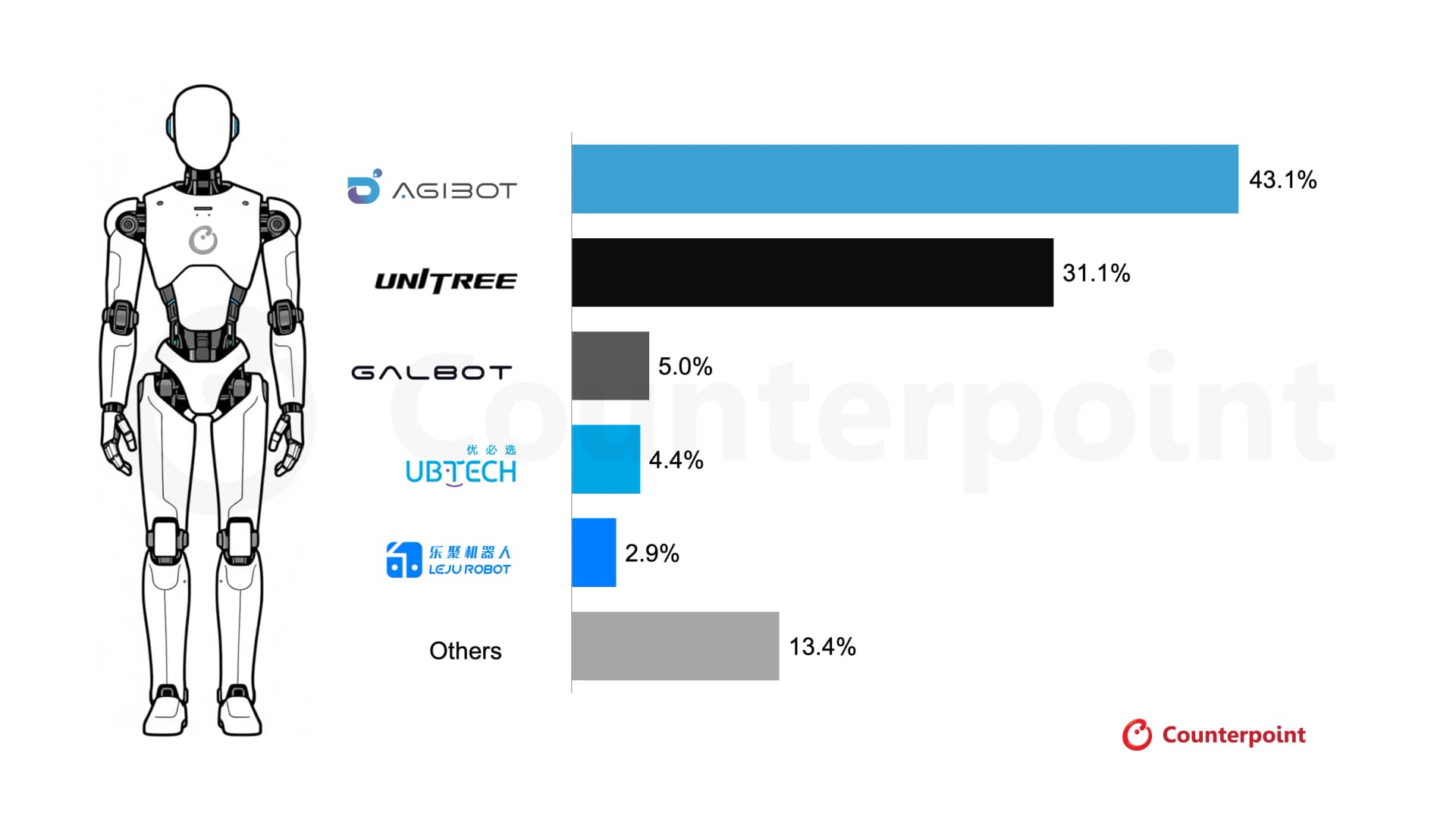
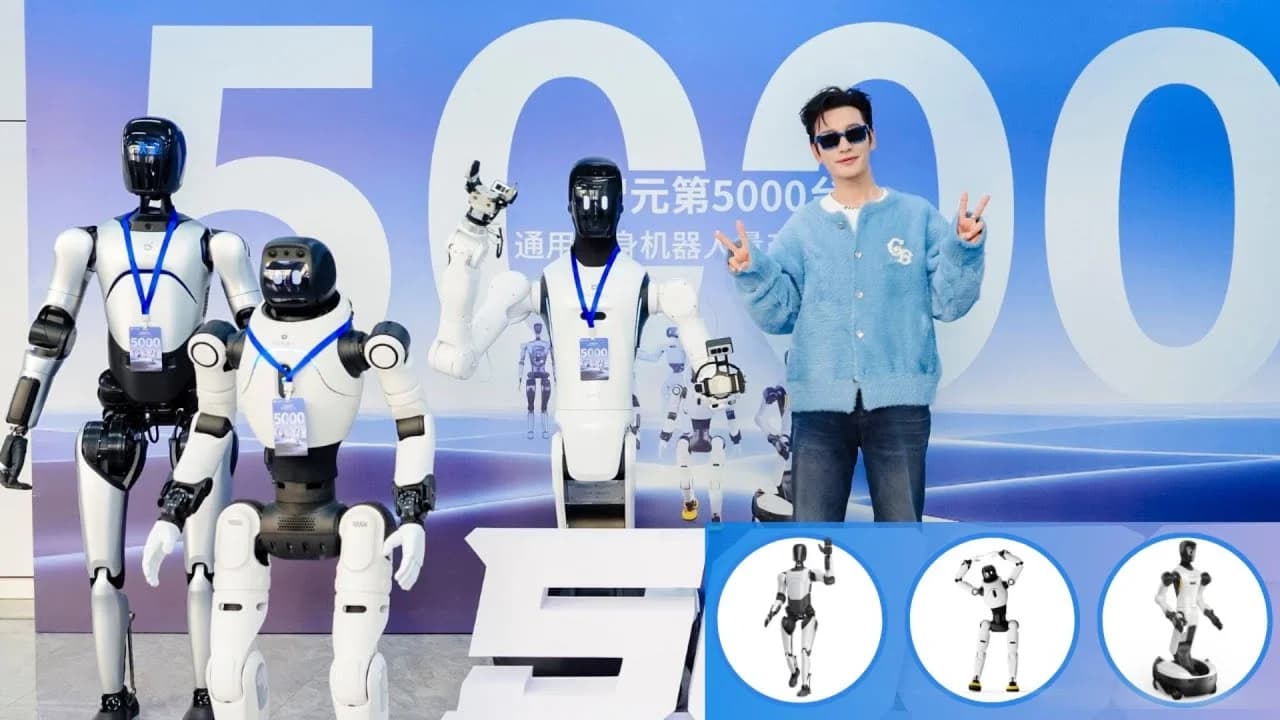
The timing of Unitree’s disclosure is no coincidence. On January 16, AgiBot tweeted a celebratory update claiming "5,168 mass-produced humanoids" and the global shipment lead for 2025. This followed reports from research firms Omdia and Counterpoint, which had initially estimated Unitree’s shipments at roughly 4,200 units, placing them behind AgiBot.
Unitree’s new data suggests those initial market estimates were significantly conservative. By reporting 5,500 actual shipments, Unitree not only exceeds AgiBot’s figure of 5,168 but also draws a firm line around what counts as a "humanoid."
The weekly humanoid robotics briefing
One email a week: the launches, funding and research that mattered, with context from Humanoids Daily.
Read recent issuesThe "Pure Humanoid" Jab
Perhaps the most revealing part of Unitree's statement is its fourth point, which functions as a thinly veiled critique of industry reporting:
“Currently, given the diversity of robotic forms, we suggest not to directly combine the numbers of different types of robots together for comparison.”
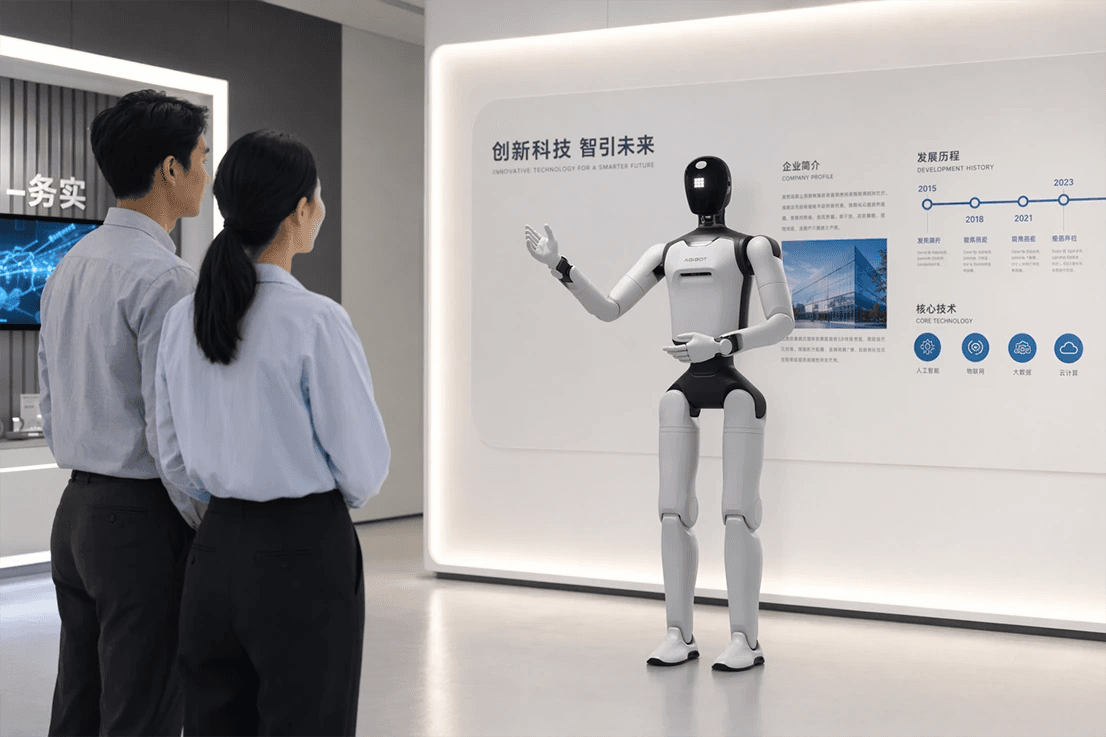
This is a direct hit at the mixed-fleet strategies favored by competitors. AgiBot, for instance, has been vocal about its diverse lineup, which includes the wheeled Genie G-Series alongside its bipedal Expedition A-Series and Lingxi X-Series. Unitree, by contrast, emphasizes that its 5,500-unit figure consists "solely of pure humanoid robots" and specifically excludes its dual-arm wheeled robots or other forms.
The subtext is clear: Unitree believes the "No. 1" title is being claimed by rivals through "misinformation" and the inflation of humanoid figures with less complex, wheeled platforms.
IPO Stakes and the "Bubble" Narrative
The intensity of this data dispute is fueled by the rapidly heating IPO race. Unitree completed its IPO tutoring phase in late 2025 and is reportedly on track for a domestic A-share listing by mid-2026. AgiBot is simultaneously pursuing a Hong Kong IPO, with a rumored valuation target between $5.1 billion and $6.4 billion.
With over 150 humanoid startups now operating in China, investors are increasingly wary of a humanoid robotics bubble. In an environment where 80% of companies are predicted to be eliminated in a coming consolidation wave, shipment volume has become the primary metric used to justify massive valuations.
Diversifying the Ecosystem
While the numbers war rages, Unitree is also attempting to move the goalposts from hardware volume to software dominance. The company recently teased a humanoid "App Store" designed to crowdsource robot skills like dancing or martial arts. By building an ecosystem around its humanoid platforms, Unitree aims to solve the "utility gap" that has seen even high-volume manufacturers struggle to find real-world factory applications.
Whether Unitree's 5,500 units represent robots doing "real work" or platforms for research remains to be seen. However, in the court of public opinion—and the eyes of regulators—the title of "Global No. 1" is a prize worth fighting for.
Share this article
Read next
- Published on
- Reading time
- 6 min read
Global Humanoid Shipments Surpass 22,000 in H1 2026 as AGIBOT Leads and Form-Factor Debates Intensify
- Published on
- Reading time
- 4 min read
The Shipment Wars: AgiBot Claims Top Spot in Five Industry Sectors as Global Market Surges
- Published on
- Reading time
- 4 min read
Rumored $13 Million Gala Bid Sparks Fears of a Humanoid Robotics ‘Bubble’ in China
- Published on
- Reading time
- 5 min read
Global Humanoid Shipments Surge 272% in 1H 2026 as AGIBOT Overtakes Unitree
- Published on
- Reading time
- 3 min read
AGIBOT Says A3 Ultra Is Going to Work in Hotels, Shops and Metro Inspection
- Published on
- Reading time
- 3 min read
Unitree Says It Won’t Become a Robot Integration Company
The weekly humanoid robotics briefing
One email a week: the launches, funding and research that mattered, with context from Humanoids Daily.
Read recent issues