- Published on
Rumored $13 Million Gala Bid Sparks Fears of a Humanoid Robotics ‘Bubble’ in China
One tap, and our reporting appears more often in your Google Top Stories. It makes a real difference to a small newsroom.


Your guide
Rich Robinson
Jee Chee Ren · Executive tour
See China’s AI and robotics ecosystem first-hand.
Six days exploring AI, robotics and advanced manufacturing.
With Rich Robinson, Clinical Professor of Entrepreneurship at Peking University
Beijing · Guangzhou · Shenzhen
29 November–4 December 2026
Referral partnership · We earn a commission on referred bookings.
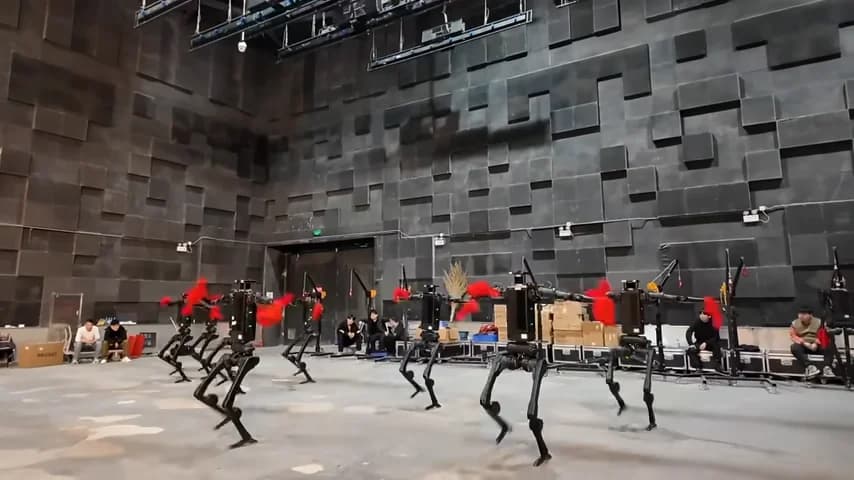
A reported bidding war for a prime advertising slot on China’s most-watched television broadcast has ignited a fierce debate within the country's robotics industry, pitting the marketing ambitions of leading startups against a growing body of data suggesting the sector is overheating.
According to reports from Chinese tech outlets 36Kr and Jiemian News, domestic heavyweights Unitree Robotics and AgiBot (Zhiyuan Robotics) have been locked in a high-stakes competition to secure a sponsorship spot for the 2026 CCTV Spring Festival Gala. The reports allege that Unitree offered as much as 100 million yuan (approx. $13.7 million) for the slot, while AgiBot reportedly bid 60 million yuan (approx. $8.2 million).
While AgiBot has denied the rumors, stating the reports are "not true," the sheer scale of the alleged figures has crystallized fears that the sector is prioritizing hype over fundamentals—a concern now validated by major institutional research.
The $13 Million Gamble vs. The $28,000 Reality
The juxtaposition of a nine-figure marketing budget against the market's actual tolerance for cost is stark. While companies compete for national airtime, a new AlphaWise survey from Morgan Stanley reveals that the customers they are trying to woo are deeply price-sensitive.
The weekly humanoid robotics briefing
One email a week: the launches, funding and research that mattered, with context from Humanoids Daily.
Read recent issuesThe survey, which polled C-suite executives across China, found that 92% of respondents require robot unit costs to fall below 200,000 yuan (approx. $28,000) for adoption to become feasible.
This creates a dangerous "optimism gap." While 62% of executives plan to adopt humanoids within three years , only 23% are satisfied with the products currently on the market. The industry appears to be spending millions to market hardware that, according to the data, most buyers feel is not yet ready for the factory floor.
"Is the industry bubble so big? Are they spending money like water?" one industry observer noted in the 36Kr report, echoing the data-driven skepticism.
The "Assembly" Trap
The Gala rumors have also reignited a fundamental critique of the Chinese sector: that too many companies are simply "assembling" imported components rather than building defensible technology.
Tian Feng, a former dean at the SenseTime Intelligent Industry Research Institute, compared the current craze to the early PC era of the 1970s. "Assembling robots actually has no moat," Tian argued, suggesting that value is limited for firms that merely integrate third-party parts.
This view is heavily supported by Morgan Stanley's "Humanoid Tech 25" report. The bank explicitly advises investors to avoid betting on specific robot brands ("OEMs") due to the high risk of failure in a crowded market. Instead, it advocates a "picks and shovels" strategy, targeting the suppliers of "brains" (EDA software), "eyes" (sensors), and "bodies" (actuators).
The report identifies a supply chain dominated not by the flashy robot startups, but by established component giants:
- Sensors: Companies like Hesai and Melexis are critical for safety and tactile sensing.
- Actuation: Manufacturers like Samsung and Inovance are pivoting to build the motors and joints that every robot needs, regardless of whose logo is on the chest.
"80% Will Be Eliminated"
The disconnect between the marketing flash of a Gala appearance and the grind of industrial commercialization is forcing a reality check. An investor who has backed multiple robot unicorns told 36Kr that "80% of the existing companies are likely to be eliminated" in a coming consolidation wave.
This aligns with recent warnings from China’s National Development and Reform Commission (NDRC) regarding "repetitive" low-quality projects. With over 150 humanoid startups now operating in China, the market is saturated with "me-too" chassis that lack the intelligence to justify their price tags.
Share this article
Read next
- Published on
- Reading time
- 6 min read
Global Humanoid Shipments Surpass 22,000 in H1 2026 as AGIBOT Leads and Form-Factor Debates Intensify
- Published on
- Reading time
- 4 min read
The Shipment Wars: AgiBot Claims Top Spot in Five Industry Sectors as Global Market Surges
- Published on
- Reading time
- 4 min read
The Great Numbers War: Unitree Claims Global Shipment Lead, Rebuts AgiBot's 'No. 1' Title
- Published on
- Reading time
- 5 min read
Global Humanoid Shipments Surge 272% in 1H 2026 as AGIBOT Overtakes Unitree
- Published on
- Reading time
- 3 min read
AGIBOT Says A3 Ultra Is Going to Work in Hotels, Shops and Metro Inspection
- Published on
- Reading time
- 3 min read
Unitree Says It Won’t Become a Robot Integration Company
The weekly humanoid robotics briefing
One email a week: the launches, funding and research that mattered, with context from Humanoids Daily.
Read recent issues