- Published on
Unitree Unveils UnifoLM-X2: World Model AI Powers Fully Autonomous Robot Combat
One tap, and our reporting appears more often in your Google Top Stories. It makes a real difference to a small newsroom.


Your guide
Rich Robinson
Jee Chee Ren · Executive tour
See China’s AI and robotics ecosystem first-hand.
Six days exploring AI, robotics and advanced manufacturing.
With Rich Robinson, Clinical Professor of Entrepreneurship at Peking University
Beijing · Guangzhou · Shenzhen
29 November–4 December 2026
Referral partnership · We earn a commission on referred bookings.
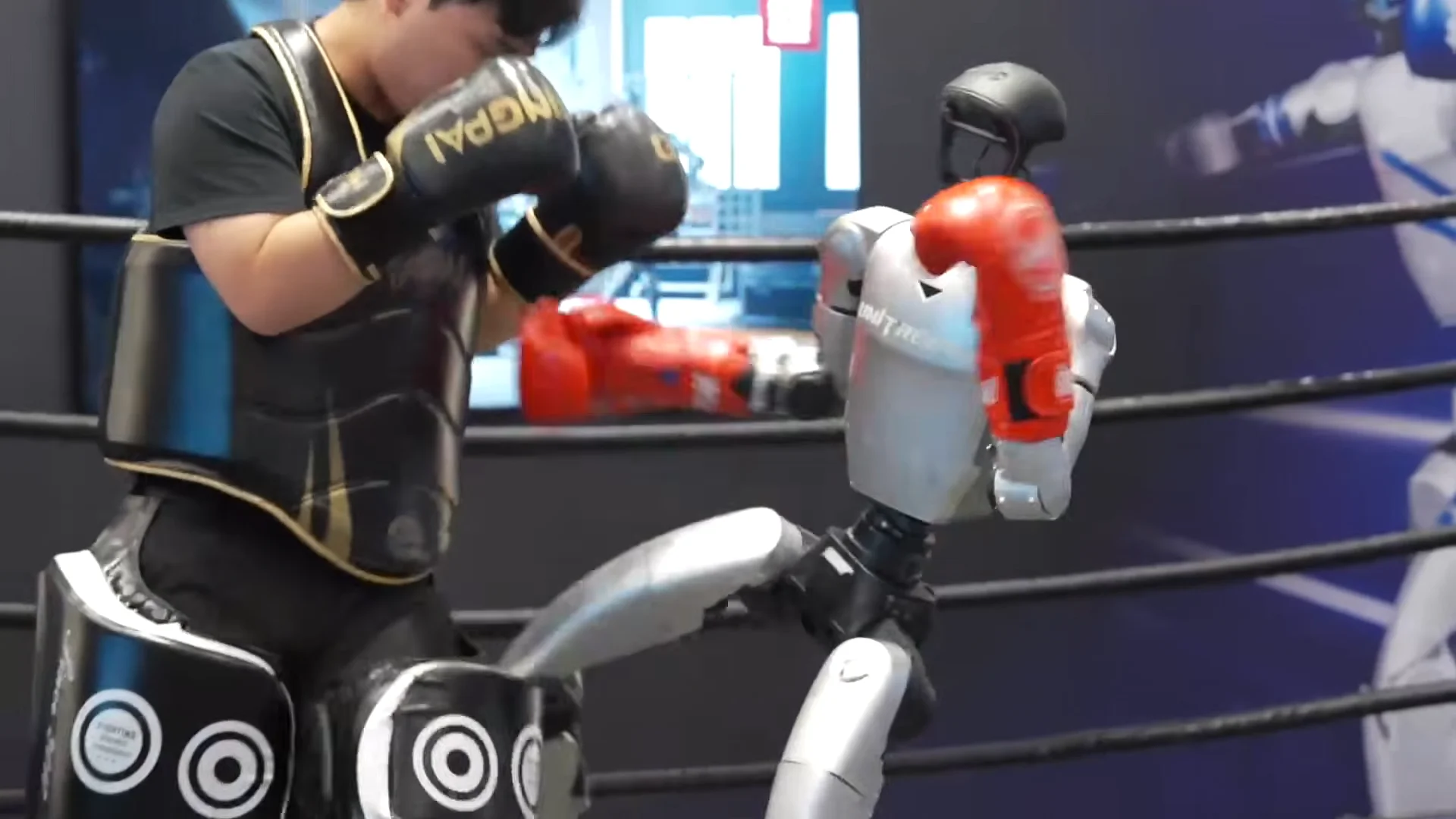
- Unitree Robotics demonstrated UnifoLM-X2-1.0, a real-time world-action model enabling fully autonomous sparring on its G1 humanoid platform.
- Unlike previous VR-piloted and gamepad-controlled fighting leagues, the system dispenses with human teleoperation, relying on predictive trajectory rollouts to anticipate movements and execute dynamic strikes.
- The software breakthrough follows remarks from CEO Wang Xingxing highlighting unresolved physical robotics bottlenecks, positioning high-speed dynamic interaction as a proving ground for general physical AI.
- Telemetry logs suggest a client-server policy pipeline, indicating the computationally heavy world-model inference likely runs offboard rather than natively on the robot's local compute.
Humanoid combat has spent the past year establishing itself as one of the robotics sector's most viral spectacles. Until now, however, every punch thrown in the ring has required a human operator pulling the strings behind the scenes.
Unitree Robotics is looking to remove the teleoperator entirely. The Hangzhou-based manufacturer released demonstration footage showcasing its G1 humanoid engaged in real-time, fully autonomous sparring against a human partner, driven by a new AI architecture dubbed UnifoLM-X2-1.0.
Described by Unitree as the "world's first real-time world model-driven fully autonomous humanoid robot combat," the demonstration represents a significant technical pivot from the human-in-the-loop bipedal brawling that defined earlier exhibition bouts.
Cutting the Teleoperation Tether
Robotic martial arts tournaments have proliferated rapidly across both the US and China. When humanoids first stepped into the ring during the CMG World Robot Competition in Hangzhou, human handlers relied on collaborative controls to guide G1 humanoids through strike combinations. Subsequent commercial efforts—including REK and UFB in the United States—standardized around low-latency VR headsets and gamepad controllers to transform bipeds into remote-controlled avatars.
The weekly humanoid robotics briefing
One email a week: the launches, funding and research that mattered, with context from Humanoids Daily.
Read recent issuesUnifoLM-X2-1.0 operates on a fundamentally different premise. Rather than translating an operator's body motion or analog stick inputs into motor commands, the system runs an autonomous, predictive perception-to-action loop.
In the demonstration video, a Unitree G1—fitted with red boxing gloves and sparring against a human trainer equipped with body shields and leg pads—can be seen slipping strikes, recalibrating footwork, throwing straight punches, and landing body kicks. Visual overlays marked "predictive modeling for future planning" show the underlying network predicting anticipated scene changes and projecting opponent motion fractions of a second before committing to physical joint actuation.
According to Unitree, UnifoLM-X2-1.0 specifically targets the latency bottlenecks that have historically plagued world-action models: instantaneous motion planning, rapid tactical decision-making, and stable closed-loop execution during high-frequency, contact-rich interactions.
The Architecture Behind the Ring
The demonstration marks the latest evolution of Unitree's in-house foundation model family, which has progressed from factory manipulation architectures like UnifoLM-X1-0 to multimodal models like UnifoLM-OminiA-0.3.
World models aim to solve a fundamental problem in physical AI: understanding and predicting how an unstructured environment changes according to physical dynamics. In high-speed sparring, reactive control is insufficient; the compound latency of sensor processing, trajectory optimization, and motor response would leave a robot hopelessly behind an opponent's punches. By utilizing an internalized world model, the network continuously runs predictive rollouts of potential futures—simulating both the adversary's momentum and its own joint balance—to select optimal motor trajectories in advance.
Telemetry displayed in the video's lower console logs, however, provides key insight into the system's current implementation. Lines showing [PolicyServer] OBS/replan alongside EXEC env.step indicate a distributed architecture where raw sensor observations are streamed over a local network to a policy server, which calculates the generative rollouts and returns actuation commands to the on-robot client.
This distributed pipeline suggests that the computationally intensive generative inference required by UnifoLM-X2-1.0 still relies on external workstation compute rather than running entirely onboard the G1's local processors. For unconstrained deployment, compressing these real-time predictive models to execute purely at the edge remains an active engineering hurdle.
Proving Grounds Beyond the Ring
While combat entertainment generates immediate mainstream attention, robotics companies increasingly treat high-contact sports as a rigorous stress test for industrial-grade physical AI. Domestic competitor EngineAI formalized this concept with its URKL combat league, offering a $1.4 million championship prize pool to benchmark mechanical durability, autonomous recovery, and thermal stability under impact.
For Unitree, which recently completed a blockbuster STAR Market IPO and reached 18,000 cumulative bipedal humanoids produced, the focus is shifting rapidly toward closing the software gap. Just weeks ago at the 2026 World Robot Conference, Unitree CEO Wang Xingxing gave an unvarnished assessment of the field, explaining why humanoids still aren't ready to scale in factories. Wang pointed directly to the "lossy" nature of the physical world, noting that while language models operate in lossless vector spaces, physical robots struggle with the compound micro-deviations of dynamic contact.
Unitree argues that autonomous combat helps bridge this exact gap, claiming UnifoLM-X2 "validates the fundamental feasibility of large-scale deployment of world model-driven humanoid robots." If an AI system can anticipate sudden human movements, absorb unpredictable kinetic strikes, and dynamically rebalance a 35-kilogram chassis in real time, the underlying predictive framework could help robots operate safely alongside human workers in crowded, chaotic industrial spaces.
Still, significant caveats remain. The sparring shown in Unitree's demonstration was conducted with a compliant trainer presenting predictable targets rather than an unconstrained opponent actively trying to decommission the hardware. Unitree also attached an explicit safety disclaimer to the demonstration, cautioning operators to maintain a 2-to-3-meter buffer zone and warning against unvetted operational experiments.
As Unitree pairs its aggressive hardware scaling with joint software initiatives alongside partners like DeepSeek, UnifoLM-X2 signals that humanoid robotics is moving past simple playback scripts and remote piloting—taking its first tentative steps toward physical foresight.
Share this article
Read next
- Published on
- Reading time
- 8 min read
The Unitree G1 Is Becoming a Platform for American Robot Startups
- Published on
- Reading time
- 3 min read
Unitree’s H2-X Flips Off Cars in New Kung Fu “Guardian” Video
- Published on
- Reading time
- 3 min read
After Its Stock Surge, Unitree Warns Humanoid Commercialization Is Still in Its Early Days
- Published on
- Reading time
- 2 min read
Unitree Shares Jump 16% as China Pushes Robots Into Everyday Commerce
- Published on
- Reading time
- 3 min read
Unitree’s UniUni Lets Operators Choreograph Robot Teams With Natural Language
- Published on
- Reading time
- 3 min read
Unitree’s Wang Xingxing Says GPT-6 Tests Strengthen His Optimism for Embodied AI
The weekly humanoid robotics briefing
One email a week: the launches, funding and research that mattered, with context from Humanoids Daily.
Read recent issues