- Published on
The $1.4 Billion Sprint: Inside China’s Post-Gala Humanoid Funding Frenzy
One tap, and our reporting appears more often in your Google Top Stories. It makes a real difference to a small newsroom.


Your guide
Rich Robinson
Jee Chee Ren · Executive tour
See China’s AI and robotics ecosystem first-hand.
Six days exploring AI, robotics and advanced manufacturing.
With Rich Robinson, Clinical Professor of Entrepreneurship at Peking University
Beijing · Guangzhou · Shenzhen
29 November–4 December 2026
Referral partnership · We earn a commission on referred bookings.

The 2026 Lunar New Year has left more than just festive memories for China’s robotics sector; it has triggered a capital deluge. In the first 60 days of the year, over 10 billion yuan (approximately $1.4 billion) in fresh funding has flooded into domestic humanoid startups. This surge marks a decisive pivot from the "showmanship" that defined the 2026 Spring Festival Gala toward what industry insiders are calling the "delivery battle."
While the Gala created a massive surge in public interest and orders, the reality on the ground is becoming increasingly Darwinian. With the number of domestic humanoid firms ballooning to over 320, analysts warn that an "80/20" shakeout is imminent, where only those with deep pockets and proprietary "brains" will survive the transition to the factory floor.
The New Billion-Dollar Unicorns
The recent funding rounds have minted a new tier of "billion-dollar unicorns," concentrating capital into a handful of leaders.
- Galaxy General (Galbot): Leading the pack, the company secured 2.5 billion yuan—the largest single round for embodied intelligence in early 2026. This round is notable for the formal entry of state-owned large-scale funds, effectively birthing a "National Team" for embodied AI models.
- Spirit AI: This firm recently entered the "billion-dollar club" with nearly 2 billion yuan (~$280 million) in financing, pushing its valuation past $1.4 billion. Its backers represent an "all-star" industrial lineup, including battery giant CATL and retail leader JD.com.
- AI² Robotics: Frequently dubbed China’s "most Tesla-like" startup, AI² completed a Series B exceeding 1 billion yuan (~$140 million). Remarkably, this marks the company’s 12th funding round in just one year, signaling intense investor appetite for its end-to-end Vision-Language-Action (VLA) models.
- Robotera: The Shenzhen-based startup secured a 1 billion yuan Series B, cementing its own 10-billion-yuan valuation. Robotera is aggressively targeting the automotive sector, recently adding SAIC Capital to its roster of backers.
From Showbiz to the Shop Floor
The industry is moving past the stage of "dancing machines" to focus on scenario-specific industrial utility. Spirit AI has already launched the world’s first humanoid production line at a CATL battery base, where its "Xiaomo" robots reportedly operate at speeds comparable to skilled human workers.
The weekly humanoid robotics briefing
One email a week: the launches, funding and research that mattered, with context from Humanoids Daily.
Read recent issuesThis focus on the "shop floor" is also driving a division of labor between "body" and "brain." FIVEAGES, which recently raised hundreds of millions of RMB, has positioned itself as the primary model provider for Unitree Robotics. While Unitree maintains its lead in global hardware shipments—reporting over 5,500 units in 2025—FIVEAGES provides the "brains" needed for the G1 and H2 models to navigate complex power inspection and retail environments.
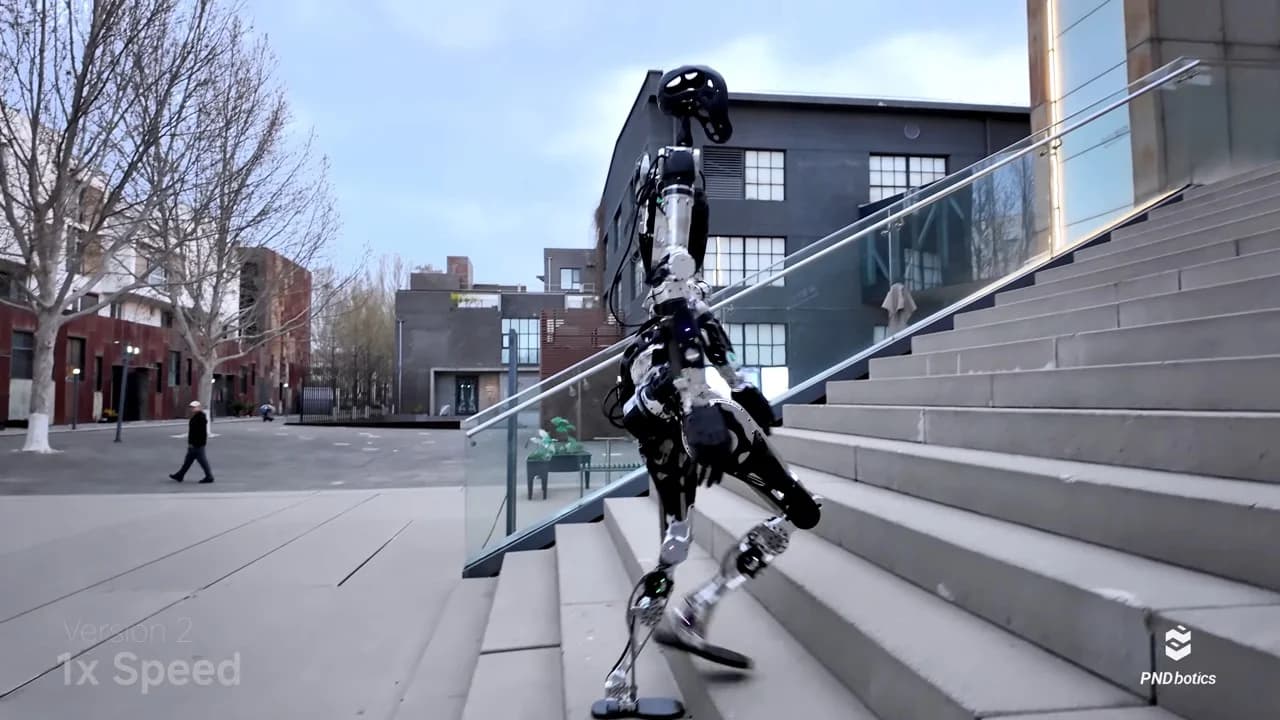
Similarly, PNDbotics secured tens of millions of dollars following the appearance of its "Adam" robot on CGTN. The funds are earmarked for a smart manufacturing center in Tianjin capable of producing hundreds of units annually, moving the company closer to the mass-delivery milestones seen by competitors like UBTECH and Dobot.
The "Great Escape": A Looming Industry Shakeout
Despite the record-breaking capital flow, a "head effect" is emerging. The top 10 companies now account for roughly 40% of total industry financing. For the remaining 300+ startups, the window for survival is closing.
"2026 will be a watershed," says Jiang Lei, chief scientist of the National Humanoid Robot Innovation Center. While the industry previously competed on "demo videos," the new benchmarks are yield rates, customer site stability, and cost reduction.
Current projections suggest that 80% to 90% of existing robotics companies could face elimination or restructuring by the end of the year. Investors are increasingly wary of "repetitive clones"—companies that merely assemble third-party components without owning core algorithmic moats. As a result, firms like Noematrix are focusing on the "data flywheel," developing specialized hardware like the CoMiner exoskeleton to collect the high-quality physical data required to train more capable AI.
Scaling the "Utility Gap"
The ultimate challenge remains the utility gap. While global shipments surged by over 500% in 2025 to 18,000 units, the market is still in its infancy. For companies like Robotera and AI² Robotics, the goal is to drive unit costs down to the 200,000 yuan (~$28,000) threshold that Morgan Stanley’s research identifies as the tipping point for mass industrial adoption.
As the "National Team" led by Galaxy General and the "All-Star" teams like Spirit AI square off, the robotics industry in 2026 is no longer just a spectacle of synchronized martial arts. It is a high-stakes war of attrition where the winners will be determined not by the brightness of the spotlight, but by the reliability of the robots on the assembly line.
Share this article
Read next
- Published on
- Reading time
- 4 min read
The "Robot Super Bowl": Humanoids Dominate China’s 2026 Spring Festival Gala
- Published on
- Reading time
- 6 min read
Global Humanoid Shipments Surpass 22,000 in H1 2026 as AGIBOT Leads and Form-Factor Debates Intensify
- Published on
- Reading time
- 6 min read
Galbot Opens Pre-Orders for ET1 Bipedal Humanoid Aimed at Entertainment and Performance
- Published on
- Reading time
- 4 min read
Galbot Reportedly Eyes $4 Billion Hong Kong IPO, Joining China’s Humanoid Rush
- Published on
- Reading time
- 4 min read
From Lab to Pavement: PNDBotics Adam Humanoid Demonstrates Real-World Stair Navigation
- Published on
- Reading time
- 3 min read
CATL Deploys Humanoid Fleet to High-Voltage Lines, Claims Production Breakthrough


The weekly humanoid robotics briefing
One email a week: the launches, funding and research that mattered, with context from Humanoids Daily.
Read recent issues