- Published on
Figure AI Demonstrates 15-Foot Autonomous Ladder Ascent and Descent for Industrial Mezzanines
One tap, and our reporting appears more often in your Google Top Stories. It makes a real difference to a small newsroom.

- Figure CEO Brett Adcock demonstrated the Figure 03 autonomously climbing up and down a 15-foot industrial ladder.
- Adcock confirmed the vertical mobility benchmark is tied to an active commercial customer requirement involving accessing mezzanine work areas.
- The demonstration highlights the whole-body loco-manipulation of Figure's Helix software architecture, coordinating visual perception, dynamic balance, and contact loading.
- While social media comparisons arose alongside the high-speed sprints at the World Humanoid Robot Games, Figure remains focused on industrial verticality over athletic display.
Navigating unstructured human workspaces requires humanoids to move beyond flat concrete surfaces. Expanding on its earlier autonomous ladder climbing demonstrations, Figure AI has revealed that its humanoid platform can autonomously scale and descend a full 15-foot industrial structure.
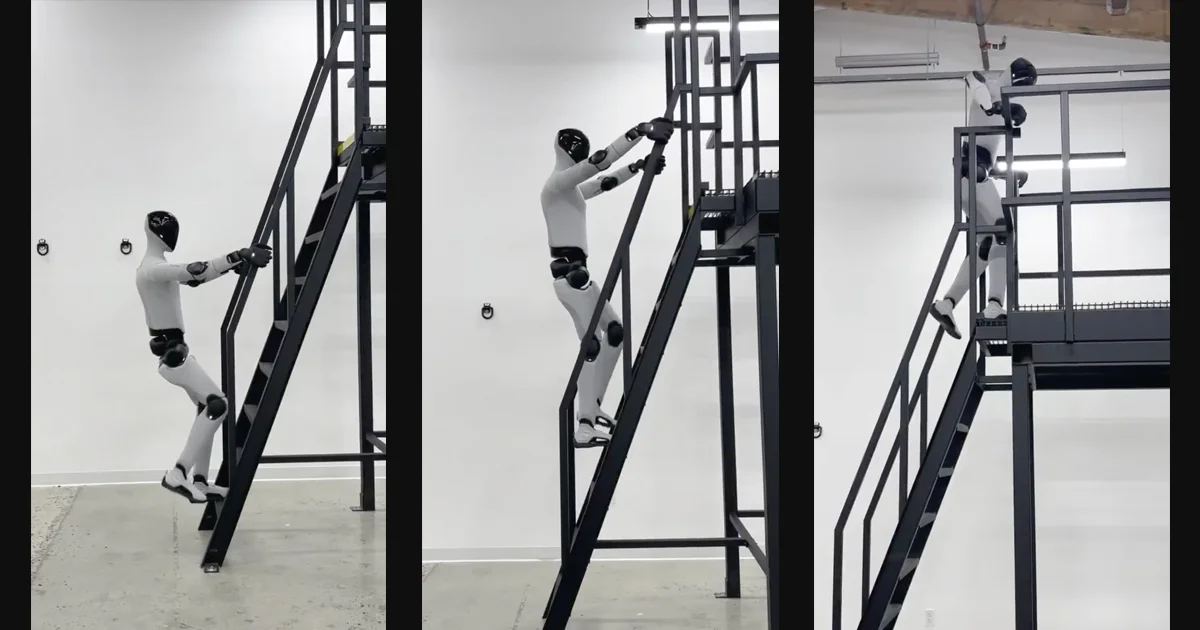
On August 22, Figure CEO Brett Adcock shared video footage of the achievement, captioning the post: "15 feet up. 15 feet down. Fully autonomous."
The video demonstrates the robot methodically placing its hands and feet on the ladder rungs, hoisting its full weight vertically before executing the reverse sequence to descend safely back to ground level.
Commercial Mezzanines Over Athletic Benchmarks
Shortly after the video was posted, Adcock confirmed the technical milestone is not merely a laboratory exercise. Quoting tech executive and investor Jen Zhu Scott, Adcock clarified that the vertical routine was engineered to solve a specific industrial requirement.
The weekly humanoid robotics briefing
One email a week: the launches, funding and research that mattered, with context from Humanoids Daily.
Read recent issues"One interesting point: this is a real customer use case," Adcock stated. "We have to climb up this exact ladder to a mezzanine to do the work, then just climb back down when the shift is over."
The confirmation aligns with Figure's broader commercial strategy of designing autonomy around targeted enterprise workflows, such as its logistics sequencing deployment at BMW Plant Spartanburg and automated sorting for Catalyst Brands. In legacy warehouses and manufacturing facilities, mezzanines and elevated platforms are frequently accessed via vertical ladders and steep ship's stairs rather than elevators or standard ramps—environments where wheeled robotic platforms remain physically constrained.
The Complexities of Whole-Body Loco-Manipulation
As noted by industry observers including Jen Zhu Scott, scaling a 15-foot structure introduces stringent dynamic control challenges that differ significantly from horizontal walking:
“This is hard to achieve, because it must continuously coordinate vision, grasping/hand placement, leg stepping, weight shifting, & balance. Any mismatch risks a fall from height. This couples perception, planning, + dynamic control in a continuous task—harder than flat-ground walking or isolated manipulation.”
The achievement builds on Figure’s proprietary Helix neural network stack. Rather than following hardcoded kinematics or pre-programmed routines, the system continuously integrates real-time visual perception with high-frequency proprioceptive feedback.
Descending a ladder presents an even tighter tolerance for error than climbing. The descent demands careful load distribution and dynamic weight transfer to ensure handholds and footholds maintain sufficient friction without destabilizing the robot’s center of mass.
Utility Versus Spectacle
The release of the footage coincided with the record-breaking athletic performances at the 2nd World Humanoid Robot Games in Beijing, where bipedal machines shattered human sprinting and jumping benchmarks. Some social commentators drew comparisons, questioning the pacing and visual impact of methodical ladder climbing against sub-10-second 100-meter sprints.
However, the contrast highlights two diverging development philosophies across the humanoid ecosystem. While track-and-field demonstrations push the limits of raw actuator burst power and thermal management, industrial adoption hinges on non-destructive whole-body coordination in brownfield environments.
For the $39 billion startup, proving the Figure 03 can access multi-level facilities without retrofitting expensive infrastructure represents an essential step toward achieving general-purpose labor utility.
Share this article
Read next
- Published on
- Reading time
- 5 min read
Figure Melts Figure 02 With Arnold Schwarzenegger in a Terminator-Style Sendoff
- Published on
- Reading time
- 4 min read
Figure’s Multibillion-Dollar Compute Deal Meets Nscale’s Data-Center Buildout Challenge
- Published on
- Reading time
- 3 min read
Hasta La Vista, Figure 02: Adcock Teases a Terminator-Style Sendoff
- Published on
- Reading time
- 2 min read
Brett Adcock’s vehicle clip echoes Figure 03’s delivery demo
- Published on
- Reading time
- 4 min read
Figure AI Reports Rapid Growth for Index, Surpassing 69,000 Weekly Active Users
- Published on
- Reading time
- 5 min read
Figure Inks Multi-Billion-Dollar Compute Deal With Nscale to Deploy 100,000 Next-Gen NVIDIA GPUs
The weekly humanoid robotics briefing
One email a week: the launches, funding and research that mattered, with context from Humanoids Daily.
Read recent issues